
Foreign transaction fees matter because international payments often cost more than the price shown at checkout, on an invoice, or in a payment request.
A card purchase, online payment, subscription charge, contractor invoice, or ecommerce order can move through several payment systems before the final amount is posted, settled, and recorded.
Each step may involve currency conversion, cross-border processing, exchange rate adjustments, card network rules, issuer pricing, processor costs, and merchant settlement decisions.
For customers, foreign transaction fees can make a purchase more expensive than expected. A product may appear affordable at checkout, but the posted card amount may include an added percentage, a currency conversion cost, or an exchange rate markup.
For business owners, international transaction fees can reduce margins, complicate pricing, and make payment reconciliation harder.
These costs are especially important for ecommerce sellers, freelancers, contractors, consultants, service providers, travel-related businesses, digital product sellers, and any company accepting international card payments.
Even if a business does not actively “sell internationally,” it may still receive payments from customers using foreign-issued cards, online wallets, international billing addresses, or payment methods routed through another location.
Understanding how foreign transaction fees work helps both businesses and customers make smarter payment decisions. It can also reduce confusion when a cardholder sees an extra charge, when a merchant statement includes unexpected cross-border transaction fees, or when the amount received after settlement is lower than the original sale amount.
This guide explains what foreign transaction fees are, how they differ from currency conversion fees, when they apply, how they affect businesses and customers, and what practical steps can help reduce international payment costs.
What Are Foreign Transaction Fees?
Foreign transaction fees are additional charges that may apply when a payment is considered international by a card issuer, payment network, bank, processor, or payment provider.
These fees are commonly associated with card purchases made in another currency, but currency is not the only factor. A transaction may also be treated as foreign if the merchant, acquiring bank, processor, payment gateway, or settlement path is located outside the cardholder’s usual payment market.
For cardholders, a foreign transaction fee usually appears as a percentage of the purchase amount. It may show up as a separate line item on a card statement or be included in the total posted charge. These fees are sometimes called international transaction fees, foreign purchase fees, international service fees, or overseas purchase fees.
For merchants, the similar-sounding costs often appear differently. Businesses may see cross-border transaction fees, international assessment fees, currency conversion fees, payment processing fees, or higher card acceptance costs on their merchant statements.
These are not always the same as the cardholder’s foreign transaction fee, even though they can be triggered by the same purchase.
A simple example is an online customer buying from a merchant whose payment processor settles transactions through a different region. The customer may pay in a familiar currency, but the card issuer may still classify the purchase as foreign because of the merchant’s processing setup.
At the same time, the merchant may pay additional cross-border payment processing fees because the customer’s card was issued elsewhere.
Foreign transaction fees exist because international payments require more coordination than domestic payments. They may involve different currencies, different banking systems, additional fraud checks, card network assessments, currency exchange mechanisms, and more complex settlement rules.
How Foreign Transaction Fees Work
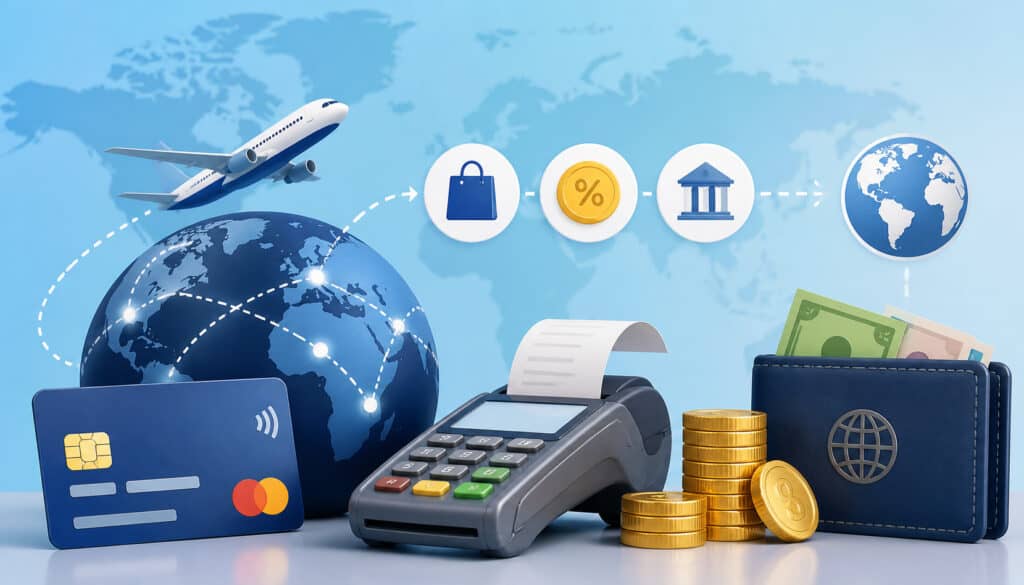
To understand foreign transaction fees, it helps to look at the payment flow. When a customer makes a card payment, the transaction does not simply move directly from the customer to the merchant.
It usually travels through a payment gateway, processor, acquiring bank, card network, and issuing bank before it is approved, cleared, converted if needed, and settled.
At checkout, the customer enters card details or taps a card. The merchant’s payment system sends the authorization request to its processor or acquiring bank.
From there, the request moves through a card network to the issuing bank, which decides whether to approve or decline the payment. Even if the authorization is approved instantly, the final transaction amount may not be fully settled until later.
Currency conversion may happen when the transaction currency differs from the cardholder’s billing currency or the merchant’s settlement currency. The exchange rate used may include a spread, markup, or conversion cost. This is where currency conversion fees and exchange rate markup can affect the final amount paid or received.
Card networks may also classify the payment as cross-border based on the location of the card issuer, merchant, acquiring bank, or transaction identifiers.
The processor may then pass cross-border transaction fees or international assessment costs to the merchant. Separately, the issuing bank may charge the cardholder a foreign transaction fee under the cardholder agreement.
| Fee Type | Who May Charge It | What It Covers |
| Foreign transaction fee | Card issuer or bank | Cardholder cost for a transaction classified as foreign |
| Currency conversion fee | Issuer, card network, processor, or conversion provider | Cost of converting one currency into another |
| Cross-border transaction fee | Card network, acquirer, processor, or payment provider | Additional cost for processing a payment across different payment locations |
| Exchange rate markup | Bank, issuer, processor, or conversion service | Margin added to the exchange rate used for conversion |
| Payment processing fees | Merchant processor or acquiring bank | Cost of accepting, routing, authorizing, clearing, and settling payments |
| Chargeback or dispute fee | Processor, acquirer, or card network | Cost related to payment disputes and international card risk |
For a deeper comparison of cardholder-side and merchant-side costs, this guide on foreign transaction fees vs cross-border fees is a useful related resource.
Currency Conversion Fees
Currency conversion fees apply when a payment amount must be converted from one currency to another. This can happen when a customer pays in a currency different from the card’s billing currency, when a merchant prices goods in one currency but settles in another, or when a payment provider converts funds before depositing them into a business account.
The cost may appear as a separate conversion fee, but it is often built into the exchange rate. For example, the customer may not see a line item labeled “currency conversion fee,” but the rate used to convert the transaction may be less favorable than the mid-market exchange rate. This difference is commonly called an exchange rate markup or FX spread.
Currency conversion fees can affect both sides of the transaction. Customers may pay more than expected after conversion, while businesses may receive less than expected after settlement. This matters for contractors, freelancers, ecommerce sellers, subscription businesses, and service providers that invoice or accept payments in multiple currencies.
Cross-Border Transaction Fees
Cross-border transaction fees may apply when the cardholder, merchant, processor, acquiring bank, or payment route involves different locations. These fees are usually more relevant to merchants than cardholders, although the cost can indirectly affect customer pricing.
A business may see cross-border fees on its merchant processing statement when it accepts a card issued outside the merchant’s acquiring setup.
The fee may be listed as a cross-border assessment, international service assessment, international acquiring fee, global processing fee, or another similar label. The exact wording depends on the processor, pricing model, and reporting format.
These fees can apply even when no currency conversion occurs. For example, a customer may pay in the same currency displayed by the merchant, but if the card issuer and merchant acquiring setup are classified as different payment locations, a cross-border fee may still apply.
For businesses trying to understand different merchant-side fee categories, this overview of types of cross-border merchant fees can help explain common statement labels.
Issuer and Network Fees
Issuer and network fees are two major reasons international card payments can cost more than domestic payments. The issuing bank provides the customer’s card and may charge the cardholder a foreign transaction fee when a purchase qualifies under the card’s terms.
The card network routes the payment and may apply assessment fees based on how the transaction is classified.
For the customer, issuer fees are usually the most visible. A cardholder may see an added percentage after the transaction posts. Sometimes it appears as a separate fee; other times the total converted amount simply looks higher than expected.
For the merchant, network fees and processor pass-through costs are more common. These may appear in merchant statements as assessments, international fees, cross-border fees, or bundled payment processing fees. Businesses on flat-rate pricing may not see each fee itemized, but international card payments may still influence the overall cost structure.
Foreign Transaction Fees vs Currency Conversion Fees

Foreign transaction fees and currency conversion fees are related, but they are not the same. A foreign transaction fee is usually charged because the payment is classified as foreign or international. A currency conversion fee is charged because money must be converted from one currency to another.
A foreign transaction fee can apply even when the customer pays in their billing currency. This may happen when the merchant’s processing location, acquiring bank, or payment setup is outside the card issuer’s expected domestic environment. In that case, the issuer may still treat the transaction as international.
A currency conversion fee, on the other hand, depends on the need to convert currency. If a customer’s card is billed in one currency and the merchant charges in another, the final amount must be converted. The conversion may be handled by the issuer, card network, merchant processor, payment gateway, or a dynamic currency conversion provider.
Both fees can appear together. For example, a customer buys from an international ecommerce store in a foreign currency. The issuer converts the transaction into the card’s billing currency and may also add a foreign transaction fee. The customer may experience both a conversion cost and a foreign transaction fee.
They can also appear separately. A customer may pay a foreign transaction fee without currency conversion if the payment is processed internationally but charged in the customer’s currency. A customer may also experience a conversion cost without a separately labeled foreign transaction fee if the issuer or payment provider includes the cost in the exchange rate.
Dynamic currency conversion adds another layer of confusion. At checkout, the customer may be offered the option to pay in their own card billing currency instead of the merchant’s local transaction currency. This can feel convenient, but it may include a less favorable exchange rate or markup. More detail is available in this guide to dynamic currency conversion fees.
When Do Foreign Transaction Fees Apply?

Foreign transaction fees may apply in more situations than many customers and businesses expect. The most obvious example is travel-related spending, such as paying for lodging, transportation, meals, or services in another currency.
However, international payment costs are just as common in online purchases, digital services, imported goods, subscriptions, and contractor payments.
An online purchase can trigger foreign transaction fees even if the customer never leaves home. A website may display prices in a familiar currency while processing payments through an international merchant account. The customer may only realize the purchase was treated as foreign after the card statement posts.
International subscriptions are another common example. Software platforms, streaming services, online tools, cloud products, design apps, marketing platforms, and business services may bill from a payment entity outside the cardholder’s usual market. If the issuer classifies that billing setup as foreign, the transaction may trigger a fee.
Businesses may also encounter foreign purchase fees when paying overseas vendors, buying imported inventory, hiring international freelancers, booking global logistics services, or purchasing digital tools from international providers. Even if the invoice amount is clear, the final card charge may change due to exchange rates, conversion timing, or issuer fees.
Common situations include:
- Online purchases from international merchants
- Payments for imported goods or wholesale inventory
- Travel, lodging, transportation, and event bookings
- International software subscriptions
- Contractor and freelancer payments
- Cross-border B2B invoices
- Global marketplace purchases
- Multi-currency ecommerce orders
- Digital product and course purchases
- International service retainers
How Foreign Transaction Fees Affect Businesses
Foreign transaction fees affect businesses in several direct and indirect ways. While cardholder foreign transaction fees are usually paid by the customer, merchant-side international transaction fees can reduce the amount a business receives after settlement. These costs can influence pricing, margins, customer experience, refund handling, and financial reporting.
For ecommerce sellers, international customers may generate higher processing costs than domestic customers. The processor may apply cross-border transaction fees, higher assessment fees, additional fraud screening costs, or different interchange categories.
If the business offers free shipping, discounts, or narrow-margin products, these fees can quietly reduce profitability.
For service businesses, international payment costs may affect invoices and cash flow. A consultant, designer, agency, contractor, or developer may quote one amount but receive less after payment processing fees, currency conversion fees, or settlement adjustments. If the invoice currency is not clear, both the business and client may be surprised by the final cost.
Chargebacks can also become more expensive in cross-border commerce. International card payments may involve different fraud patterns, customer expectations, documentation requirements, and response timelines. If a customer disputes a transaction, the business may face chargeback fees, lost revenue, refund costs, and additional administrative work.
Settlement currency is another important factor. A business may accept payments in multiple currencies but settle funds into one account currency. Each conversion can create exchange rate exposure. If rates move between authorization, capture, clearing, and settlement, the final amount received may differ from the expected amount.
Businesses can manage these issues by reviewing processor statements, understanding fee categories, setting clear payment terms, offering appropriate payment methods, and tracking international payment costs separately from domestic payment volume. A helpful starting point is this guide on merchant account fees for international payments.
Impact on Contractor and Service Payments
Contractors and service providers often work with clients across different payment systems. A freelancer may invoice in one currency, receive payment through a card platform, and settle funds into another currency. Each step can create international payment costs that affect the net amount received.
The payment method matters. Card payments may be convenient, but they can include payment processing fees, foreign transaction fees for the client, and cross-border transaction fees for the provider.
Bank transfers, payment platforms, digital wallets, and invoicing tools may have different fee structures. The cheapest option for the payer is not always the cheapest option for the recipient.
Invoice currency also matters. If a contractor invoices in the client’s currency, the contractor may absorb the conversion cost. If the contractor invoices in their own settlement currency, the client may face a foreign purchase fee or conversion cost. Neither option is automatically wrong, but both parties should understand the tradeoff.
Impact on Ecommerce and Online Sales
Ecommerce sellers face international payment costs at checkout, authorization, settlement, refunds, and disputes. A seller may advertise global shipping or accept international cards, but the actual cost of each order may vary depending on card origin, currency, processor pricing, fraud tools, and settlement setup.
Clear pricing helps reduce customer confusion. If prices are shown in one currency but charged in another, customers may feel misled when their card statement posts a different amount. This can increase support requests, refund demands, abandoned carts, and chargebacks.
Offering suitable payment methods can also improve conversion. Some customers prefer to pay in their own currency. Others prefer the merchant’s currency if it avoids dynamic currency conversion markup. Businesses should test payment options, review approval rates, and compare the total cost of each method rather than assuming one option is best.
How Customers Can Reduce Foreign Transaction Fees
Customers can reduce foreign transaction fees by choosing payment methods carefully and understanding how international card payments are priced. The most effective step is using a card or payment method that does not charge a foreign transaction fee.
Many card products clearly disclose whether they charge these fees, so reviewing card terms before international purchases can prevent surprises.
Customers should also pay attention to the currency displayed at checkout. If a merchant offers the option to pay in the customer’s billing currency through dynamic currency conversion, the customer should compare the convenience against the exchange rate offered.
Paying in the merchant’s transaction currency may sometimes result in a better conversion rate from the card issuer, though this depends on the card and issuer terms.
Reviewing the exchange rate is important for large purchases. Small differences in exchange rate markup may not matter much on a low-cost purchase, but they can become significant on travel bookings, equipment purchases, subscriptions, tuition, professional services, or imported goods.
Customers should also avoid unnecessary payment layers. Paying through an intermediary platform, wallet, or conversion service may add another fee or exchange rate spread. Sometimes the extra layer is worth it for buyer protection or convenience, but it should not be assumed to be free.
Useful steps include:
- Use a card with no foreign transaction fees when available
- Review whether the merchant charges in local currency or converted currency
- Decline unnecessary dynamic currency conversion when the rate is unfavorable
- Compare exchange rates before large purchases
- Check card statements after international transactions post
- Avoid using multiple conversion services for the same payment
- Read subscription billing terms before signing up
- Save receipts showing the selected currency
How Businesses Can Manage International Transaction Fees
Businesses can manage international transaction fees by treating them as a measurable operating cost rather than an occasional surprise. The first step is understanding how the current payment provider prices international card payments.
Merchant statements may include cross-border fees, international assessments, currency conversion costs, gateway fees, chargeback fees, refund fees, and settlement adjustments.
Comparing processors is also important. Some processors are better suited for domestic card acceptance, while others offer stronger global payment processing tools, multi-currency settlement, local acquiring options, improved international approval rates, and clearer reporting. The lowest advertised rate may not be the best choice if international volume is high.
Settlement currency should be selected carefully. A business that accepts multiple currencies but settles into one currency may face repeated conversion costs. A business with suppliers, contractors, or operating expenses in multiple currencies may benefit from holding or settling funds in more than one currency, depending on available payment provider options.
Clear customer communication reduces disputes. Businesses should disclose accepted currencies, billing descriptors, refund policies, payment timing, and whether the final card amount may vary due to issuer fees or conversion rates. This is especially important for high-ticket purchases, subscriptions, deposits, retainers, and international ecommerce orders.
Businesses should also review international payment costs by channel. Marketplace payments, direct website payments, invoices, virtual terminals, recurring billing, and payment links may each have different costs. Tracking them together can hide expensive patterns.
Review Payment Processor Statements
Business owners should review processor statements regularly because international payment costs are often spread across multiple line items. A statement may show base processing rates in one section, assessments in another, chargebacks elsewhere, and currency conversion adjustments in a separate deposit report.
Look for labels such as cross-border fee, international assessment, foreign card fee, currency conversion fee, FX fee, global payment fee, international card not present fee, and assessment surcharge. If the processor uses bundled pricing, ask for a clearer breakdown of international card payment costs.
Refunds and chargebacks deserve special attention. Some fees may not be refunded when a transaction is refunded. Chargebacks may add separate dispute fees, and international disputes can require more documentation. Tracking these costs helps businesses understand the true profitability of international customers.
Offer Clear International Payment Terms
Clear international payment terms help prevent confusion before a customer pays. Businesses should state the invoice currency, accepted payment methods, whether taxes or duties are included, how refunds are calculated, and whether the final card statement may vary due to issuer or currency conversion charges.
For contractors and service providers, payment terms should explain whether the client or provider is responsible for payment platform fees. If underpayments occur because of bank deductions or conversion costs, the agreement should explain how the balance will be handled.
For ecommerce sellers, checkout pages should clearly display the transaction currency and avoid surprising customers with unexpected conversion prompts. Refund policies should explain whether refunds are issued in the original transaction currency and whether exchange rate changes can affect the final refunded amount.
Common Mistakes to Avoid
One common mistake is assuming that all card fees are the same. Domestic card payments and international card payments can have different cost structures. Businesses that price products using only a standard processing rate may underestimate the real cost of global sales.
Another mistake is ignoring exchange rate markup. A payment provider may advertise low international transaction fees while using a less favorable conversion rate. The total cost is the visible fee plus the hidden spread inside the exchange rate.
Customers often make the mistake of choosing dynamic currency conversion without reviewing the rate. Paying in a familiar currency can feel safer, but the offered conversion rate may include a markup. The better choice depends on the rate, card terms, issuer fees, and available alternatives.
Businesses also make mistakes by failing to disclose currency clearly. If a customer sees one currency on the product page and another at checkout or on the receipt, confusion can lead to abandoned carts, complaints, refunds, or disputes.
Another common issue is not reviewing merchant statements. Cross-border transaction fees may appear under different labels, and processors may change pricing categories over time. Without regular review, businesses may miss rising international payment costs.
Chargeback costs are also easy to overlook. International customers may face longer delivery times, currency confusion, unfamiliar billing descriptors, or refund misunderstandings. Each of these can increase dispute risk.
Avoid these mistakes:
- Assuming foreign transaction fees and currency conversion fees are identical
- Ignoring exchange rate markup
- Failing to disclose invoice or checkout currency
- Choosing payment methods based only on convenience
- Not reviewing processor statements
- Overlooking refund and chargeback costs
- Treating global payment processing as a single flat expense
- Forgetting that customer-side fees can affect satisfaction
FAQs
What are foreign transaction fees?
Foreign transaction fees are extra charges that may apply when a payment is treated as international. They are commonly charged by card issuers to cardholders, while businesses may also face related costs such as cross-border transaction fees, international assessment fees, or currency conversion charges.
How do foreign transaction fees work?
Foreign transaction fees work by adding a cost layer when a transaction is processed across currencies, banks, card networks, processors, or merchant locations. A card issuer may charge the customer, while processors or card networks may charge merchants for international card payments or cross-border processing.
Are foreign transaction fees the same as currency conversion fees?
No. A foreign transaction fee is usually based on whether a payment is classified as international. A currency conversion fee applies when one currency must be converted into another. Both fees can appear together, but they are not always the same.
Who charges foreign transaction fees?
Foreign transaction fees are most often charged by the card issuer to the cardholder. Businesses may also see related international payment costs from card networks, acquiring banks, processors, gateways, or payment platforms.
Do online purchases trigger foreign transaction fees?
Yes. Online purchases can trigger foreign transaction fees if the merchant, payment processor, acquiring bank, or billing setup is considered international. This can happen even when the customer pays from home or sees prices displayed in a familiar currency.
How can customers avoid foreign transaction fees?
Customers can reduce or avoid foreign transaction fees by using cards with no foreign transaction fees, reviewing checkout currency, comparing exchange rates, avoiding unnecessary currency conversion prompts, and checking card statements after international purchases post.
How can businesses reduce international payment costs?
Businesses can reduce international payment costs by reviewing processor statements, comparing payment providers, choosing settlement currency carefully, disclosing payment terms clearly, tracking cross-border fees, and monitoring refunds, chargebacks, and exchange rate markups.
Do contractors need to worry about foreign transaction fees?
Yes. Contractors, freelancers, consultants, and service providers working with international clients should understand payment method costs, invoice currency, settlement timing, conversion fees, and who is responsible for any payment-related charges.
Conclusion
Foreign transaction fees are important to understand whenever payments cross currencies, banks, processors, card networks, payment platforms, or borders.
They can affect customers through card statement charges and exchange rate markups, and they can affect businesses through cross-border transaction fees, currency conversion costs, chargebacks, settlement differences, and higher payment processing fees.
The key is knowing that international payment costs are layered. A foreign transaction fee, currency conversion fee, cross-border fee, processor markup, and exchange rate spread may be related, but they are not always the same charge. Understanding the difference helps customers choose better payment methods and helps businesses protect margins.
Businesses can reduce surprises by reviewing processor statements, comparing global payment processing options, setting clear payment terms, monitoring refunds and disputes, and tracking international payment costs separately.
Customers can reduce costs by using suitable cards, reviewing checkout currency, avoiding unfavorable conversion prompts, and checking posted statement amounts.
Foreign transaction fees do not have to be confusing. With better fee visibility, clear records, and informed payment choices, both businesses and customers can make international payments with more confidence and fewer unexpected costs.