
If you sell online, serve international travelers, run subscriptions, or invoice overseas clients, merchant account fees for international payments can quietly become one of your biggest cost lines.
The reason is simple: cross-border card transactions add extra layers—currency conversion, additional network assessments, higher fraud risk, more compliance checks, and extra intermediary handling—each of which can introduce a fee.
This guide breaks down merchant account fees for international payments in plain language, shows you where the costs hide, and gives practical ways to reduce them without sacrificing approvals or customer experience.
It’s written for businesses operating from the U.S. market, but it avoids naming specific countries unless it’s truly needed for clarity.
What counts as an “international payment” in merchant processing

In payments, “international” does not just mean “shipping abroad.” For merchant account fees for international payments, most processors and card networks treat a transaction as international when the cardholder’s card is issued in a different region than the merchant’s acquiring setup.
A second trigger is cross-currency—when the shopper pays in one currency but settlement happens in another.
That means you can see merchant account fees for international payments even when the buyer is physically local (for example, they’re traveling but using a card issued elsewhere), or when you price in a foreign currency to improve conversions.
The payment “route” matters more than the customer’s location: issuer region, acquirer region, currency, and network rules determine whether cross-border pricing applies.
From an operational standpoint, international payments often introduce extra steps: address checks can be less reliable across regions, authentication rules differ, and some issuer banks are stricter with online approvals. That’s why providers may price international transactions differently than domestic ones—because risk and processing overhead are materially different.
If you want to control your costs, start by labeling transactions correctly in your reporting: separate (1) domestic same-currency, (2) cross-border same-currency, and (3) cross-border cross-currency.
That segmentation is the foundation for optimizing merchant account fees for international payments, because each bucket tends to have different drivers and different fixes.
Why merchant account fees for international payments are usually higher than domestic
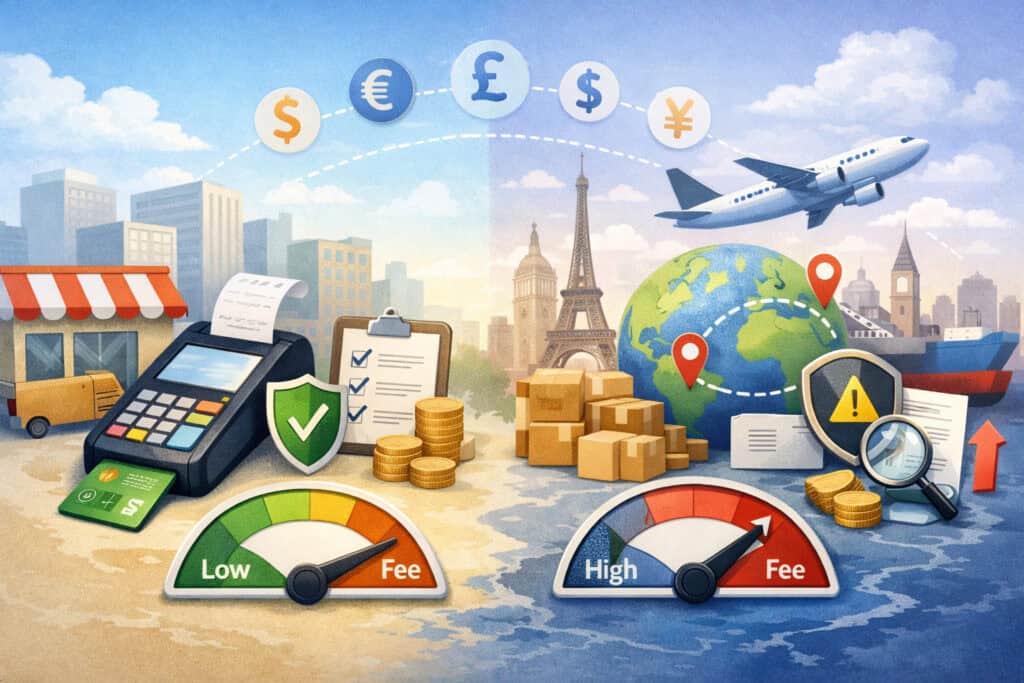
Merchant account fees for international payments tend to run higher because the transaction travels through more toll booths. At a minimum, card payments include interchange (paid to the issuer), assessments (paid to the card network), and processor/acquirer markup (paid to your provider).
International adds potential cross-border assessments, currency conversion markups, and sometimes extra fraud tooling costs.
Risk is also a real factor. Cross-border card-not-present transactions historically have higher fraud pressure than domestic in many industries. To protect themselves, some acquirers increase pricing, enforce stronger reserves, or tighten underwriting.
Even when your fraud rate is low, your category may be classified as “higher risk” for cross-border, influencing what you pay.
There’s also a routing reality: not every acquirer has equal “reach.” If your provider must use certain routes or intermediaries to complete an authorization, the cost can rise.
And if your business is missing key data fields (like customer billing address, tax indicators, or enhanced data for B2B cards), issuers may downgrade the transaction into a more expensive interchange bucket—another hidden contributor to merchant account fees for international payments.
The best news: higher cost is not unavoidable. In many cases, the biggest drivers are controllable—pricing model, currency strategy, fraud stack, billing descriptor setup, and acquirer architecture. Treat international fees as a system you can tune, not a tax you must accept.
The full stack of costs: interchange, network assessments, and processor markup

To understand merchant account fees for international payments, you need to see the “three-layer cake” of card pricing:
Interchange (issuer cost)
Interchange is set by the card brands and paid to the issuing bank. It varies by card type (debit, credit, premium), how the payment is accepted (keyed, ecommerce, tokenized), your business category, and whether you pass required data.
Interchange is not “negotiable” in the normal sense, but your practices can influence which interchange category applies—especially for ecommerce and B2B.
Network assessments (card brand fees)
Assessments are charged by the network for using the rails. These often include base assessment plus additional cross-border or cross-currency components.
Mastercard, for example, publishes network assessment fee schedules that include a volume assessment and a cross-border assessment concept (structure and rates vary by program and region).
Processor/acquirer markup (your provider’s margin + platform costs)
This is the portion you can most directly negotiate. It includes per-transaction fees, gateway charges, batch fees, monthly minimums, PCI programs, chargeback handling, and—sometimes—international “uplifts.”
When businesses complain about merchant account fees for international payments, they often blame interchange, but the biggest savings frequently come from (1) eliminating unnecessary processor uplifts, (2) reducing downgrades, and (3) choosing a settlement/currency strategy that cuts conversion costs.
Cross-border assessments and network fees: what they are and why they matter

Cross-border assessments are network charges that can apply when the issuer region differs from the merchant’s region. They are separate from interchange and separate from your processor’s markup.
While networks differ in naming, the concept is consistent: cross-border traffic costs more to operate, monitor, and govern, so the network charges more.
Mastercard’s published network assessment materials describe an acquirer volume assessment and reference cross-border assessment applying when merchant and cardholder country codes differ (language may differ across schedules and regions).
This is exactly the kind of line item that increases merchant account fees for international payments even if your processor’s pricing seems “reasonable.”
Why it matters operationally: if you don’t break out cross-border assessments in reporting, it’s hard to tell whether your cost increase is coming from network fees or from your processor’s uplift. Many providers present a blended “effective rate,” which hides the cause.
A strong best practice is to require fee transparency in your statements: ask for separate lines for interchange, assessments, and markup (or adopt interchange-plus pricing that makes this separation natural).
Once you can see cross-border assessment totals by month and by currency, you can connect them to business events—new marketing region, new pricing currency, new subscription plan—and proactively manage your merchant account fees for international payments.
Currency conversion and DCC: the silent driver of international payment costs
Currency is where merchant account fees for international payments can quietly explode. Even if you don’t add a visible “international fee,” someone is getting paid for conversion. That “someone” might be:
- The issuer (through an FX rate spread)
- The processor (through an FX markup)
- A third-party conversion service
- A DCC (dynamic currency conversion) program
DCC typically means the buyer sees a choice to pay in their home currency at checkout (or at the terminal) rather than the merchant’s pricing currency.
This can improve clarity for the buyer—but it can also carry higher spreads and can create disputes if not disclosed properly. In ecommerce, “multi-currency pricing” can feel like DCC to the customer even when it’s implemented differently behind the scenes.
For cost control, you want to separate two decisions:
- Display currency (what the customer sees and selects)
- Settlement currency (what you receive into your merchant account)
A common high-performing setup is to display local currencies in top markets (to boost conversions) while settling in one primary currency for treasury simplicity—but only if your provider’s FX markup is competitive.
Otherwise, a multi-currency display can increase merchant account fees for international payments more than it boosts revenue.
The rule: don’t guess. Run an A/B test on currency presentation, track authorization rate, refund/chargeback rate, and net margin after fees. Currency strategy is a revenue lever and a fee lever.
Pricing models that impact merchant account fees for international payments
How you are billed matters as much as what you are billed. The most common pricing models you’ll see in merchant processing include:
Interchange-plus (pass-through)
You pay actual interchange + actual assessments + a fixed markup. This is often the most transparent way to manage merchant account fees for international payments, because you can see whether international cost increases are driven by network/issuer components or your provider’s add-ons.
Tiered pricing
The processor groups transactions into buckets (qualified, mid-qualified, non-qualified). International transactions often land in more expensive tiers. Tiered pricing can make it hard to optimize because the downgrade rules are opaque.
In many cases, tiered plans inflate merchant account fees for international payments beyond what the underlying networks charge.
Flat-rate pricing
One blended rate for everything. Simple, but often expensive at scale—especially for cross-border—because the provider builds in risk and variability. Flat rate can be reasonable early on, but as international volume grows, it can become the main reason merchant account fees for international payments are too high.
“International uplift” add-ons
Some providers charge an additional percent on top of everything for international cards or cross-currency transactions. Sometimes this is justified by risk and routing cost; sometimes it’s simply margin. If you see uplifts, you should challenge them with data and shop alternatives.
A practical approach: start with interchange-plus for transparency, then negotiate your markup based on your fraud controls, chargeback performance, ticket size, and volume consistency.
Common fee line items you should expect (and how they show up)
When reviewing statements, merchant account fees for international payments often appear as a combination of familiar and unfamiliar line items. Here are the most common categories businesses encounter:
- Per-transaction fee (e.g., $0.10–$0.30): charged by processor/acquirer; applies to every authorization or capture.
- Discount rate / markup percent (e.g., +0.20% to +0.80% over pass-through): provider margin.
- Cross-border fee / international service fee: sometimes a separate percent added for foreign-issued cards.
- Cross-currency fee: additional percent when currency differs between shopper and settlement.
- Gateway fee: monthly and/or per-transaction if using a separate payment gateway.
- AVS/CVV fees: small fees for verification tools—these can rise with international volume because verification attempts may increase.
- Chargeback handling fees: administrative fees per dispute (plus potential network dispute fees).
- Refund fees: some providers do not refund the original processing fees; this can matter a lot in cross-border where refund rates might be higher due to delivery timelines.
- PCI program fees: not “international,” but they affect your true effective rate.
- Wire/treasury fees (if your international strategy involves bank transfers): incoming/outgoing fees, intermediary fees, and FX spreads.
The goal is not to eliminate every fee, but to ensure each fee is tied to a real service, priced competitively, and aligned with your risk profile. A clean fee architecture makes merchant account fees for international payments predictable—predictability is what helps you price correctly and scale confidently.
Industry factors that change international merchant fees dramatically
Two businesses can process the same monthly volume and pay very different merchant account fees for international payments. The difference often comes from:
Business category (MCC) and risk perception
Digital goods, subscriptions, travel, coaching, and high-ticket ecommerce can trigger higher scrutiny and higher pricing because disputes are more common.
Card-not-present vs. card-present
Ecommerce cross-border tends to be more expensive than in-person tourism spend, because fraud pressure is typically higher online.
Ticket size and frequency
Microtransactions can inflate fixed per-transaction costs. High-ticket orders can raise reserve requirements.
Refund and chargeback behavior
High refund rates increase net cost because many processors keep some fees even when you refund. Chargebacks create direct costs and can increase future pricing.
Data quality and downgrade rate
Missing tax fields, missing address data, or using manual entry can push transactions into more expensive categories. This is one of the most fixable drivers of merchant account fees for international payments.
If you want to rank internationally and keep margins healthy, build a profile: approval rate, fraud rate, dispute rate, refund rate, and downgrade rate by region and currency. That profile becomes your negotiating power.
Compliance and security costs: PCI, SCA-style authentication, and fraud tooling
International growth often forces an upgrade in compliance and authentication, which can influence merchant account fees for international payments indirectly. The biggest cost driver is usually fraud tooling (not just fraud losses). As cross-border volume grows, you may add:
- Stronger identity verification
- Smarter fraud scoring
- 3DS-style authentication where applicable (to shift liability and reduce disputes)
- More detailed logging and evidence management for disputes
These can add platform costs, but they frequently reduce your total cost because they prevent chargebacks, keep your account in good standing, and improve approvals with cautious issuers. In other words, the cheapest processing stack on paper can be the most expensive once fraud and disputes are included.
At a minimum, you want: tokenization where available, consistent billing descriptors, reliable customer support workflows, fast refund handling, and strong evidence packs for disputes. Those operational moves reduce the “hidden” part of merchant account fees for international payments—the costs you pay through lost revenue, withheld funds, and rising risk pricing.
Settlement options: one currency vs. multi-currency merchant accounts
Settlement strategy is one of the biggest levers for merchant account fees for international payments. You typically have three options:
Single-currency settlement (simple treasury)
You price and settle in one currency. Buyers may still pay with foreign-issued cards, but FX happens on the issuer side. This is operationally simple and can be cost-effective if your buyer base is mixed and you don’t need localized pricing.
Multi-currency settlement (localize without constant conversions)
You settle into multiple currency balances (often through a specialized provider). This can reduce conversions and improve margin if you have predictable payouts or supplier payments in those currencies.
Local acquiring (regional acquiring setups)
You establish acquiring in multiple regions (often through an enterprise PSP or multiple providers). This can improve authorization rates and can reduce cross-border assessments in some cases, but it increases operational complexity.
Your best approach depends on: where your customers are, your average order value, your refund rate, your payout needs, and how much complexity your finance team can support. The right settlement model can reduce merchant account fees for international payments while also improving conversion, which is a double win.
Alternative rails: wires, bank transfers, RTP-style networks, and SWIFT tracking
Not every international payment should run on cards. For large invoices, recurring B2B payments, or supplier settlements, bank transfer rails can reduce merchant account fees for international payments—but you must manage speed, transparency, and reconciliation.
SWIFT gpi is one example of an industry initiative that improves transparency and tracking for cross-border bank payments, offering real-time tracking and improved visibility into fees and payment status.
That matters because bank transfers historically suffered from “mystery fees” taken by intermediaries. Better tracking reduces operational overhead and improves customer experience.
The tradeoff is that bank transfers can shift responsibility to your operations team: matching payments to invoices, handling sender errors, and dealing with delays. If you choose bank rails to reduce merchant account fees for international payments, invest in reconciliation automation and clear customer instructions.
For many businesses, the optimal setup is mixed:
- Cards for ecommerce checkout and instant authorization
- Bank transfers for high-value invoices and repeat business customers
- Wallets or alternative methods for specific segments (when it improves conversion and reduces disputes)
How to calculate your true “international effective rate” (the number that matters)
To manage merchant account fees for international payments, you need a single metric that includes everything. Many businesses only look at the processor’s percent and ignore:
- FX spread
- Refund leakage (fees not returned)
- Chargeback admin costs
- Fraud tooling subscription costs
- Reserve opportunity cost (cash tied up)
A useful calculation is:
International Effective Rate = (All processing fees + all FX costs + dispute/admin fees + tooling costs tied to international payments) / International Gross Sales
Then track it by:
- Currency presented
- Buyer region (issuer region)
- Payment method
- Product line
- New vs returning customers
Once you have this, you can make decisions confidently. For example, you might learn that multi-currency checkout increases conversion but raises fees slightly—yet net profit still grows.
Or you might find that one region has high approval failure, causing repeated attempts that inflate per-transaction fees and fraud checks—pushing merchant account fees for international payments higher than expected.
This is the difference between reacting to fees and engineering your fee outcomes.
12 practical ways to lower merchant account fees for international payments
1) Move to interchange-plus for transparency
If you’re on a tiered or flat-rate, you may be overpaying for cross-border. Interchange-plus makes merchant account fees for international payments visible and optimizable.
2) Negotiate or eliminate international uplifts
Ask your provider to justify uplifts with loss data and routing cost. If they can’t, shop alternatives.
3) Reduce downgrades with better data
Use address verification where it works, pass CVV, use tokens, and capture enhanced data when selling to business cards.
4) Improve authorization rates with smarter routing
Some platforms offer multi-acquirer routing or regional acquiring that increases approvals and reduces retries (which reduces per-transaction fees).
5) Re-think currency presentation
Test local currency display in top markets. Optimize based on net margin after merchant account fees for international payments, not just conversion rate.
6) Tighten refund policies and speed
Fast refunds reduce disputes. Lower disputes reduce long-term pricing pressure and keeps your processing stable.
7) Use 3DS-style authentication selectively
Use it where it improves approvals and reduces disputes, but avoid blanket rules that harm conversion.
8) Tune fraud tools by region
International risk is not uniform. Over-blocking can reduce approvals; under-blocking increases chargebacks. Tune rules to reduce total cost.
9) Fix billing descriptors and support workflows
Clear descriptors reduce “friendly fraud.” Better support reduces chargebacks. Fewer disputes lowers merchant account fees for international payments over time.
10) Choose payout timing strategically
Some providers charge more for faster payouts. If cash flow allows, slower payouts can lower overall cost.
11) Separate high-risk traffic into a dedicated MID
If one product line has high disputes, isolate it. This protects your broader pricing and reduces account-wide fee pressure.
12) Consider bank transfer rails for large invoices
When card fees are too high for high-value B2B, bank rails can reduce merchant account fees for international payments—especially when paired with better tracking and reconciliation.
Each of these tactics works best when paired with reporting that isolates cross-border and cross-currency segments.
Contract traps that inflate international processing costs
Many businesses lose money not because of “normal” merchant account fees for international payments, but because of contract traps:
- Rate increase clauses with minimal notice
- Bundled “international” fees that can’t be audited
- Minimum monthly fees that trigger when international seasonality dips
- Non-refundable fees on refunds
- Termination fees that block you from switching providers
- Opaque FX pricing (no disclosure of spread)
A healthy contract gives you transparency: pass-through interchange and assessments, clearly stated markup, clear FX policy, and written definitions of cross-border and cross-currency. Without that, international costs drift upward.
Future predictions: where international merchant fees are heading (2026–2030)
The next few years will likely reshape merchant account fees for international payments in three big ways:
1) More pressure on cross-border fee regulation and caps
Globally, regulators have shown interest in cross-border fee levels, especially where they rise sharply after market structure changes. Recent reporting on regulatory actions abroad highlights how fee caps and legal challenges can emerge when cross-border interchange rises.
Even if your business operates from the U.S. market, global policy trends influence how networks and issuers approach cross-border pricing.
2) Greater transparency and tracking across rails
Initiatives like SWIFT gpi emphasize real-time tracking and visibility of cross-border payments, including fee visibility and payment certainty. Expect customer expectations to rise: buyers and merchants will demand clearer fee disclosure, faster settlement, and fewer “mystery charges.”
3) Smarter fraud controls with lower friction
AI-driven fraud scoring, passkeys, device intelligence, and tokenization will reduce fraud loss rates while improving approvals. Over time, that can reduce the risk premium baked into merchant account fees for international payments—but only for merchants who adopt modern controls and maintain strong dispute performance.
The likely outcome: the best-run merchants will see their effective international costs decline (or at least stabilize), while merchants with weak data quality, high disputes, or opaque pricing contracts will see costs rise.
FAQs
Q.1: What is the typical range for merchant account fees for international payments?
Answer: There isn’t one universal number because merchant account fees for international payments depend on card mix, regions, currency, fraud risk, and your pricing model.
Many businesses see international transactions cost meaningfully more than domestic due to cross-border assessments, currency conversion spreads, and risk-based markups. The best way to know your range is to calculate an international effective rate that includes FX and dispute leakage, not just your processor’s advertised percent.
Q.2: Are international fees higher because of the card network or the processor?
Answer: Both can contribute. Networks charge assessments that can include cross-border components (structure varies). Processors may also add “international uplifts” or higher markup for foreign-issued cards.
To tell which is driving your costs, you need transparent reporting (ideally interchange-plus) so you can see assessments vs markup.
Q.3: Do I pay extra fees when I refund an international transaction?
Answer: Often yes—at least indirectly. Some providers do not return the original processing fees, and FX may not reverse at the same rate. If you have a high refund rate, this can materially raise merchant account fees for international payments.
The fix is policy (reduce preventable refunds), operational (speed refunds before disputes), and contractual (choose a provider with fair refund fee handling).
Q.4: Will offering local currencies reduce or increase my international costs?
Answer: It can do either. Local currencies can increase conversion and reduce customer confusion, but can increase FX-related cost if your provider’s spread is high. The right approach is to test and measure net margin after merchant account fees for international payments, not just conversion rate.
Q.5: Is switching to bank transfers always cheaper than card payments for international business?
Answer: Not always, but it can be for large invoices. Bank rails can reduce card-based merchant account fees for international payments, but may introduce intermediary fees, FX spreads, and reconciliation overhead. Tools that improve tracking and transparency can make bank transfers more operationally viable.
Q.6: What’s the fastest way to lower merchant account fees for international payments without changing providers?
Answer: Start with downgrade reduction and dispute reduction. Improve data quality (CVV, address where applicable, tokens), tighten fraud rules by region, and improve customer support and descriptors to reduce chargebacks. Those changes often lower your total cost even if your base pricing stays the same.
Conclusion
International revenue is exciting, but it only stays profitable when you engineer your costs. Merchant account fees for international payments are not just one fee—they’re a stack of costs: interchange, network assessments, processor markup, FX spreads, and operational leakage from refunds and disputes. If you treat them as a single blended rate, you’ll miss the levers that matter.
The winning playbook is consistent: segment your transactions (cross-border vs cross-currency), demand transparency (prefer interchange-plus), optimize currency strategy, reduce downgrades with better data, and invest in fraud and dispute prevention that improves approvals while lowering risk pricing.
As cross-border transparency improves and tracking gets better across multiple payment rails, merchants who build modern payment operations will have more control over merchant account fees for international payments than ever before.