By crossborderfees March 1, 2026
International card payments often look simple at checkout—tap, click, approved. But once the transaction hits a cardholder’s statement or a merchant processing statement, it can split into multiple fees that sound interchangeable: foreign transaction fee, cross-border fee, international service assessment, currency conversion fee, and more.
This guide explains foreign transaction fees vs cross-border fees in plain language, with an “analyst lens” on how card networks, issuers, and acquirers apply charges across the authorization → clearing → settlement lifecycle.
The goal is to help you map confusing line items back to who charged them, why they exist, and what you can do about them—whether you’re a frequent traveler trying to avoid surprises, or a finance team reconciling international card processing costs.
Who this guide is for
This article is written for:
- Ecommerce merchants selling to international customers, including marketplaces and cross-border DTC brands
- Subscription businesses with recurring billing and higher exposure to chargebacks on international transactions
- Finance teams reconciling processing costs, dispute losses, and fee category changes
- Frequent travelers and cardholders who want to understand issuer foreign transaction fee charges and avoid DCC
- Operations and risk teams who monitor declines, fraud rates, and cross-border assessment impacts on net margin
If you only remember one thing: foreign transaction fees are usually charged to the cardholder by the issuer, while cross-border fees are typically card network assessments that usually affect the merchant side. They can happen in the same purchase—but they’re not the same fee.
Definitions that actually match statements
When people search for the difference between foreign transaction fees and cross-border fees, they’re usually trying to explain one of two things:
- “Why did my card statement show an extra fee?”
- “Why did my merchant statement show higher fees on international volume?”
To answer those, you need vocabulary that aligns with how fees are assessed.
What is a foreign transaction fee?
A foreign transaction fee is typically an issuer fee charged to the cardholder when a transaction is considered “foreign” under the card’s terms. “Foreign” can mean different things depending on the issuer’s disclosure, but common triggers include:
- The transaction is processed outside the cardholder’s home market (based on merchant location or acquiring setup)
- The transaction is in a foreign currency
- The merchant uses a foreign acquiring bank—even if the cardholder pays in their own currency (yes, this happens)
Issuer disclosures often describe this fee as a percentage of each foreign transaction amount. For example, a cardmember agreement may state a foreign transaction fee of up to 3% per foreign transaction.
What is a cross-border fee?
A cross-border fee is commonly used to describe a card network assessment that applies when the transaction is “cross-border” under network rules—often based on a mismatch between the merchant’s location indicators and the cardholder’s issuing location indicators.
Network documentation sometimes labels this in different ways, such as cross-border assessment, international service assessment, or other card network assessment fees that increase on transactions involving different location codes.
For example, network-published acquiring assessment documents describe cross-border assessment logic and publish example rates that can apply when merchant and cardholder location codes differ.
Where currency conversion fees fit in
Currency conversion is related—but it’s a separate “layer”:
- If the transaction is presented (authorized/cleared) in a currency different from the cardholder’s billing currency, conversion must occur somewhere.
- Conversion can happen via the issuer (using issuer rules/exchange rate spread) or via an acquirer/merchant service (often through dynamic currency conversion (DCC) or multi-currency pricing tools).
Even when an issuer doesn’t charge a foreign transaction fee, the cardholder can still experience a cost via:
- FX markup / exchange rate spread embedded in the rate applied
- A disclosed currency conversion fee (issuer-side or DCC-side)
How DCC differs (and why it causes confusion)
Dynamic currency conversion (DCC) is a checkout-time service that offers the cardholder the choice to pay in a currency different from the merchant’s local currency—often the cardholder’s billing currency.
Network guidance describes DCC as a service provided by acquirers and merchants (not the network itself), and emphasizes disclosure requirements so cardholders understand the costs and can opt out.
DCC doesn’t “remove” cross-border fees. It changes who performs conversion and how the conversion rate/markup is set and disclosed. It can also create situations where:
- The cardholder thinks they avoided issuer FX costs, but the DCC markup is higher
- The merchant believes DCC improves transparency, but disputes increase due to “unexpected currency conversion” claims
Fee glossary: what it’s called, who charges it, who pays it, where it appears
The same underlying cost can show up under different names across issuers and processors. This table is designed for reconciliation: who charges it, who pays it, where it appears.
| Fee / Term | Who typically charges it | Who typically pays it | Where it usually appears | Common statement labels |
|---|---|---|---|---|
| Issuer foreign transaction fee | Issuing bank | Cardholder | Cardholder statement | Foreign transaction fee, international transaction fee, foreign purchase fee |
| Cross-border assessment | Card network (assessment) | Merchant (via acquirer) | Merchant processing statement | Cross-border fee, cross-border assessment, international assessment |
| International service assessment (ISA) / international acquiring assessment | Card network (assessment) | Merchant (via acquirer) | Merchant processing statement | ISA, international service assessment, international fee |
| Currency conversion fee | Issuer or DCC provider | Cardholder (most often) | Cardholder statement or receipt | Currency conversion fee, FX fee, conversion charge |
| FX markup / exchange rate spread | Issuer or DCC provider | Cardholder (implicit) | Embedded in exchange rate | Not always separately itemized |
| Dynamic currency conversion (DCC) markup | Acquirer/DCC provider | Cardholder | Receipt + statement (varies) | DCC, currency conversion, exchange rate markup |
| Card-not-present international transactions uplift | Network + processor pricing | Merchant | Merchant statement | CNP international, ecommerce international, cross-border CNP |
| Interchange and assessments (high-level) | Issuer (interchange) + network (assessments) | Merchant | Merchant statement | Interchange, assessments, dues & assessments |
| Chargebacks on international transactions | Network rules + issuer/acquirer operations | Merchant (loss + fees) | Merchant statement + dispute platform | Chargeback fee, dispute fee, retrieval fee |
Foreign transaction fees vs cross-border fees: side-by-side comparison
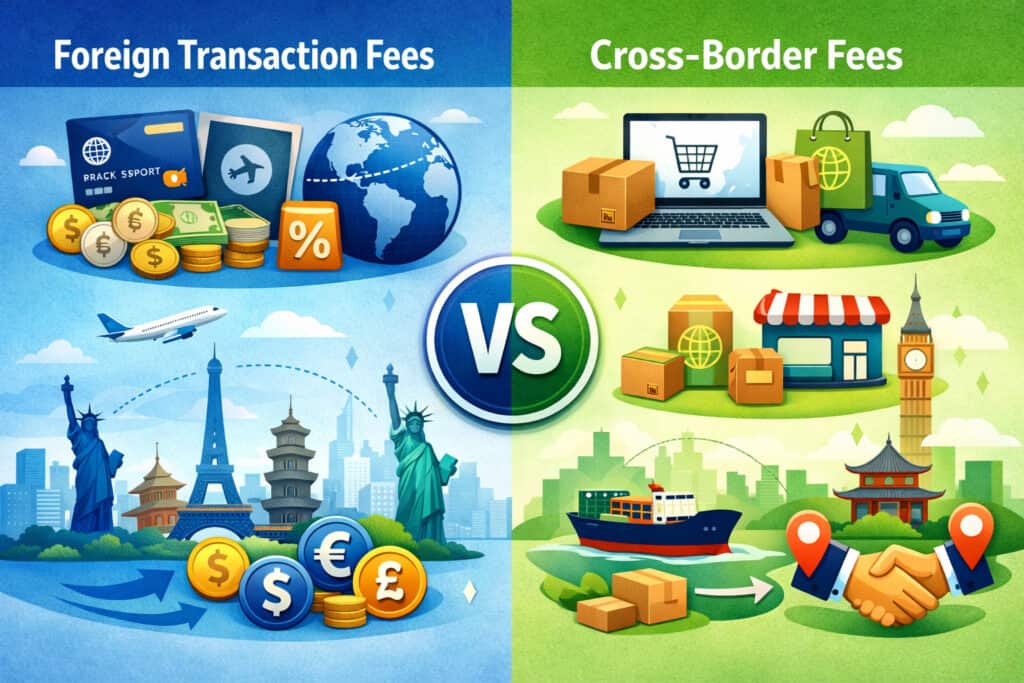
This is the core of foreign transaction fees vs cross-border fees—what they are, who controls them, and why both might apply to one purchase.
| Category | Foreign transaction fee | Cross-border fee / cross-border assessment |
|---|---|---|
| What it is | Issuer fee charged to cardholder for “foreign” transactions | Network assessment typically charged on cross-border transaction characteristics |
| Who sets it | Issuing bank | Card network, then passed through via acquirer |
| Who pays it | Cardholder | Merchant (as part of processing costs) |
| Typical trigger | Issuer classifies transaction as foreign (currency, location, acquiring) | Merchant and cardholder location indicators differ; network cross-border logic applies |
| How it shows up | Separate line item on cardholder statement (or included in pricing terms) | Merchant statement line item (assessments), sometimes bundled |
| Can it be waived? | Yes—some cards have no foreign transaction fee (issuer decision) | Not “waived” by issuer; mitigated by merchant acquiring setup, routing, or acceptance strategy |
| Is currency conversion required? | Not always (can apply even in cardholder’s currency) | Not necessarily tied to currency conversion; tied to cross-border indicators |
| Best lever to reduce it | Card choice + decline DCC where appropriate | Optimize acquiring, multi-currency pricing strategy, and statement monitoring |
Who charges each fee—and who actually feels it
The fastest way to stop confusion is to separate the international payment ecosystem into three parties:
- Issuing bank (issuer): gives the card to the cardholder, sets cardholder fees (including issuer foreign transaction fee)
- Card network: routes the transaction and sets assessment categories (including cross-border assessment logic and related dues/assessments)
- Merchant acquiring bank (acquirer) / processor: provides acceptance, passes through network costs, and may add markup or bundled pricing
Issuing bank vs card network vs acquiring bank
If you’re reconciling statements, the questions that matter are:
- “Is this fee coming from the issuer or the acceptance stack?”
- “Is it a cardholder fee or a merchant fee?”
- “Is the fee explicitly itemized, or implied through a rate (FX spread) or bundled pricing?”
A foreign transaction fee is typically charged by the issuer and appears on the cardholder statement. An issuer may disclose the foreign transaction fee as “up to X%,” and it’s applied at posting for qualifying transactions.
A cross-border fee is typically assessed by the network and passed to the merchant side through the acquirer/processor. Network-published acquiring assessment schedules describe how cross-border assessment applies when merchant and cardholder location codes differ, and provide example assessment rates for certain cases.
Merchant vs cardholder impact: why the same purchase triggers two costs
One purchase can create:
- A merchant-side cross-border assessment (network assessment passed through the acquirer)
- A cardholder-side issuer foreign transaction fee (issuer fee disclosed in card terms)
That’s why customers sometimes complain, “I paid an extra fee,” while merchants say, “We also paid higher processing.” Both can be true.
Where these fees show up on statements (and why names don’t match)
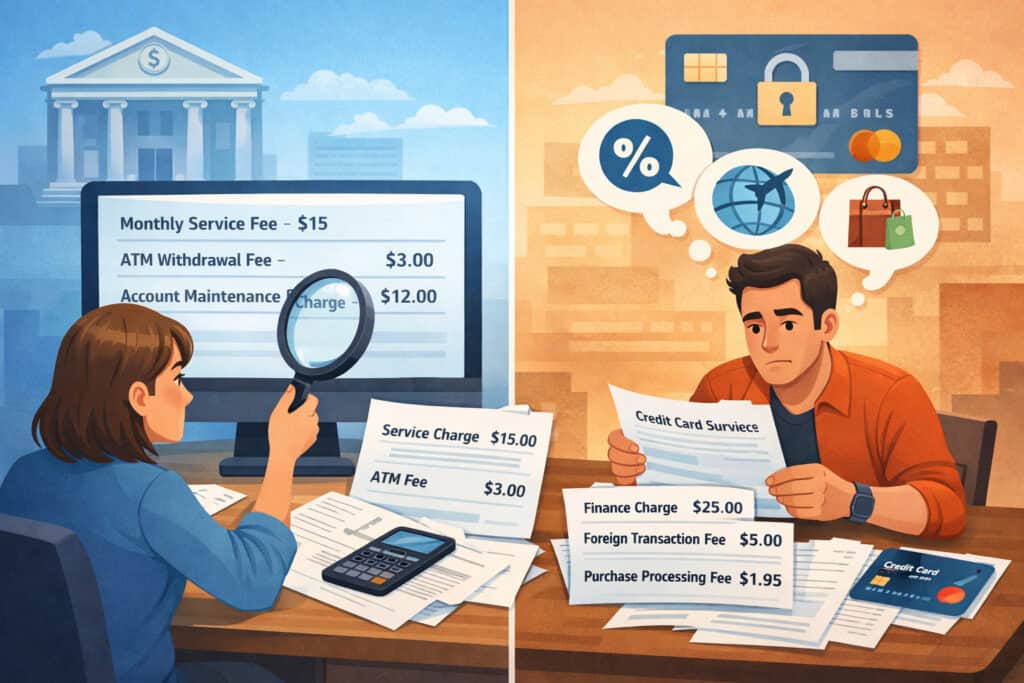
A big part of understanding foreign vs cross-border payment fees is recognizing that statement terminology is inconsistent.
Cardholder statements: typical placement and naming patterns
On a cardholder statement, you may see:
- A separate line item shortly after the transaction posts, labeled “foreign transaction fee” or similar
- A combined fee label that references “international transaction” rather than “foreign”
- No explicit fee line item, but a higher-than-expected converted amount (FX markup / exchange rate spread)
Issuer agreements often disclose the presence and maximum amount of foreign transaction fees, commonly expressed as a percentage of each foreign transaction amount.
Common confusion: cardholders assume “foreign transaction fee” means “I bought something in a foreign currency.” In reality, issuers can define “foreign” based on processing location and acquiring setup—even when the cardholder sees prices in their own currency at checkout.
Merchant processing statements: what to look for
On merchant statements, cross-border fees can appear as:
- Cross-border fee
- International service assessment
- International acquiring fee
- “Dues and assessments” with a subline for cross-border
- A blended “international card processing costs” category if you’re on bundled pricing
Network schedules may explicitly describe cross-border assessment logic and list example rates for cross-border scenarios.
Why names don’t match: processors sometimes rename network fees for readability, or group them into internal buckets. That’s why two processors can show the same network assessment under different labels.
The payment flow: authorization → clearing → settlement (and where fees get applied)
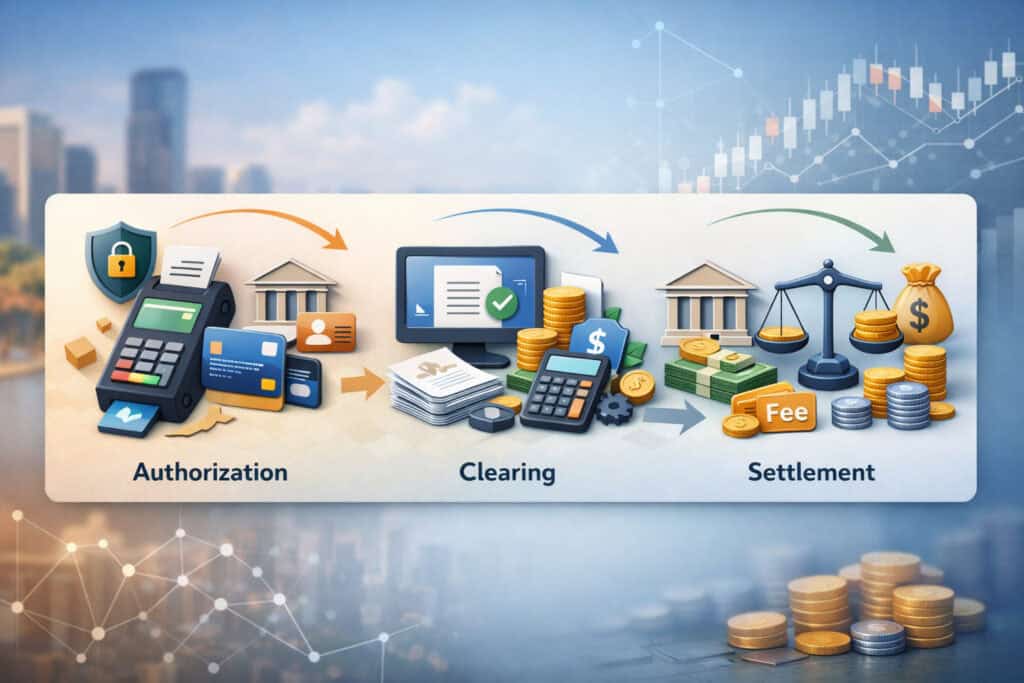
To really understand foreign transaction vs cross-border fees, you need to know where each fee is calculated in the lifecycle.
Step 1: Authorization (the “approved/declined” moment)
Authorization happens when:
- The cardholder submits payment (card-present or card-not-present international transactions)
- The merchant/acquirer sends an authorization request through the network
- The issuer approves or declines, often with fraud and risk checks
At authorization time, the key data elements that later influence international fees include:
- Merchant category code (MCC)
- Merchant location/acquiring identifiers
- Transaction currency (presentment currency)
- Card issuing location indicators (from the BIN/IIN range)
Some fees are not fully calculated at authorization. Authorization is primarily about risk and availability. That’s why you can see one amount at auth and a slightly different posted amount later—especially with currency conversion.
Step 2: Clearing (when the transaction becomes “real”)
Clearing is where the transaction details are finalized and transmitted for posting. This is the stage where:
- The transaction becomes eligible for settlement
- The network classifies the transaction for assessment categories
- Currency conversion rules (if applicable) are applied using network/issuer mechanisms
This stage is often where cross-border assessment logic is applied, because the network has the final transaction data required to classify it.
Network documentation for acquiring assessments describes cross-border assessment triggers based on merchant and cardholder location code differences and provides example assessment rates.
Step 3: Settlement (money movement and final charges)
Settlement is the final exchange of funds among parties:
- Issuer sends funds (minus interchange) through the network to the acquirer
- Merchant receives net funds after processor pricing, assessments, and other deductions
This is also where:
- Merchant-side fees appear in merchant reporting
- Cardholder-side issuer fees often post (including issuer foreign transaction fee)
- Any DCC conversion markup is reflected based on the selected currency option
If DCC was used, network guidance emphasizes required disclosures and the cardholder’s right to opt out and pay in the local currency, to avoid confusion at settlement/posting.
Common transaction scenarios: which fees apply?
This table gives practical mapping. It won’t match every processor’s labeling, but it matches the underlying mechanics.
| Scenario | Currency conversion happens? | Foreign transaction fee (cardholder)? | Cross-border fee (merchant)? | Notes |
|---|---|---|---|---|
| Customer uses a foreign-issued card, pays in merchant’s local currency | Maybe (issuer converts billing currency) | Possible (issuer policy) | Likely (cross-border indicators differ) | This is a classic case where both merchant and cardholder may see international costs |
| Customer uses a local-issued card, pays in foreign currency | Yes (issuer converts) | Possible (issuer policy) | Not necessarily cross-border | Currency alone can trigger issuer classification, even if merchant is “local” but priced in foreign currency |
| DCC applied at checkout (cardholder chooses billing currency) | Yes (acquirer/DCC provider converts) | Still possible (issuer policy varies) | Cross-border still possible | DCC changes conversion source; disclosures required |
| Ecommerce cross-border sale with no currency conversion (merchant prices in cardholder billing currency) | Not always | Possible (issuer may still classify as foreign) | Likely (cross-border indicators differ) | “No conversion” does not guarantee “no international fee” |
| Subscription renewal on an international card | Usually | Possible | Likely | Adds dispute exposure: chargebacks on international transactions may increase with unclear descriptors |
| Refund on an international purchase | Depends | Fee reversal varies by issuer | Assessment reversal varies by network/acquirer | Some refunds reverse assessments; issuer foreign transaction fee reversal depends on issuer terms |
Real-world examples with simple math (2026-ready)
The numbers below use placeholders and illustrative rates. Always confirm your own processor/issuer disclosures. Where this guide references specific published ranges, it uses official network schedules or issuer disclosures.
Example 1: Foreign-issued card billed in local currency (no DCC)
Scenario:
- Merchant sells an item for 100.00 in local currency
- Cardholder uses a card issued outside the merchant’s local market
- Cardholder is billed in their billing currency later (issuer conversion)
What the merchant may pay:
- Merchant processing includes interchange + assessments + markup
- A cross-border assessment may apply due to differing merchant vs cardholder location codes (network classification). Network schedules describe this logic and publish example cross-border assessment rates.
What the cardholder may pay:
- The issuer converts 100.00 into billing currency using issuer rules
- The issuer may charge an issuer foreign transaction fee, often disclosed as a percentage (some issuers disclose up to 3% per foreign transaction).
Why people get confused:
Both parties see “international costs,” but they’re separate: merchant-side assessments vs cardholder-side issuer fees.
Example 2: Local-issued card billed in foreign currency
Scenario:
- Merchant prices in a foreign currency (multi-currency pricing)
- Cardholder uses a locally-issued card
- Transaction amount is 100.00 in foreign currency
Cardholder impact:
- Issuer performs conversion and may apply FX markup / exchange rate spread
- Issuer may also apply a foreign transaction fee depending on how “foreign” is defined in the card terms (currency can be a trigger even if the merchant is local)
Merchant impact:
- Depending on acquiring setup, merchant might still be “local acquired,” so cross-border assessment may not apply
- But the merchant may pay additional processor fees for multi-currency pricing or FX services, depending on the solution
Example 3: DCC applied at checkout (cardholder chooses billing currency)
Scenario:
- Merchant offers DCC
- Cardholder chooses to pay in billing currency at checkout
- DCC provider applies a disclosed exchange rate + markup
Network guidance emphasizes that DCC is provided by acquirers/merchants and requires clear disclosures, including the cardholder’s ability to opt out and pay in local currency.
Cardholder impact:
- The conversion rate is set by the DCC provider (not the issuer)
- The markup may be shown on the receipt or implied in the rate
- The cardholder may still see issuer foreign transaction fee in some cases depending on issuer rules and how the transaction is coded (policies vary)
Merchant impact:
- Cross-border assessment may still apply if the transaction remains cross-border under network logic
- DCC can increase dispute risk if disclosures are unclear (“I didn’t authorize conversion” chargebacks)
Example 4: Ecommerce cross-border sale with no currency conversion
Scenario:
- Customer buys online from abroad
- Merchant prices in local currency
- Customer’s card is billed in their billing currency by the issuer (issuer conversion)
Fees likely to appear:
- Merchant: cross-border assessment due to cross-border indicators (network classification)
- Cardholder: issuer foreign transaction fee depending on issuer policy (often disclosed as a percentage, potentially up to 3%)
The misconception it breaks: “No currency conversion means no international fee.” Not true—cross-border classification can still apply.
Common misconceptions that cause reconciliation errors
This section exists because most confusion isn’t about math—it’s about assumptions.
Misconception 1: “No currency conversion means no international fee”
It’s easy to think international fees only exist when a transaction is converted into a different currency. But cross-border assessment logic often depends on location indicators, not currency alone. Network schedules describe cross-border assessment application based on merchant vs cardholder location code differences.
Similarly, issuers can classify a transaction as foreign because it was processed through a foreign acquiring setup—even if the cardholder paid in their own currency at checkout.
Operational impact: merchants under-forecast “international” costs because they only look at currency mix, not issuing mix.
Misconception 2: “Foreign transaction fee and cross-border fee are the same”
They’re different in three ways:
- Who charges it: issuer vs network (via acquirer)
- Who pays it: cardholder vs merchant
- Where it appears: card statement vs merchant processing statement
When you see both on the same purchase, it’s not “double charging.” It’s two different fee layers applied to different parties.
Misconception 3: “DCC eliminates all extra charges”
DCC changes conversion mechanics—it doesn’t erase cross-border classification, and it doesn’t guarantee the cardholder gets a better total cost.
Network guidance stresses disclosure and informed choice because costs can differ depending on whether the cardholder selects billing currency or transaction currency.
Practical outcome: DCC can reduce issuer FX variability, but it can introduce higher conversion markups and increase chargeback exposure if implemented poorly.
How businesses can reduce international fee impact (without guessing)
You can’t manage what you can’t see. The most effective strategy is to make international costs measurable and then choose levers that fit your business model.
1) Understand your acquiring setup
Your merchant acquiring bank vs issuing bank relationship matters. If you sell internationally, your acquiring configuration can affect:
- How transactions are classified (domestic vs cross-border)
- Which assessment categories apply
- How quickly you can reconcile cross-border fee drivers
Network schedules define cross-border assessment logic based on merchant and cardholder location code differences; your acquiring setup influences those merchant indicators.
Action steps:
- Ask your processor what merchant country/location codes are used for your MID(s)
- Confirm how online storefronts, marketplaces, and payment links map to those identifiers
- Validate whether you’re using a single acquiring setup or multi-entity routing
2) Evaluate multi-currency pricing carefully
Multi-currency pricing can improve conversion in some markets by showing familiar pricing. But it introduces tradeoffs:
- Currency selection influences issuer conversion vs merchant/acquirer conversion
- FX risk may shift to you (or be priced into a service fee)
- Chargeback representment can become more complex if the cardholder disputes the currency choice
If you’re considering DCC-like experiences, follow network disclosure principles for clarity and opt-out choice.
3) Monitor international transaction mix (beyond currency)
Track:
- Issuing mix (what portion of volume comes from cards issued outside your local market)
- Cross-border approval rates vs domestic approval rates
- Fraud and dispute rates for international vs domestic
- Refund rate differences (and whether fees reverse)
This turns “international card processing costs” from a vague complaint into measurable drivers.
4) Optimize routing and pricing (high-level)
Depending on your stack, you may have options like:
- Multi-acquirer strategies for different regions (where supported)
- Smart routing or cascading to reduce unnecessary declines
- Pricing adjustments for high-cost regions or high-fraud cohorts
Keep this high-level unless you have strong internal capabilities—routing changes can alter risk, compliance scope, and reporting complexity.
5) Communicate transparently with customers
Customers mostly get angry when fees feel hidden. You can reduce friction by:
- Explaining that issuers may charge foreign transaction fees (merchant doesn’t control)
- Providing clear receipts, descriptors, and customer support language
- Avoiding forced currency conversion experiences
Network guidance underscores clear disclosure for currency conversion choices to prevent confusion at the statement level.
Merchant checklist to reduce international fee impact
Use this as a practical “do next” list.
| Checklist item | Why it matters | Owner |
|---|---|---|
| Get a merchant statement fee breakdown that separates interchange and assessments | Cross-border fees are often hidden inside assessment totals | Finance / Payments |
| Track issuing mix (local vs foreign-issued) monthly | Cross-border fees correlate with issuing location, not only currency | Finance / Data |
| Confirm your merchant identifiers and location indicators with your processor | Misconfigured merchant profile can increase cross-border assessments | Payments Ops |
| Review multi-currency pricing and DCC flows for disclosure and opt-out | Reduces chargebacks on international transactions tied to confusion | Product / Compliance |
| Segment fraud tools for cross-border ecommerce | Different risk profile vs domestic transactions | Risk |
| Reconcile refunds: do assessments reverse, and how are FX differences handled? | Prevents “refund gap” surprises | Finance |
| Add customer-facing FAQ language about issuer foreign transaction fees | Reduces support tickets and negative reviews | Support |
| Benchmark processing costs by region/channel (CNP vs CP) | Card-not-present international transactions often cost more | Finance / Payments |
How consumers can avoid foreign transaction fees (and avoid the “DCC trap”)
If you’re a cardholder, you can’t control cross-border fees on the merchant side. But you can control a lot about what shows up on your own statement.
1) Choose cards with no foreign transaction fee
Some issuers offer cards that advertise “no foreign transaction fee.” The most reliable method is still the boring one:
- Read the card’s pricing disclosure and terms
- Search the agreement for “foreign transaction fee” and “international transaction”
Issuer agreements can explicitly disclose foreign transaction fee amounts—sometimes as a percentage up to a stated maximum.
2) Decline DCC where appropriate
When you’re offered a choice of currencies at checkout, remember:
- Paying in the merchant’s local currency typically means the issuer handles conversion
- Paying in billing currency via DCC means the acquirer/DCC provider handles conversion
Network guidance stresses that DCC must provide informed choice and warns that costs may differ depending on the selection.
3) Review issuer disclosures and learn your statement patterns
If you travel or buy internationally often, take five minutes to learn how your issuer posts:
- Does the foreign transaction fee post as a separate line item?
- Does it post on the same day as the transaction, or after it settles?
- Does it apply to online merchants that are “foreign acquired” even when you pay in your own currency?
That knowledge prevents a lot of frustration (and unnecessary merchant complaints).
FAQs
Q1) Are foreign transaction fees the same as cross-border fees?
Answer: No. The simplest way to remember the difference between foreign transaction fees and cross-border fees is: issuer vs network. A foreign transaction fee is typically an issuer fee charged to the cardholder (and disclosed in card terms). Cross-border fees are typically network assessments passed through the acquirer to the merchant side.
Q2) Who pays cross-border fees?
Answer: In most setups, the merchant pays cross-border fees as part of processing costs because they are assessed on the acquiring side and passed through by the processor/acquirer. Network schedules describe cross-border assessment logic and publish example assessment rates.
Q3) Why did I get a foreign transaction fee when I bought in my own currency?
Answer: Because many issuers define “foreign” based on where the transaction is processed (merchant/acquirer indicators), not only the currency you saw at checkout. If the merchant uses a foreign acquiring setup, the issuer may still apply an issuer foreign transaction fee according to the card’s terms.
Q4) Does DCC save money?
Answer: Sometimes, but not reliably. DCC changes who performs conversion and what exchange rate/markup is applied. Network guidance emphasizes disclosure and that costs may differ depending on whether you select billing currency or transaction currency.
If you can’t clearly evaluate the offered rate and markup, DCC may increase cost and increase confusion.
Q5) Can merchants avoid cross-border fees entirely?
Answer: Usually, not entirely—because cross-border assessments are tied to how the network classifies the transaction.
However, merchants can sometimes reduce exposure through acquiring strategies, transaction routing approaches, and careful configuration of merchant identifiers (where supported). The best first step is visibility: get a statement breakdown that isolates cross-border assessments.
Q6) Are debit and credit cards treated differently?
Answer: They can be. The underlying concept is the same (issuer vs network vs acquirer), but pricing can differ across debit vs credit products and across card-not-present vs card-present environments. Your best source is your issuer disclosure for cardholder fees and your merchant acquiring statement for merchant-side assessments.
Q7) Do refunds reverse foreign transaction fees?
Answer: It depends on issuer policy. Some issuers reverse the foreign transaction fee when a purchase is refunded; others may not, or may handle it differently depending on timing and currency effects. The only reliable answer is the issuer’s agreement and posted fee policy. On the merchant side, assessment reversals may occur for refunds, but processor handling varies.
Q8) What’s the typical range of foreign transaction fees?
Answer: Issuer disclosures commonly express foreign transaction fees as a percentage, and some agreements disclose amounts up to 3% per foreign transaction. The exact amount depends on your issuer and card product—so always confirm using your issuer’s pricing disclosure.
Q9) What’s the typical range of cross-border assessment fees?
Answer: Cross-border assessment rates vary by network program, acceptance channel, and the network’s published schedules in your acquiring region.
Some network acquiring assessment schedules publish example cross-border assessments such as 0.60% or 1.00% depending on conditions, and similar rates in international acquiring fee schedules. Treat published schedules as the source of truth for your acquiring configuration.
Q10) Why do I see “international service assessment” instead of “cross-border fee”?
Answer: Because processors and networks use different naming conventions. What one processor calls “cross-border fee,” another might label “international service assessment,” “international acquiring assessment,” or group under “dues and assessments.” Network schedules often describe the underlying logic even when labels differ.
Q11) What should I ask my processor about international fees?
Answer: Ask for concrete, reconcilable answers:
- “Which line items represent card network assessment fees?”
- “How are cross-border assessments calculated in my setup?”
- “Can you provide a report that separates interchange and assessments from processor markup?”
- “How are refunds handled for assessments and FX differences?”
- “Do you support multi-currency pricing, and what fees/risks does it introduce?”
Q12) Can a merchant cause a foreign transaction fee?
Answer: The merchant typically doesn’t charge the issuer foreign transaction fee, but the merchant’s acquiring setup can influence whether the issuer classifies a transaction as “foreign” under issuer rules. The fee itself is still an issuer decision and appears on the cardholder statement per issuer disclosure.
Conclusion
International card fees look similar on statements, but they come from different places: foreign transaction fees are usually issuer charges to cardholders, while cross-border fees are typically network assessments passed through to merchants. Add currency conversion and DCC into the mix, and the best way to avoid surprises is to match each line item to who charged it and why.
For clarity and cost control, review your issuer and processor disclosures, track cross-border volume separately from currency conversion, and document how your provider labels international fees so your team (and your customers) aren’t guessing.