
By crossborderfees January 3, 2026
Cross-border vs domestic transactions are often described as “sending money far away” versus “sending money nearby,” but the real differences go much deeper than distance.
Cross-border vs domestic transactions affect how payments are authorized, routed, screened, converted, settled, returned, disputed, and reported. Those mechanics directly change your costs, your speed to funds, your fraud exposure, your compliance workload, and even your customer experience.
In practical terms, domestic transactions usually move within one payment ecosystem—one set of bank rails, one legal regime, and one currency. Cross-border vs domestic transactions become complex when a payment touches multiple banking systems, multiple regulatory expectations, and often multiple currencies.
That means extra intermediaries, extra data requirements, extra checks, and more variability in timelines. It also means more opportunities for fees and errors—like incorrect beneficiary details, mismatched names, or missing remittance information—because more parties touch the payment.
For businesses, the key isn’t to “avoid” cross-border activity. It’s to design payment operations that fit the reality of cross-border vs domestic transactions: more transparency where possible, more resilient data, better reconciliation, and smarter routing.
Industry initiatives are explicitly focused on making cross-border payments faster, cheaper, more transparent, and more inclusive over the next several years.
What “Domestic” Transactions Really Mean in Payment Processing
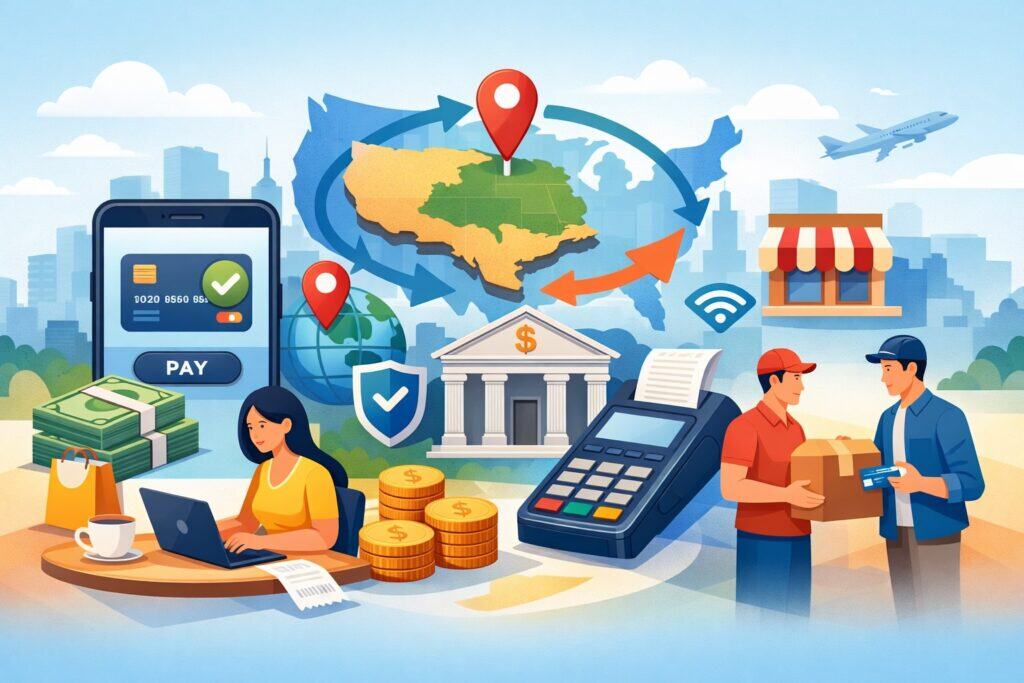
Domestic transactions are payments where the payer, payee, and the core payment rails operate under a single national framework—typically one currency, one set of banking identifiers, and one primary legal regime.
In cross-border vs domestic transactions, the domestic side tends to be more predictable because there are fewer handoffs. That predictability shows up in clearer fee structures, better tracking, and more standardized timing for settlement and returns.
Domestic transactions can still be complex, though. A domestic card payment involves authorization, clearing, and settlement across card networks, issuers, acquirers, and processors.
A domestic bank transfer can travel via ACH, wire rails, or real-time payment systems, each with different cutoffs and rules. But the biggest advantage of domestic transactions is that the data formats and compliance expectations are usually aligned because everyone is operating in the same “rules universe.”
In the domestic market, newer rails are also changing expectations. Instant payments are becoming more common, and participation has grown significantly on the real-time rail operated by the central bank, which has reported well over a thousand participating institutions and rising usage.
That growth matters when comparing cross-border vs domestic transactions, because customers begin to expect “instant” everywhere—even when cross-border complexity makes that harder.
Another domestic advantage is standardized dispute and return handling. Even when disputes are painful, the processes are typically well-defined.
That’s not always true in cross-border vs domestic transactions, where returns may depend on multiple intermediaries and where “why a payment failed” can be opaque without strong tracking tools and clean data.
What “Cross-Border” Transactions Really Mean (And Why They Cost More)
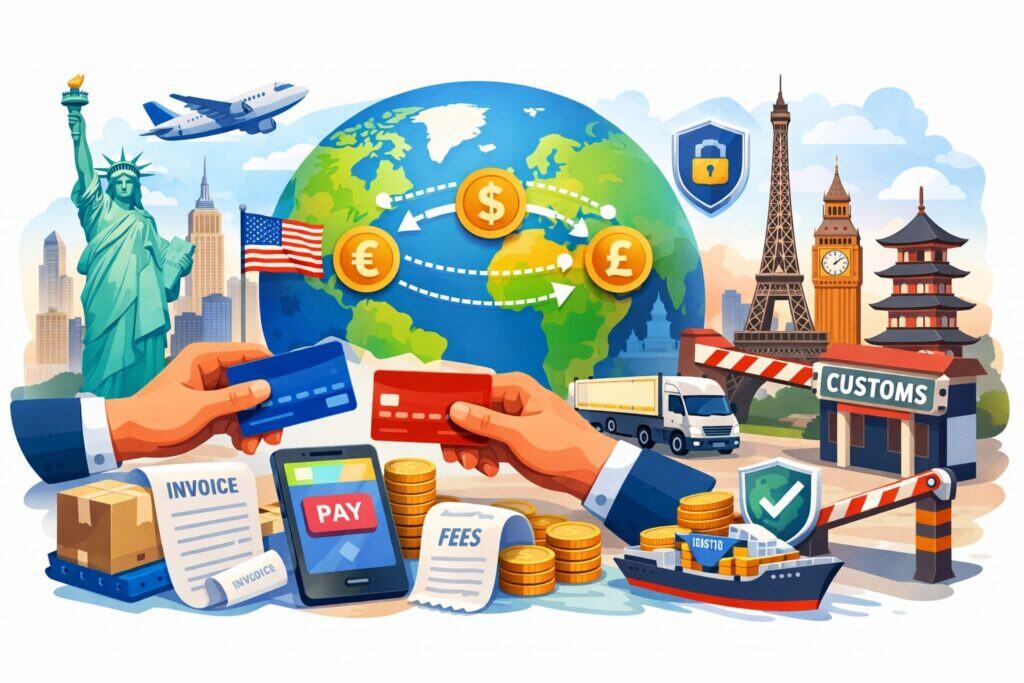
Cross-border transactions are payments where the movement of funds crosses national boundaries or touches multiple national payment infrastructures.
In cross-border vs domestic transactions, the “cross-border” label often implies at least one of these complexities: currency conversion, correspondent banking, extra sanctions/AML checks, differing bank identifiers, and additional parties who charge fees or impose cutoffs.
Even when the customer sees a simple checkout, cross-border vs domestic transactions may route very differently behind the scenes. A cross-border card payment can trigger cross-border assessment fees, different interchange dynamics, and added fraud controls.
A cross-border bank transfer may involve a chain of correspondent banks, each taking a fee and each introducing time and uncertainty. Tracking may be limited unless the corridor supports modern tracking and structured messaging.
The industry has been pushing improvements, but progress is uneven. Global policy groups have a multi-year roadmap aiming to make cross-border payments faster, cheaper, more transparent, and more accessible, with quantitative targets largely set for end-2027.
At the same time, some reporting suggests those targets are challenging to meet on schedule because real-world infrastructure changes and coordination are slow.
A key reason cross-border vs domestic transactions differ so much is data quality. Cross-border payments require richer information to manage compliance and reduce errors (names, addresses, purpose of payment, structured remittance data, and more).
That’s one reason the move to modern data standards like ISO 20022 has become central to the future of cross-border payments.
Cross-Border vs Domestic Transactions: The Full Lifecycle (Authorization to Settlement)
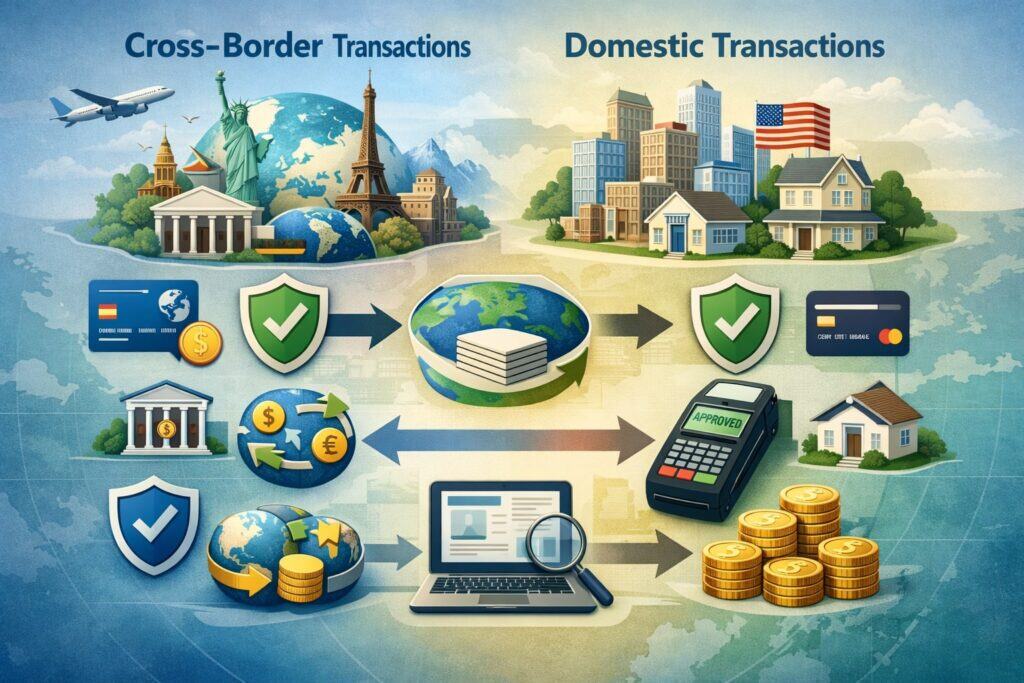
To truly understand cross-border vs domestic transactions, you need to see the full lifecycle. Most payments pass through stages—initiation, validation, screening, routing, authorization (for cards), clearing, settlement, reconciliation, and exceptions (returns/disputes).
Domestic transactions usually keep those stages within one ecosystem. Cross-border vs domestic transactions introduce additional layers at multiple steps.
- Initiation and validation: Domestic transactions often validate against standardized formats (routing + account, or tokenized card details).
In cross-border vs domestic transactions, you may need different identifiers (varied account formats, bank codes, or region-specific rules). Errors are more common when customers manually enter beneficiary details. - Screening and compliance checks: Domestic payments still require risk checks, but cross-border vs domestic transactions frequently add sanctions screening, AML monitoring, and corridor-specific controls. If there’s a strong nexus to local regulators or currency rails, screening expectations can escalate rapidly.
- Routing and intermediaries: Domestic transfers might route directly on ACH or a wire rail. In cross-border vs domestic transactions, routing may require correspondent banks, intermediary banks, or partner networks—each adding time and cost.
- Clearing and settlement: Domestic settlement can be fast and increasingly real-time in many cases, while cross-border vs domestic transactions may settle in batches, in multiple time zones, and sometimes only after FX conversion and intermediary reconciliation.
- Exceptions: Returns and investigations are usually simpler domestically. In cross-border vs domestic transactions, investigations can involve multiple institutions, missing tracking, and “fees deducted en route,” making it harder to reconcile what the recipient actually received.
This lifecycle view helps businesses choose the right rail for each use case: payroll, vendor pay, customer refunds, marketplace payouts, subscriptions, or high-value invoices. When you optimize cross-border vs domestic transactions, you’re really optimizing lifecycle risk and lifecycle cost—not just the transaction fee.
Fees and FX: Why Pricing Looks Predictable Domestically and Messy Cross-Border

One of the most visible differences in cross-border vs domestic transactions is pricing. Domestic pricing is typically anchored to known cost components: interchange (for cards), network/processing fees, or bank fees (for ACH/wire).
Cross-border vs domestic transactions add currency conversion and intermediary costs, and those costs can be “explicit” (shown upfront) or “implicit” (embedded in FX rates or deducted fees).
- FX spread and conversion timing: A cross-border payment that needs conversion will usually include an FX spread. Even when a provider advertises “low fees,” the FX spread can be the real cost center.
Cross-border vs domestic transactions are especially sensitive to when conversion happens (at authorization, at settlement, or via treasury netting). Timing changes the effective rate and affects reconciliation. - Intermediary fees and lifting fees: In correspondent banking, intermediary banks may charge fees that reduce the amount received. This is a classic frustration in cross-border vs domestic transactions because the sender expects “$X delivered,” but the recipient gets “$X minus unknown deductions.”
- Scheme and cross-border assessments (cards): Cross-border card acceptance can trigger additional scheme fees and risk controls. That can be worth it for conversion and convenience, but it makes cross-border vs domestic transactions less predictable than domestic card acceptance.
- Operational overhead: The cost of exceptions matters. If cross-border vs domestic transactions generate more returns, investigations, or manual reconciliation, the “total cost” is much higher than the per-transaction fee suggests.
Future trend: richer messaging and better interoperability are pushing toward more transparent pricing and tracking—especially as modern standards and policy roadmaps keep pressure on the ecosystem to reduce cost and increase transparency.
Speed and Settlement Times: Cutoffs, Time Zones, and Real-Time Pressure
Speed is where customer expectations collide with reality. Domestic transactions increasingly feel immediate—especially when real-time rails are available—while cross-border vs domestic transactions can still take hours to days depending on corridor, intermediaries, and compliance checks.
On the domestic side, real-time payment participation has expanded significantly, and adoption metrics show sustained growth and rising transaction volumes. That domestic acceleration sets a new baseline: customers assume “payments are instant,” and they blame merchants when funds don’t arrive quickly.
Cross-border vs domestic transactions face these common speed constraints:
- Time zones and cutoffs: Even modern systems must interact with banks that have local cutoffs.
- Intermediary handoffs: Each handoff can add delay and reduce traceability.
- Compliance holds: Sanctions/AML review can pause a payment if data is incomplete or if the name match requires investigation.
- FX processing windows: Conversion may happen in batch windows, especially for large institutions managing liquidity.
That said, the direction is clear. Global initiatives are explicitly targeting faster cross-border payments and better transparency, and ISO 20022 adoption supports richer data that can reduce compliance friction and repair rates.
For certain corridors and certain payment types, “near real-time” cross-border is becoming more achievable as networks interconnect and data standards mature.
Future prediction: expect more “real-time-like” cross-border experiences for low-to-mid value payments first (payouts, remittances, marketplace settlements), with high-value corporate flows improving more slowly due to liquidity, compliance, and risk governance requirements.
Compliance and Risk: Sanctions, AML, and Recordkeeping in Cross-Border Flows
Compliance is often the biggest operational difference in cross-border vs domestic transactions. Domestic payments can still trigger AML monitoring, but cross-border payments are more likely to be screened for sanctions exposure, higher-risk jurisdictions, and complex ownership structures.
This is not just a banking issue—it impacts fintechs, marketplaces, and any business moving money internationally through regulated rails.
Sanctions compliance is a major driver. When a payment has a regulatory nexus—especially when it touches local currency rails or regulated institutions—sanctions screening and AML controls become mandatory operational steps.
Enforcement actions and frequent sanctions list updates keep this area high risk. Cross-border vs domestic transactions therefore require stronger name screening practices, better customer due diligence, and clear escalation procedures for potential matches.
Recordkeeping is another factor. Funds transfer rules and international transmittal recordkeeping requirements exist to preserve an information trail that helps detect financial crime.
Cross-border vs domestic transactions often require more complete originator and beneficiary details, plus purpose-of-payment information in some corridors.
Standards are also evolving. Global AML standards for funds transfers (often referred to as “travel rule” expectations) have been revised in recent years to adapt to changing payment products and messaging standards, reflecting how quickly payments innovation outpaces compliance frameworks.
Operationally, the best approach is to treat compliance as “data engineering.” Cross-border vs domestic transactions succeed when your onboarding, KYC, screening, and payment message construction consistently produce clean, structured, complete data—reducing false positives, delays, and costly investigations.
Data, Messaging, and ISO 20022: The Backbone of Modern Payment Transparency
Data quality is the hidden battleground of cross-border vs domestic transactions. When payment messages are unstructured or incomplete, banks and networks can’t automate screening, routing, or exception handling.
That increases repair rates, slows settlement, and raises compliance risk. The global move toward richer, structured payment messages is one of the most important changes shaping the next decade.
ISO 20022 is a central part of that shift. It’s not just a “format change.” It enables more structured fields for parties, addresses, remittance information, and purpose codes—improving interoperability and automation.
Major payment ecosystems have been transitioning from legacy formats to ISO 20022 messages, with defined migration periods and guidance published by global messaging providers and large institutions.
Why this matters for cross-border vs domestic transactions:
- Fewer payment repairs: Better structured data reduces rejections.
- Faster compliance screening: More precise fields support better matching and lower false positives.
- Improved tracking: Richer messages support better status visibility.
- Better reconciliation: Remittance data becomes more machine-readable, lowering manual effort.
For domestic flows, ISO 20022 alignment also improves interoperability with modern rails and upgrades to financial market infrastructures. For cross-border vs domestic transactions, the biggest benefit is reducing friction between systems that historically didn’t “speak the same language.”
Future prediction: as ISO 20022 reaches deeper penetration, expect more “smart routing” and more automated compliance decisions, especially when paired with AI-assisted anomaly detection.
However, businesses will only benefit if they capture the right data upstream—garbage in still means garbage out.
Choosing the Right Rail: Cards, ACH-Like Transfers, Wires, and Real-Time Options
Businesses often compare cross-border vs domestic transactions without separating rail choice from geography. But the rail you choose can matter as much as whether the payment is cross-border. Each rail has different strengths for cost, speed, reversibility, fraud risk, and data richness.
- Cards (domestic and cross-border): Great for customer convenience and global reach, but subject to disputes and chargebacks. Cross-border vs domestic transactions on cards may face extra assessments, higher fraud scrutiny, and increased declines due to issuer risk models.
- ACH-like transfers (domestic): Typically lower cost and strong for recurring payments, payroll, and vendor pay. Domestic ACH volumes have continued to grow, and same-day capabilities have been a meaningful driver in recent reporting.
For cross-border vs domestic transactions, ACH-like systems usually don’t “extend” cleanly across borders without partner networks and conversion layers. - Wires: Strong for high-value, time-sensitive transfers, but can be expensive. Cross-border wires may involve correspondent chains and intermediary fees, adding unpredictability.
- Real-time rails: Domestic real-time options are expanding, with large participation and ongoing innovation. Cross-border vs domestic transactions may increasingly leverage interconnected real-time systems, but live cross-border interoperability is still emerging.
Future direction: policy roadmaps and innovation projects aim to connect instant payment systems across regions to improve speed and cost for cross-border payments.
Over time, businesses should expect more “real-time payout corridors,” particularly for B2C payouts, marketplaces, and contractor payments.
Fraud, Chargebacks, and Disputes: How Risk Shifts Across Borders
Fraud dynamics change substantially in cross-border vs domestic transactions. Domestic fraud controls often benefit from familiar patterns, stable identity signals, and standardized dispute procedures.
Cross-border transactions introduce more variability—new device patterns, mismatched identity signals, and higher exposure to triangulation fraud, synthetic identities, and mule activity.
For card payments, cross-border vs domestic transactions often show:
- Higher issuer declines: Issuers may apply stricter controls when location, IP, merchant country, and card issuing region don’t align.
- More “friendly fraud” disputes: Customers may not recognize international descriptors or may experience shipping delays and file disputes.
- More costly chargeback handling: Documentation may require extra proof of delivery, customs records, or cross-border return policies.
For bank transfers, fraud is different. Transfers can be exploited through business email compromise (BEC), invoice redirection, or account takeover.
Cross-border vs domestic transactions make recovery harder because funds may move through multiple jurisdictions quickly. That’s why stronger payee validation, invoice verification, and transaction monitoring are critical.
The best defense is layered: strong onboarding, sanctions/AML screening, velocity controls, device intelligence, and clear customer communication. Customer communication is underrated—many disputes happen because buyers don’t understand a timeline or descriptor. If you reduce confusion, you reduce disputes.
Future prediction: as richer messaging (ISO 20022) and real-time rails expand, fraud controls will become more data-driven and more immediate. But faster payments also reduce the time available to stop scams, so expect more emphasis on pre-transaction risk scoring and confirmation-of-payee style validation in more corridors.
Reconciliation, Returns, and Reporting: Where Operations Teams Feel the Pain
Operations is where cross-border vs domestic transactions can either scale smoothly—or become a daily firefight. Domestic reconciliation is often simpler because settlement timing is consistent and fees are predictable.
Cross-border transactions can create gaps: partial receipts due to lifting fees, delays with unclear status, and remittance data that doesn’t match invoices.
Key operational friction points in cross-border vs domestic transactions include:
- Unstructured remittance info: Hard to auto-match payments to invoices.
- Short payments: Recipient receives less than expected due to intermediary deductions.
- Status opacity: Hard to answer “where is the money?” without strong tracking.
- Returns that take longer: More parties must coordinate, and fees may not be returned.
- Regulatory reporting: Cross-border flows may trigger additional recordkeeping and audit expectations.
The fix is part process, part technology. Process: standardize invoice references, enforce data completeness, and define exception workflows. Technology: use structured payment references where available, integrate bank status reporting APIs, and unify transaction IDs across systems.
Future Outlook: Where Cross-Border vs Domestic Transactions Are Headed Next
The next few years will reshape cross-border vs domestic transactions through a combination of policy targets, messaging upgrades, and infrastructure interconnection. Global bodies are pushing measurable improvements in cost, speed, transparency, and access, with many targets set toward the end of 2027.
However, progress may not be uniform, and credible reporting has suggested timelines could slip because coordination and infrastructure modernization are difficult.
Three practical trends are likely to matter most for businesses:
- Richer data becomes mandatory, not optional. ISO 20022 adoption and related guidance will increasingly influence how banks accept and process cross-border payments. Clean, structured data will reduce delays and repairs.
- More instant-payment interconnection. Innovation initiatives are explicitly working on linking domestic instant payment systems to improve cross-border speed and reduce cost. Expect early wins in specific corridors and use cases (payouts, remittances, marketplace settlements) before universal coverage.
- Compliance automation accelerates. Sanctions enforcement and AML expectations remain intense, and recent actions underline ongoing scrutiny. AI-assisted screening and anomaly detection will expand, but only with strong governance and high-quality data.
For domestic transactions, real-time adoption and innovation will continue to raise customer expectations. That “instant norm” will keep pressuring cross-border vs domestic transactions to converge on speed and visibility, even if cost and compliance remain tougher cross-border.
FAQs
Q.1: What is the biggest difference between cross-border vs domestic transactions for a small business?
Answer: The biggest difference between cross-border vs domestic transactions is the number of systems and rules a payment touches. Domestic payments usually run inside one national framework with consistent identifiers, predictable cutoffs, and standardized exception handling.
Cross-border payments often involve multiple banking ecosystems, additional intermediaries, and sometimes currency conversion—each adding variability in cost, timing, and visibility.
For a small business, this shows up as “surprises.” A domestic transfer fee is usually known upfront. In cross-border vs domestic transactions, fees can be split across providers, embedded in FX spreads, or deducted by intermediaries.
Speed is similar: domestic transfers can be same-day or real-time depending on the rail, while cross-border may vary by corridor and compliance checks. Also, customer support can become harder cross-border because the payment status might not be fully visible without modern tracking and structured messaging.
Operationally, small businesses should focus on data quality (accurate beneficiary details, consistent invoice references) and rail selection (cards for convenience, bank transfers for predictability, specialized payout rails for certain corridors).
As global roadmap initiatives continue pushing improvements in speed and transparency, the experience should improve over time—but today, cross-border vs domestic transactions still require more operational discipline.
Q.2: Are cross-border vs domestic transactions treated differently for compliance and sanctions screening?
Answer: Yes—cross-border vs domestic transactions are commonly treated with higher compliance sensitivity because cross-border flows can introduce sanctions exposure, higher-risk jurisdictions, and complex ownership or beneficiary patterns.
Even when the amount is small, if a transaction touches regulated rails, sanctions lists, or a regulated financial institution, screening expectations can apply. Enforcement actions and frequent list updates reinforce why businesses and payment providers take this seriously.
Domestic transactions still face AML monitoring, but the risk profile is often simpler because parties are easier to verify, and fewer jurisdictions are involved. In cross-border vs domestic transactions, additional recordkeeping and information-trail expectations can come into play, especially for international funds transmittals.
The practical takeaway is that compliance isn’t just “a bank problem.” Businesses should build clean onboarding, accurate customer data, consistent naming conventions, and clear payment purpose information. Those steps reduce false positives and delays and make cross-border vs domestic transactions smoother while lowering regulatory risk.
Q.3: Why do cross-border vs domestic transactions fail or get delayed so often?
Answer: Cross-border vs domestic transactions fail or get delayed more often because there are more failure points. A domestic payment might fail due to insufficient funds or incorrect account details, but the path is usually direct.
Cross-border payments can fail due to missing or mismatched beneficiary information, intermediary bank requirements, compliance holds, FX processing windows, or cutoffs in different time zones.
Data structure is a major cause. When payment messages are incomplete or unstructured, banks may need to “repair” the payment manually or request more information. That’s why modern messaging standards like ISO 20022 matter so much—they support richer, structured fields that can reduce repairs and improve automation.
Another delay driver is compliance review. If a name resembles a sanctioned entity or a high-risk pattern triggers monitoring, the payment can be paused for investigation.
When customers say “my money is stuck,” it’s often because the system is waiting for clarification or review. The best prevention is upstream: collect complete details, standardize invoice references, and use providers with strong tracking and clear exception workflows.
Q.4: Will cross-border vs domestic transactions become “instant” in the next few years?
Answer: Some cross-border vs domestic transactions will feel close to instant in more corridors, but not all payments will be instant everywhere. Domestic real-time rails are expanding participation and innovation, raising customer expectations for speed.
Cross-border progress is advancing through two big levers: (1) richer data standards (ISO 20022) and (2) projects that connect domestic instant payment systems across regions.
However, cross-border payments still face constraints that domestic payments often don’t: compliance checks across jurisdictions, liquidity and FX handling, and legacy bank infrastructure in certain corridors.
Policy roadmaps have set ambitious targets to improve speed, cost, transparency, and access over the coming years, but credible assessments suggest timelines may be challenging.
So the most realistic expectation is “more instant experiences” for specific use cases—payouts, marketplace settlements, and remittances—while high-value and complex corporate payments improve more gradually.
Q.5: What’s the best way to lower costs in cross-border vs domestic transactions without increasing risk?
Answer: Lowering costs in cross-border vs domestic transactions is about optimizing total cost, not just provider fees. First, reduce FX leakage: compare spreads, understand when conversion happens, and consider multi-currency pricing or local settlement where appropriate.
Second, reduce exception costs: standardize data collection, enforce clean beneficiary details, and use structured remittance references. Third, choose the right rail per use case: cards for reach and conversion, bank rails for predictability, and payout networks for scale.
Risk must stay front and center. Strong KYC, sanctions screening, and monitoring are essential, especially for cross-border flows. Enforcement activity underscores that sanctions compliance is not optional.
Also, recordkeeping expectations for funds transfers and international transmittals can apply and should be designed into operations, not bolted on later.
Finally, build a feedback loop: track failure reasons, return reasons, and dispute drivers. When you know why cross-border vs domestic transactions break, you can fix root causes—improving speed and lowering operational cost at the same time.
Conclusion
Cross-border vs domestic transactions aren’t just a pricing comparison—they’re two different operational realities. Domestic payments usually offer more predictability: fewer intermediaries, cleaner data alignment, and simpler exception handling.
Cross-border vs domestic transactions become more complex when multiple banking systems, compliance expectations, and currencies intersect, creating more variability in cost, speed, and transparency.
The businesses that succeed with cross-border vs domestic transactions take three steps. First, they choose the right rails for each use case rather than forcing every payment through the same method.
Second, they engineer data quality upstream—accurate identities, structured remittance information, and consistent references—so payments can move with fewer repairs and fewer compliance delays.
Third, they build operational resilience: clear exception workflows, strong reconciliation, and proactive customer communication to reduce disputes.
The future direction is encouraging. Global roadmaps are pressuring the ecosystem toward faster, cheaper, more transparent cross-border payments, and modern data standards like ISO 20022 are a foundational upgrade. But timelines may be uneven, and cross-border vs domestic transactions will not fully converge overnight.