
By crossborderfees January 3, 2026
Cross-border commerce is no longer “enterprise-only.” Subscription brands, marketplaces, SaaS, digital services, B2B wholesalers, and even local retailers now sell to customers outside their home market—often with the same checkout, the same fulfillment stack, and the same customer-support team. That convenience is exactly why cross-border payment risks deserve a dedicated playbook.
For merchants, the biggest challenge is that cross-border transactions combine multiple risk layers at once: identity verification across different data ecosystems, inconsistent banking and card-issuer behaviors, multi-currency settlement, sanctions and AML expectations, higher dispute rates, and longer delivery timelines.
Even when everything is legitimate, operational friction (declines, delayed settlement, verification step-ups, FX volatility, and mismatched billing descriptors) can look “fraud-like” to issuers and networks—creating avoidable losses and churn.
This guide breaks down the cross-border payment risks that most directly hit merchant revenue, explains how they show up across cards, bank transfers, and alternative payment methods, and gives controls you can implement without turning checkout into an obstacle course.
It’s written for a merchant operating primarily in a domestic market, with examples and compliance references where U.S. requirements are unavoidable.
What “cross-border payment risks” really mean for merchants
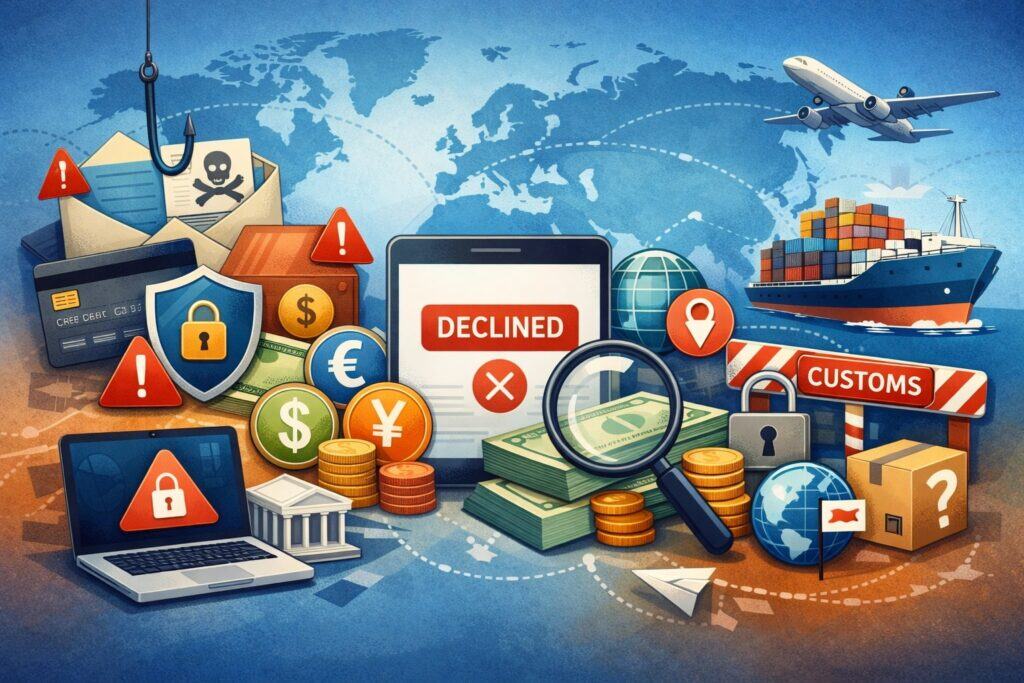
Most teams treat cross-border risk as “more fraud” or “more chargebacks,” but that’s only part of it. In practice, cross-border payment risks are any conditions unique to cross-jurisdiction selling that increase (1) unauthorized payments, (2) friendly fraud and disputes, (3) compliance exposure, or (4) preventable transaction failure.
A cross-border payment can be “cross-border” in more than one way: the card is issued abroad, the customer’s IP or device is abroad, the bank is abroad, the shipping address is abroad, or the settlement currency is different from your pricing currency.
Each variation changes how issuers score the authorization and how post-purchase disputes are evaluated. That’s why cross-border payment risks can spike even when your product and marketing stay the same—your risk model must account for new issuer behaviors and new consumer expectations.
Another overlooked driver is timing. Cross-border orders often take longer to ship, clear customs, or deliver digitally (due to verification). The longer the time between purchase and value delivery, the more likely a customer forgets, disputes, or claims “not received.”
Networks and issuers also care about your disclosure quality—billing descriptor clarity, refund policy visibility, and proof-of-delivery quality—because those details shape the dispute outcome under card rules.
Visa’s publicly available core rules emphasize merchant agreement requirements, transaction processing standards, and data requirements that become more critical when transactions cross regions.
If you want a simple mental model: cross-border payment risks are the compound effect of distance (delivery + support), data gaps (identity signals), and differing rules (legal + network). Treat them as a system—not a single fraud setting.
Regulatory and sanctions compliance risk
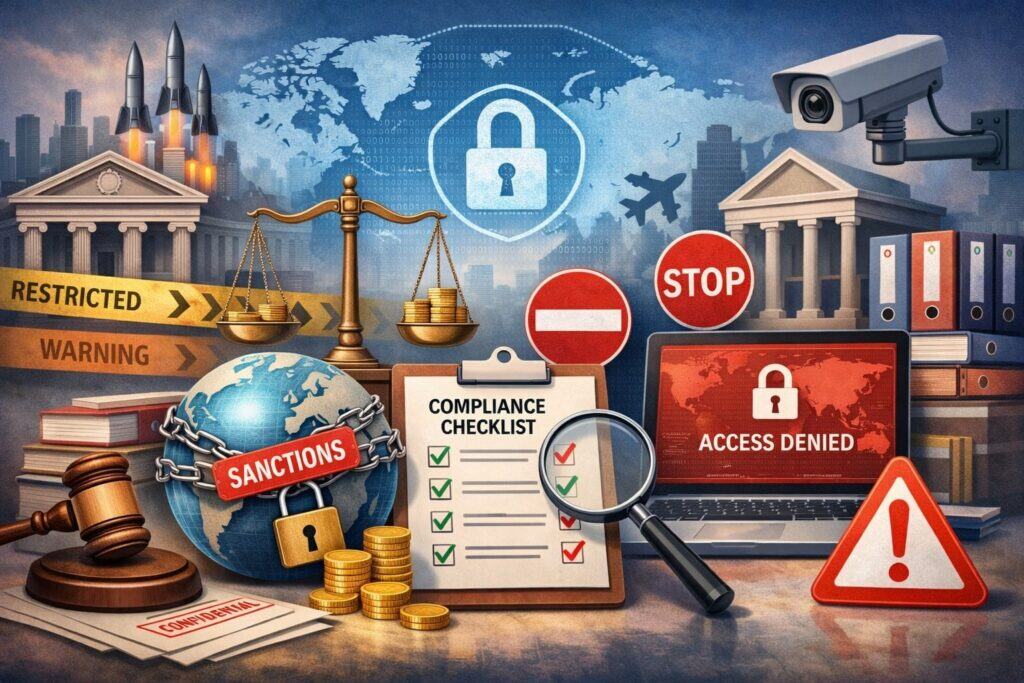
For many merchants, the most intimidating cross-border payment risks live in the compliance bucket—especially sanctions screening and restricted-party exposure.
Even if you’re not a bank, you can still face account freezes, payout holds, or termination if your processor or acquiring bank determines you’ve facilitated prohibited transactions. That can happen through direct sales into restricted regions, sales to blocked parties, or even “indirect” risk such as third-party resellers and marketplace sellers.
A practical baseline is to align your controls with how sanctions regulators expect organizations to behave. Treasury’s Office of Foreign Assets Control (OFAC) publishes a formal framework describing the core elements of a sanctions compliance program: management commitment, risk assessment, internal controls, testing/auditing, and training.
Merchants don’t need to copy a bank’s program, but your processor may expect you to show these elements in proportion to your risk.
This is where operational reality matters. If you sell digital goods, you may never see shipping documents that help prove a destination. If you sell physical goods, reshippers and freight forwarders can obscure the true end user.
If you sell B2B, you’ll face more entity-level complexity (subsidiaries, beneficial owners, and procurement cards). The correct control is rarely “block everything international.” It’s: screen customer and business identifiers when risk is elevated, keep strong logs, and implement escalation rules that pause fulfillment until reviewed.
Also note recordkeeping expectations can change. In 2025, OFAC finalized a rule extending certain recordkeeping requirements from five to ten years, which increases the time horizon you (and your partners) may need to retain compliance evidence.
Even if the rule targets regulated entities, merchants often feel the downstream effect through processor policies and audit requests.
If you want fewer surprises, treat sanctions and restricted-party risk as one of the core cross-border payment risks and build a repeatable “review lane” that’s fast, documented, and consistent.
AML, illicit finance, and high-risk counterparty exposure

Cross-border selling increases exposure to money laundering typologies: synthetic identities, mule accounts, triangulation fraud, and refund abuse routed through multiple jurisdictions.
A merchant might think, “I’m not a financial institution,” but payment intermediaries still expect you to reduce exposure because your behavior affects their own AML obligations.
One reason this risk keeps rising is that cross-border commerce produces “thin-file” customers: fewer reliable identity signals, different address formats, inconsistent phone verification, and less shared fraud intelligence across regions.
Fraud actors exploit that. They also exploit the “refund layer”—for example, placing a legitimate-looking order, then pushing you to refund to a different instrument or to split refunds across methods.
This is where policy discipline reduces cross-border payment risks quickly:
- Refund-to-original-instrument as the default, with exceptions tightly controlled.
- Name matching between the payer instrument and the customer profile when risk is high.
- Velocity controls on first-time cross-border buyers (attempts, cards, emails, devices).
- Escalation for orders involving freight forwarders, high resale items, or unusual rush shipping.
If you do B2B cross-border, corporate transparency and ownership questions can appear. Regulatory approaches evolve over time and can be affected by litigation and rule updates, so merchants should avoid “one-and-done” assumptions and instead use periodic reviews of their processor’s compliance requirements and any applicable Treasury/FinCEN guidance.
For example, reporting rules under the Corporate Transparency Act have been subject to legal and administrative changes and uncertainty, which affects how businesses think about beneficial ownership verification in vendor onboarding.
The goal isn’t to turn your business into a compliance department. The goal is to prevent the most common illicit-finance pathways that become disproportionately likely in cross-border transactions—another reason cross-border payment risks need their own controls.
FX risk, currency conversion, and pricing integrity

Foreign exchange can quietly become one of the most expensive cross-border payment risks because it impacts margins, dispute rates, and customer satisfaction at the same time. The risk shows up in three main ways:
- Margin erosion: If you price in one currency but settle in another, your effective revenue can swing between authorization and settlement. Add refunds, partial shipments, and chargebacks, and your realized FX rate can drift from what finance expects.
- Customer confusion: Customers dispute more when the amount posted doesn’t match what they remember. This happens when currency conversion is unclear, when a dynamic currency conversion experience is confusing, or when taxes/duties aren’t communicated.
- Refund mismatch: Refunds processed after FX movement can look “wrong” to the customer, even when the local-currency refund is correct. That confusion can trigger disputes—especially for digital and subscription products.
To reduce these cross-border payment risks, decide (a) what currency you present at checkout, (b) what currency you capture/settle, and (c) how you disclose conversion.
For many merchants, the simplest approach is “price and settle in the customer’s currency” for top markets and “price in your domestic currency with clear disclosure” elsewhere. But whichever you choose, consistency matters more than cleverness.
Also watch for operational FX leakage in your stack: separate FX handling across your gateway, processor, subscription platform, and ERP can cause reconciliation gaps. Those gaps delay refunds, which increases disputes, which increases chargeback monitoring pressure—turning a finance problem into a payments risk problem.
FX isn’t as flashy as fraud, but it’s a core driver of cross-border payment risks because it silently changes customer expectations and your unit economics.
Authorization risk: higher declines, issuer friction, and false positives
A major reason cross-border revenue underperforms is not fraud—it’s failure to get approved. Cross-border transactions are more likely to be declined due to issuer risk models, unfamiliar merchant patterns, or missing local authentication expectations.
The merchant experiences this as “mystery declines,” but it’s a predictable category of cross-border payment risks.
Common authorization pain points include:
- Issuer distrust of cross-border merchant locations (especially for first-time buyers).
- AVS and address formatting mismatches that create false signals.
- Step-up authentication expectations (e.g., stronger customer verification in some regions).
- Descriptor mismatch (brand name vs legal entity) that increases issuer suspicion.
- Time zone anomalies (purchase at “odd hours” relative to cardholder behavior).
The fix is part data, part routing, part customer experience. You reduce cross-border payment risks by increasing your “good friction” signals (accurate customer data, device intelligence, consistent descriptors) and decreasing avoidable “bad friction” (over-aggressive rules that block legitimate buyers).
Tactically, merchants often see lift from:
- Using network tokenization where available.
- Optimizing soft descriptor and statement descriptor clarity.
- Capturing customer email/phone in a consistent, validated format.
- Retrying soft declines with adjusted parameters (without spamming issuers).
- Local acquiring or smart routing for top corridors (when volume supports it).
This isn’t just theoretical—industry survey work highlights that merchants continue to report fraud pressure and payment friction as top concerns, and those pressures often intensify as you expand internationally.
Declines are one of the most immediate cross-border payment risks because they hit conversion instantly. Treat authorization optimization as revenue protection, not just “payments ops.”
Fraud risk: card-not-present attacks, account takeover, and triangulation
Fraud is the most visible category of cross-border payment risks, but merchants sometimes defend the wrong layer. They focus only on card testing and stolen cards, while cross-border growth increasingly attracts blended attacks:
- Account takeover (ATO): Fraudsters compromise a legitimate customer account, then place cross-border orders that look “trusted” because the account history is real.
- Triangulation fraud: Fraudsters use stolen payment credentials to buy goods sold through a fake storefront, shipping to the real buyer while the real merchant takes the loss.
- Synthetic identity building: Fraudsters create identities that pass basic checks, then scale up transaction size once approved.
Cross-border amplifies these because identity verification signals are weaker and because shipping logistics create more opportunities to reroute. That’s why cross-border payment risks demand layered defense:
- Pre-authorization controls: device fingerprinting, velocity, BIN intelligence, IP risk.
- Authorization controls: 3DS strategy where appropriate, risk-based step-ups.
- Post-authorization controls: fulfillment holds for high-risk orders, address verification, customer confirmation.
- Post-purchase controls: refund discipline, return verification, dispute prevention.
Use “risk segmentation” rather than global strictness. For example, let returning customers flow smoothly while applying tighter controls for first-time cross-border orders, high-value carts, or mismatched signals (IP vs shipping region). This keeps conversion healthy while reducing cross-border payment risks where they actually cluster.
Fraud pressure remains a top merchant concern in current industry reporting, reinforcing that fraud tactics evolve and merchants must continuously tune defenses rather than “set and forget.”
Chargebacks and disputes: friendly fraud, delivery friction, and rule pressure
Chargebacks are often where cross-border payment risks become financially painful, because they combine lost revenue, fees, operational time, and sometimes monitoring program exposure.
Cross-border disputes trend higher for several reasons: longer delivery times, customs delays, language barriers in customer support, and weaker recognition of a foreign merchant on a bank statement.
The “friendly fraud” pattern is especially relevant. A customer may recognize the purchase but still dispute it because they forgot, didn’t understand the descriptor, didn’t expect FX differences, or found the refund process too slow. Cross-border increases all those triggers.
Merchants should also be aware that network rules and dispute ecosystems evolve. Visa publishes updated core rules and product/service rules regularly, and these rules define evidence standards, timelines, and processing requirements that affect dispute outcomes.
If your evidence package doesn’t match what the network expects (proof of delivery, cancellation policy acceptance, usage logs for digital goods, etc.), you can lose disputes even when you’re “right.”
Practical dispute reduction controls that lower cross-border payment risks include:
- Ultra-clear billing descriptor and support contact (email + phone where feasible).
- Localized order confirmation with a simple “manage order” link.
- Proactive shipment tracking notifications (and delivery confirmation capture).
- Fast refunds when you decide to refund—speed reduces disputes more than generosity.
- Compelling evidence templates tailored by product type (physical vs digital vs subscription).
Chargeback environment commentary from payments analysts continues to stress that dispute volumes and behaviors aren’t simply reverting to “old normal,” which is a signal merchants should build dispute resilience into cross-border expansion plans.
Data privacy, security, and cross-border data transfer risk
Many merchants underestimate how much cross-border payment risks include data handling. Selling across borders typically means collecting more customer information and sharing that information with more parties (gateways, fraud tools, logistics partners, tax engines). Each handoff expands your breach surface area and your compliance complexity.
From a merchant perspective, the biggest risks are:
- Over-collection: gathering data you don’t truly need increases breach impact and regulatory exposure.
- Fragmentation: different tools store different versions of truth, making incident response difficult.
- Vendor risk: a weak link in your fraud or customer support stack can expose sensitive data.
- Cross-border transfers: moving data between regions may trigger extra contractual and compliance obligations depending on where your customers are located.
Even without naming every regulation, the operational principle is consistent: minimize sensitive data, tokenize where possible, restrict access, and log everything. Payment data should be handled through PCI-aligned providers.
Customer identity and risk data should be retained only as long as necessary to manage cross-border payment risks (fraud, disputes, and compliance), then safely deleted.
You can also reduce risk by designing your verification flows to avoid storing raw identity documents unless absolutely necessary. If you must store them, encrypt at rest, separate keys, apply strict retention windows, and ensure audit logs are immutable.
Data risk doesn’t show up as a “decline” or “chargeback” on day one, but when it hits, it hits hard—making it one of the most asymmetric cross-border payment risks merchants face.
Tax, duties, and landed-cost disputes
A huge source of cross-border customer dissatisfaction is surprise cost: import duties, taxes, brokerage fees, and delays. Those surprises frequently turn into “item not received,” “not as described,” or “unauthorized” disputes—especially when the customer feels they were not told the full cost.
That’s why landed-cost clarity is one of the most effective ways to reduce cross-border payment risks. Even if you can’t calculate exact duties for every destination, you can set expectations:
- Explain whether duties/taxes are included or collected on delivery.
- Provide an estimated range for common destinations.
- Offer Delivered Duty Paid (DDP) options where feasible for top markets.
- Put duty/tax terms in the checkout flow, not buried in a footer.
Operationally, you also need a clean workflow for returns and refused deliveries. A refused delivery often produces a double loss: you lose the sale and you risk a chargeback if the customer believes the merchant “didn’t deliver.”
If you can intercept shipments, document attempted delivery, and process refunds promptly upon return confirmation, you reduce cross-border payment risks significantly.
This category is also where customer support becomes a payment control. Fast, clear responses reduce disputes. Clear policies reduce “policy-based” disputes. If your cross-border support is slow or only in one language, disputes become the customer’s fastest path to resolution—which is exactly what you don’t want.
Settlement, payout holds, and processor dependency risk
Merchants often discover a hidden class of cross-border payment risks only after scaling: settlement delays, reserve increases, rolling holds, and sudden underwriting reviews. Cross-border volume changes your risk profile in the eyes of acquirers and processors because it correlates with higher fraud and dispute rates in many verticals.
The risk here is not just “cash flow inconvenience.” It can become existential if payroll, inventory, or ad spend depends on timely payouts. Typical triggers include:
- A spike in cross-border sales percentage
- High average ticket sizes from new geographies
- Increased refund rates due to delivery friction
- Dispute ratios rising above program thresholds
- Higher fraud tooling step-ups creating support complaints and refunds
To reduce these cross-border payment risks, build an early-warning dashboard that tracks: approval rate by corridor, refund rate by corridor, dispute rate by corridor, and time-to-delivery. Then align your underwriting story with your controls: show how you verify customers, manage shipping, handle returns, and prevent disputes.
Also maintain redundancy where possible: alternative payment methods, backup gateways, and clear contingency plans. Even if you never switch, having options reduces the operational risk of being locked into one provider during a cross-border incident.
Practical risk framework merchants can implement now
The best cross-border program is not “strict.” It’s adaptive. Below is a merchant-friendly framework that directly reduces cross-border payment risks without crushing conversion.
1) Segment your cross-border traffic: Create tiers: (A) returning customers, (B) first-time buyers from low-risk regions, (C) first-time buyers from higher-risk regions, (D) high-ticket or reshipper patterns. Apply different controls by tier.
2) Build a “golden data set” for orders: For each order, capture: device, IP region, BIN country/region, shipping country/region, customer history, delivery estimate, and policy acceptance signals. This makes disputes and reviews faster and improves model tuning.
3) Use friction strategically: Instead of blanket 3DS or blanket blocks, step up only when multiple risk signals stack. Good friction reduces cross-border payment risks; bad friction pushes good customers away and trains issuers to distrust you.
4) Make refunds fast and disciplined: Refund-to-original instrument, clear timelines, and automated status updates reduce friendly fraud.
5) Operationalize compliance: Adopt a simple, documented sanctions/AML workflow aligned to the risk-based program concepts OFAC emphasizes (risk assessment, internal controls, testing, training).
This framework turns cross-border payment risks into manageable processes rather than constant firefighting.
Future prediction: how cross-border payment risks may evolve
The next wave of cross-border commerce will likely be shaped by three forces: stronger authentication expectations, richer payment data, and faster settlement rails. Each force changes cross-border payment risks—sometimes lowering one risk while raising another.
Richer transaction data and commercial data programs
Card networks are encouraging more enhanced data (particularly in commercial transactions). Programs that push richer Level 2/Level 3 data can improve transparency and reconciliation, but they also raise the bar on data quality and processing consistency. Merchants with messy billing data may see more friction until they clean it up.
Rule and evidence tightening
Publicly available network rules continue to be updated, and dispute outcomes increasingly favor merchants who can produce precise, policy-consistent evidence quickly. If your cross-border operations don’t store the right artifacts (delivery confirmation, digital access logs, policy acceptance, customer communications), your dispute win rate can lag.
Sanctions and geopolitical volatility
Sanctions lists and enforcement priorities shift, sometimes rapidly, which means cross-border compliance screening must remain current. Recent sanctions-related actions and updates underscore that enforcement and list changes are a living system, not a static checklist.
AI-driven fraud and AI-driven defense
Fraudsters will continue to automate identity attacks and refund abuse, while merchants adopt better anomaly detection and identity graphing. The merchants who win will be those who treat cross-border payment risks as a measurable system—approval rate, fraud rate, refund rate, dispute rate—then iterate weekly.
FAQs
Q.1: What are the biggest cross-border payment risks for merchants?
Answer: The biggest cross-border payment risks typically fall into five buckets: (1) higher fraud and account takeover, (2) higher disputes due to delivery timing and customer confusion, (3) compliance exposure related to sanctions and restricted parties, (4) FX-related margin and refund confusion, and (5) authorization friction that lowers approval rates.
Merchants feel these risks as lost conversion, higher fees, and unpredictable cash flow from reserves or payout holds.
To prioritize, start with what is most measurable: approval rate by region, dispute rate by region, and refund rate by region. Then map each metric to controls—risk-based step-ups, descriptor improvements, faster refunds, better shipping visibility, and a simple compliance review lane aligned to risk-based expectations like those described in OFAC’s compliance framework.
Q.2: How can merchants reduce cross-border payment risks without hurting conversion?
Answer: Reducing cross-border payment risks without harming conversion requires segmentation and selective friction. Keep checkout smooth for returning customers and low-risk corridors, while stepping up verification for first-time buyers, high-value carts, or mismatched signals (device/IP/shipping).
Use clear descriptors, fast customer support, and proactive delivery notifications to prevent disputes.
Operationally, reduce false positives by validating address formats, normalizing phone numbers, and avoiding rigid rules that block legitimate international customers. The best approach is continuous tuning: review weekly performance by corridor and adjust rules where losses cluster.
Q.3: Do merchants need sanctions screening for cross-border transactions?
Answer: If you sell cross-border or have cross-border customers, sanctions exposure becomes one of the most serious cross-border payment risks. Many merchants rely on their processor’s controls, but you still need internal policies that prevent avoidable violations and help you respond to reviews.
A practical approach is to screen higher-risk transactions and maintain logs of decisions, consistent with the core compliance program elements OFAC describes (risk assessment, internal controls, testing, training).
Even lightweight controls—like blocking shipments to restricted destinations and reviewing suspicious customer identifiers—can prevent account holds and terminations.
Q.4: Why are cross-border chargebacks so hard to win?
Answer: Cross-border disputes are harder because of longer delivery timelines, language barriers, customs delays, and weaker customer recognition of foreign merchants on statements.
Evidence standards also matter: networks expect specific artifacts and timely submission. Visa’s publicly available rules outline processing standards and requirements that influence dispute handling, which means merchants must tailor evidence to the transaction type (physical delivery proof vs digital usage logs).
To improve win rates, standardize evidence packs, capture policy acceptance at checkout, and store delivery confirmations and customer communications in a searchable system.
Q.5: How should merchants handle FX to reduce cross-border payment risks?
Answer: FX becomes one of the sneakiest cross-border payment risks when customers see a posted amount that doesn’t match what they expected or when refunds look “incorrect” due to rate movement.
To reduce issues, keep currency presentation consistent, disclose conversion clearly, and set expectations about refunds being processed in the original transaction currency (with issuer-side conversion behavior).
Also reconcile FX across your gateway, processor, and accounting system so refunds don’t lag—because slow refunds drive disputes.
Conclusion
Cross-border growth is a revenue multiplier—but only if you treat cross-border payment risks as a core business system rather than a one-time payments setup. The merchants who succeed don’t merely “block risky orders.”
They build a layered approach: improve authorization success, reduce fraud with smart segmentation, prevent disputes with clarity and speed, and operationalize compliance so reviews don’t become crises.
Start by measuring what matters by corridor: approval rate, fraud rate, refund rate, dispute rate, and delivery time. Then apply controls where losses cluster: risk-based step-ups, stronger descriptors, refund discipline, better shipping transparency, and a documented sanctions/AML workflow aligned with risk-based expectations.
Keep your program current as rules and enforcement expectations evolve, referencing primary sources like OFAC’s compliance framework and the card networks’ published rules when necessary.