
By crossborderfees January 3, 2026
If you sell online, serve travelers, or bill clients who live outside your home market, cross-border fees can quietly turn a “normal” card sale into a higher-cost transaction.
And because Cross Border Fees often show up as a blend of network assessments, issuer pricing, currency handling, and processor markup, many businesses don’t notice them until margins feel tighter than expected.
This guide breaks down what Cross Border Fees are, what triggers them, how they appear on statements, and how to reduce them without breaking the customer experience. You’ll also learn how pricing models affect your visibility into cross border fees, what to monitor monthly, and where the next few years may take international card acceptance.
What Cross Border Fees Really Are (and Why They Exist)
At a practical level, Cross Border Fees are additional charges that can apply when a card payment involves more than one “country code” in the card ecosystem—typically when the card is issued in a different country than the merchant’s acquiring relationship.
In other words, even if your checkout looks local and the customer is physically nearby, the “home” of the card (issuer) and the “home” of your acquiring setup can differ—activating Cross Border Fees.
Card networks and banks justify cross border fees as compensation for added complexity: extra routing logic, cross-region settlement, foreign exchange exposure, regional compliance requirements, and higher fraud risk patterns that often correlate with cross-border commerce.
Industry explainers also note that cross-border card costs can reflect a mix of network charges and bank/processor pricing layers, not a single fee line.
It’s also important to understand what cross border fees are not. They aren’t automatically the same as “currency conversion.” A purchase can be in your settlement currency but still be cross-border if the issuer is overseas.
Conversely, a domestic-issued card can still trigger currency-related charges if you price in a foreign currency or use certain conversion features. That’s why merchants who want to control Cross Border Fees need to evaluate both geography (issuer vs. acquirer location) and currency (transaction and settlement currency).
Ultimately, cross-border fees are best treated as a predictable cost category you can measure, forecast, and optimize—rather than a mysterious penalty you have to accept.
How a Card Payment Moves Across Borders (Where Cross Border Fees Get Added)
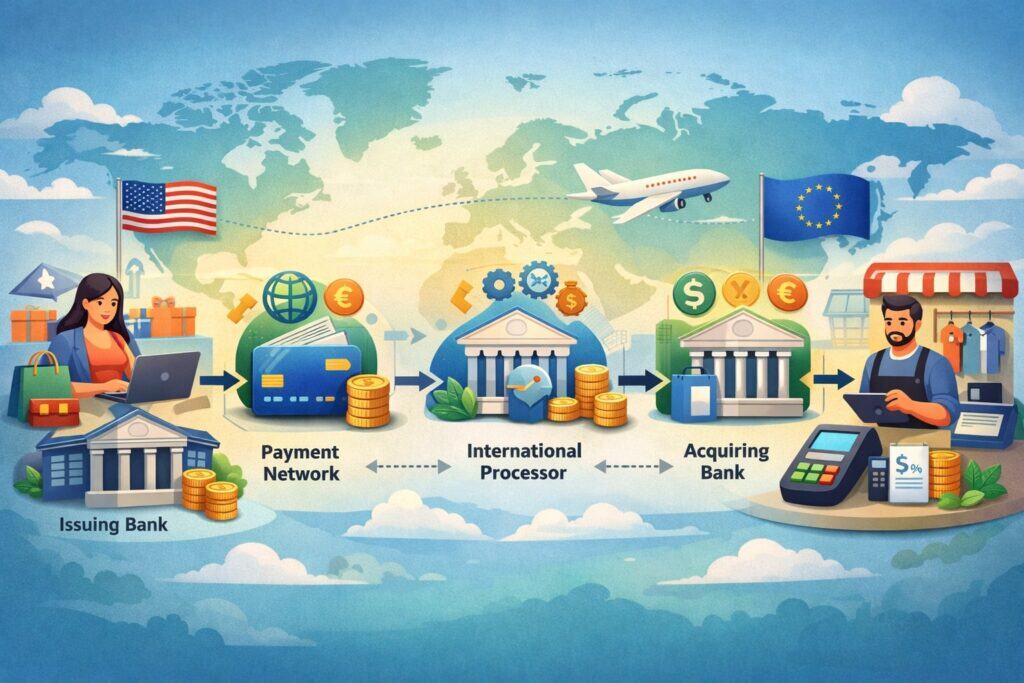
To manage cross border fees, you need to see the full path of a card transaction. Most cross-border card payments follow the same major steps as domestic payments, but with additional decision points and pricing rules.
Authorization: The “Yes/No” Decision Adds Risk Signals
When a customer pays, your payment gateway or terminal sends an authorization request to your acquirer (or payment facilitator). The request is routed through the card network to the issuing bank.
In cross-border scenarios, the network may apply different risk models, regional rules, and data requirements before the issuer responds. Higher fraud exposure in cross-border commerce is one reason cross border fees exist as a surcharge layer in the ecosystem.
Clearing: The Transaction Gets Categorized for Pricing
After approval, the transaction “clears,” and the card ecosystem assigns categories that influence pricing: card type, acceptance method (card-present vs. card-not-present), merchant category, and importantly, whether the transaction is treated as cross-border.
This is where cross border fees begin to crystallize into specific assessment and pricing components, because the network can confirm issuer region vs. merchant/acquirer region.
Settlement: Currency and Region Drive Additional Costs
Finally, settlement occurs—funds move from the issuer side through the network to the acquirer and into your merchant account. If currencies differ, additional FX-related costs can apply.
Even if currencies don’t differ, cross border fees can still be charged based on geographic mismatch rules. Some network documentation explicitly describes cross-border assessment logic tied to differing country codes between merchant and cardholder.
Seeing these phases helps you diagnose where cross border fees are coming from: risk and authorization behavior, cross-border classification during clearing, and currency/region handling during settlement.
The Building Blocks Behind Cross Border Fees

Most merchants experience Cross Border Fees as a combined effect of several fee families. When you separate them, you gain levers for reducing the total.
Interchange: Issuer Pricing That Can Rise on International Transactions
Interchange is paid to the issuing bank and varies based on card type, acceptance method, merchant category, and more. While interchange isn’t always labeled “cross-border,” international attributes can push a transaction into different (often higher) interchange categories.
Central bank and network fee schedule resources show how interchange structures are detailed and category-driven, which is why cross-border acceptance often changes the effective rate even before network assessments are added.
Optimization tip: If your international sales are mostly e-commerce, improving authentication, AVS quality, and fraud controls can sometimes shift approval patterns and reduce cost leakage tied to downgrades that amplify the pain of cross-border fees.
Network Assessments: The “Card Brand” Charges Often Driving Cross Border Fees
Network assessments are fees charged by the card networks (often as basis points on volume). Many merchants first encounter cross border fees here—because networks can apply extra assessments on cross-border or cross-region transactions.
For example, network materials describe cross-border assessments applying when merchant and cardholder country codes differ.
These network layers are a big reason cross border fees can feel unavoidable. But you can sometimes reduce them by changing where the transaction is acquired (local vs. offshore acquiring) or how it is routed (multi-acquirer strategy).
Processor Markup: The Part You Can Negotiate Most Directly
Your processor (or payment facilitator) adds markup, which can be bundled, tiered, or pass-through. In many setups, cross border fees are passed through plus a handling markup (sometimes called “international surcharge,” “cross-border markup,” or similar).
If your pricing model hides pass-through costs, you may not realize how much of your “rate” is actually driven by cross-border fees versus your processor’s margin.
FX and Conversion Costs: The Currency Side of Cross Border Fees
FX-related costs include network currency conversion assessments, issuer FX spreads, and optional services like dynamic currency conversion (DCC). You can have cross border fees without FX, and FX without cross-border—so treat them as separate line items to manage.
When you price in multiple currencies, focus on transparency and control over exchange spreads so you don’t accidentally add “customer pain” on top of your own cross-border fees burden.
What Triggers Cross Border Fees (The Most Common Real-World Scenarios)

Merchants often assume cross border fees only happen when they ship internationally. In reality, triggers are based on how the card networks and banks classify geography and acquiring setup.
Issuer Country ≠ Acquirer/Merchant Country
The classic trigger: the customer’s card is issued in a different country than where your merchant account (or acquirer) is based. Industry definitions describe cross-border assessment fees as network surcharges tied to issuer geography differing from the merchant’s acquiring bank.
This can happen even if:
- The transaction is online and the customer is “traveling”
- The shipping address is domestic
- The billing address looks domestic
- The currency is the same as your settlement currency
That’s why tracking cross border fees by issuer region (not just shipping destination) is essential.
Online-First Businesses and Subscription Billing
Digital goods, SaaS, and subscriptions frequently generate cross-border fees because customers sign up from many regions, and cards are issued globally. Subscriptions also magnify cost because the fees recur every billing cycle.
If you have high renewal volume, even small differences in cross border fees can materially change monthly gross margin.
Marketplaces and Platforms (Payment Facilitation Complexity)
Platforms may trigger cross-border fees through where the platform is boarded, how sub-merchants are domiciled, and how funds flows are structured.
If you run a marketplace, you can face cross border fees in both directions: customer payments and payouts to sellers. While this article focuses on card acceptance, remember that overall cross-border cost control often requires looking beyond card rails.
Currency Choices and “Helpful” Conversion Features
If you present prices in multiple currencies, you may improve conversion rates—but you can also add conversion layers that increase total cross-border fees and FX costs. The goal is to align currency strategy with acquiring strategy so you don’t pay extra assessments while also absorbing higher conversion expenses.
Network and Brand Fees: Understanding the “Assessment” Layer of Cross Border Fees
Network assessment fees are some of the most consistent components of cross border fees, and they often have their own naming conventions.
Mastercard Cross-Border Assessments (How They’re Framed)
Mastercard network documents describe an “Acquirer Cross-Border Assessment” that applies when merchant and cardholder country codes differ. This matters because it emphasizes that cross border fees can be driven by classification logic—rather than shipping, fulfillment, or where your business operates day-to-day.
From a merchant perspective, the key takeaway is not memorizing one rate. The real win is understanding that Mastercard cross-border assessments:
- Are volume-based (basis points on transactions)
- Depend on region/country code mismatch
- Can stack with other assessments depending on currency and program rules
Visa International Assessments (Commonly Discussed as ISA)
Visa’s cross-border network charges are commonly discussed in merchant-facing resources as an “International Service Assessment” concept for transactions involving a domestic merchant and a foreign issuer. In statements, these may appear as ISA-like line items or be embedded within pass-through fee categories depending on your processor.
For merchants, the practical implication is that cross-border fees can show up even when interchange looks “normal,” because network assessments sit outside interchange. That’s why pass-through pricing and statement clarity matter.
Amex/Discover and Other Network-Style Adders
Other networks can have international or inbound fees that function similarly to cross border fees—often assessed as a surcharge on volume for cards issued outside your home market. Some processor documents list inbound international surcharges as separate adders.
If you accept multiple brands, you should monitor cross-border fees by brand and by region, because the cost stack can differ significantly across networks.
How Cross Border Fees Show Up on Processing Statements (and Why Merchants Miss Them)
A major reason merchants feel blindsided by cross border fees is that statements rarely present them in a single, clean line. Instead, you might see:
- “International assessment”
- “Cross-border assessment”
- “International service assessment”
- “Foreign handling”
- “Network fees”
- “Currency conversion assessment”
- A generic “other fees” bucket
If you’re on bundled or tiered pricing, cross-border fees may be baked into your overall qualified/mid-qualified/non-qualified buckets. That makes forecasting hard because the rate you pay changes with the sales mix.
If you’re on interchange-plus, you’ll usually see interchange pass-through plus separate network assessments and processor markup. Interchange-plus does not automatically reduce cross border fees, but it can make them visible—so you can take targeted action.
To stop guessing, build a monthly review habit:
- Pull a brand-level summary (Visa/Mastercard/Amex/Discover).
- Filter fees that mention international/cross-border.
- Divide those fees by your cross-border sales volume (not total volume).
- Track the trend line for cross-border fees over at least 3 months.
This simple discipline turns cross border fees from an annoyance into a measurable KPI you can optimize.
Managing Cross-Border Fees Without Killing Conversion Rates
Reducing cross border fees isn’t just a finance exercise. The wrong changes can lower approval rates, increase customer friction, or trigger more chargebacks. The best strategies balance cost, authorization performance, and customer experience.
Use Local Acquiring or Multi-Acquirer Routing When Volume Justifies It
If you sell meaningfully into a region, local acquiring can sometimes reduce the portion of cross-border fees driven by issuer/acquirer mismatch.
You’re essentially meeting the card ecosystem closer to the customer’s “home” market. The tradeoff is operational: additional entities, onboarding, tax/legal considerations, and more complex reconciliation.
A middle ground is multi-acquirer routing through a provider that supports region-aware processing. Done well, this can lower cross border fees while improving approvals. Done poorly, it can increase declines if routing rules misfire.
Optimize Authentication for Cross-Border Card-Not-Present Sales
For online international sales, smarter authentication can reduce fraud and improve issuer confidence, which can improve approvals and reduce expensive downstream events (chargebacks, manual review).
While authentication doesn’t remove network cross border fees, it can lower the total cost of acceptance by reducing avoidable losses that often cluster in cross-border transactions.
Align Your Currency Strategy With Your Cost Strategy
If you price only in your settlement currency, customers may face issuer FX fees—potentially hurting conversion. If you offer multi-currency, you may take on more FX complexity. The goal is to choose a currency approach that:
- Improves checkout clarity
- Avoids unnecessary conversion layers
- Keeps cross-border fees and FX costs predictable
Avoid adding “helpful” conversion tools unless you fully understand the fee stack they introduce.
Tighten Fraud Controls Without Over-Blocking Good Customers
Because cross-border commerce can carry higher fraud risk, it’s tempting to block entire regions. That often backfires: legitimate customers get declined, and you lose profitable growth.
Instead, use signals like device reputation, velocity rules, and address verification patterns to reduce fraud while keeping approvals strong—so cross border fees don’t become a tax on growth.
Negotiating and Structuring Your Processing Agreement to Control Cross Border Fees
Even when you can’t eliminate network-imposed cross-border fees, you can often reduce the avoidable portion: processor markup, unnecessary surcharges, and hidden pricing structures.
Favor Transparent Pricing Where Possible
Interchange-plus (or pass-through) pricing can make cross border fees easier to identify and manage. The goal isn’t “cheapest-looking headline rate.” The goal is lower total cost once a cross-border mix is included.
Ask for These Specific Disclosures
When evaluating providers, request clarity on:
- How cross-border classification is determined (issuer vs. acquirer region logic)
- Whether network assessments are passed through at cost
- Any additional processor “international” markup layered on top of network cross-border fees
- Whether currency conversion assessments apply and under what conditions
- How refunds and chargebacks are treated on cross-border transactions
This is where many merchants unknowingly pay cross-border fees twice: once through network assessments and again through processor “international” add-ons.
Monitor Rule and Pricing Changes
Card fee schedules and network rules change periodically, which can shift cross-border fees even if your business doesn’t change. Recent reporting also highlights ongoing merchant-network disputes and potential rule adjustments affecting overall card acceptance costs.
You don’t need to become a free historian. But you do want a quarterly check-in so you can spot creeping cross border fees before they erode profitability.
Compliance, Risk, and Chargebacks: The Hidden Costs That Travel With Cross-Border Fees
Many businesses focus narrowly on cross border fees as percentages. But cross-border acceptance also changes your risk profile—and risk costs can dwarf the fees if unmanaged.
Higher Dispute Exposure and “Friendly Fraud” Patterns
Cross-border card-not-present transactions can face more disputes because customers may not recognize a merchant descriptor, shipping times are longer, and support expectations vary.
Each chargeback has direct costs (fees, lost revenue) and indirect costs (monitoring programs, higher reserve requirements). Even if cross border fees were zero, disputes could still make cross-border sales unprofitable without strong operational controls.
Sanctions and Restricted Commerce Screening
Cross-border payments intersect with sanctions and restricted-party considerations. Most merchants won’t touch high-risk categories, but even mainstream businesses can accidentally process orders that trigger compliance holds.
Payment partners may price higher when your cross-border footprint raises compliance workload—effectively increasing your all-in cost alongside cross-border fees.
Data Quality Requirements
Issuer approvals are sensitive to data quality. For cross-border e-commerce, accurate address data, consistent customer identifiers, and clear descriptors can improve approval rates. Higher approvals mean you spread unavoidable cross border fees over more successful transactions—reducing “wasted” processing attempts.
Future Predictions: Where Cross Border Fees Are Headed Next
No one can predict every fee change, but several trends are likely to reshape how merchants experience cross-border fees over the next few years.
More Pressure on Card Costs and Network Rules
Merchant pressure on card pricing remains a headline issue, and recent settlement reporting suggests continuing focus on interchange and acceptance rules. While these developments may not directly target cross border fees, changes to network rules, routing flexibility, and fee structures can influence international acceptance economics.
Smarter Routing and “Localization” Becoming Standard
As payment orchestration tools mature, more businesses will treat cross-border acceptance as a routing problem: choose the best acquirer, currency, and authentication path per transaction. This won’t eliminate network cross-border fees entirely, but it should make them more controllable and easier to forecast.
Tokenization and Real-Time Risk Scoring Reducing Loss Costs
Tokenization, network identity signals, and AI-driven fraud scoring are improving. If issuers gain confidence, approval rates may improve for legitimate cross-border buyers. That helps merchants because approvals and fraud losses are often the biggest swing factors in profitability—sometimes bigger than cross border fees themselves.
More Consumer Sensitivity to FX and “Surprise Costs”
Shoppers are getting more aware of hidden conversion costs. Merchants who present transparent pricing—while optimizing cross-border fees behind the scenes—will likely outperform those who rely on confusing conversion methods that create distrust at checkout.
The best “future-proof” move is building measurement: track cross-border fees separately, monitor approval rates by region, and treat international cost as an optimization loop, not a one-time setup.
FAQs
Q.1: What is the difference between cross-border fees and currency conversion fees?
Answer: Cross-border fees are primarily triggered by geography—most commonly when the customer’s card issuer is in a different country than the merchant’s acquiring setup. Currency conversion fees are triggered by currency—when a transaction is converted from one currency to another somewhere in the payment flow.
A transaction can be cross-border without currency conversion (same settlement currency, different issuer country), and it can involve currency conversion without being cross-border (for example, if a customer pays in a foreign currency but the card issuer and merchant acquiring setup are in the same country).
The reason this distinction matters is that the levers are different. To manage cross-border fees, you focus on acquiring strategy, routing, and how transactions are classified by issuer and merchant country codes.
To manage currency conversion fees, you focus on currency presentation, settlement choices, and avoiding unnecessary conversion layers.
Many businesses lose margin because they assume all “international” costs are the same bucket, when in reality cross-border fees and FX costs can stack in unpredictable ways if you don’t separate them in reporting.
If your statement lumps these together, ask your provider for a breakdown by fee type and brand. That one change often reveals quick wins in cross-border fees control.
Q.2: Do cross-border fees apply to online transactions even if I only sell domestically?
Answer: Yes. Cross-border fees can apply even when you believe you “only sell domestically,” because they are usually tied to where the card was issued versus where your acquiring relationship is based.
A customer might be visiting, might have a foreign-issued card, or might be using an international card for a domestic shipping address. Definitions of cross-border assessment fees emphasize issuer/acquirer geography mismatch rather than shipping destination.
This is common in metro areas, tourist-heavy regions, higher-education communities, and any online store with global traffic. Subscriptions are especially exposed: a customer can sign up while living abroad and keep paying for months, generating recurring cross-border fees.
To confirm whether this is happening, compare your “issuer country” analytics (often available in gateway dashboards) with your order destinations.
If issuer geography is more global than shipping geography, you’re almost certainly paying cross-border fees. Once confirmed, you can decide whether the volume is high enough to justify strategies like multi-acquirer routing or localized acquiring.
Q.3: How can I estimate cross-border fees before expanding internationally?
Answer: Start by forecasting in layers instead of guessing a single “international rate.” A practical estimation approach looks like this:
- Expected cross-border share of volume: What percent of transactions will come from foreign-issued cards?
- Brand mix: What percent is Visa vs. Mastercard vs. other brands?
- Acceptance method: How much is card-not-present vs. card-present?
- Fee layers: Interchange impact + network assessments + processor markup + FX costs (if applicable)
Network assessments are a major driver, and some network documentation describes cross-border assessments applying based on country code mismatch between merchant and cardholder.
Use that as the conceptual basis: if your acquiring setup remains domestic and issuer geography expands, cross-border fees will grow.
Then stress-test your forecast using conservative assumptions: higher decline rates, a slightly higher dispute rate, and a little more fraud screening cost. The biggest forecasting mistake is underestimating the operational cost that often comes with cross-border growth—then blaming cross-border fees alone when margins disappoint.
Q.4: Can I pass cross-border fees to customers?
Answer: Sometimes—but you need to be careful. There are a few customer-facing approaches:
- Transparent pricing: Build expected cross-border fees into your pricing strategy for international segments rather than adding surprise fees at checkout.
- Service or handling fees: In some industries, merchants add a clearly disclosed handling fee for international fulfillment. This is more aligned with logistics than card costs.
- Surcharging: Rules vary by card brand and by local regulation. Even where allowed, poor execution can hurt conversion and brand trust.
The most sustainable approach is often not a direct pass-through of cross-border fees, but a pricing model that accounts for higher payment costs while keeping checkout simple.
Customers are increasingly sensitive to unexpected “payment method penalties,” especially when currency conversion is involved. If you do introduce any checkout fee, disclose it early and clearly, and test conversion rates to ensure the cure isn’t worse than the problem.
In many cases, it’s better to reduce cross-border fees on the backend (routing, acquiring strategy, negotiation) than to risk churn by pushing the cost directly onto customers.
Q.5: Why did my cross-border fees increase even though my sales stayed the same?
Answer: This happens more often than merchants expect. Common reasons include:
- Sales mix shift: Same revenue, but more cards issued abroad (even if orders look similar).
- Brand mix shift: More volume on a brand that has higher assessment adders for cross-border.
- More card-not-present volume: e-commerce growth can shift transaction categories that combine with cross-border fees to raise the effective rate.
- Provider changes: Processor markup adjustments or new “international handling” adders.
- Network rule updates: Periodic changes to fees and rules can move the assessment layer even if you don’t change anything.
Recent reporting highlights ongoing pressure and changes around card fee structures and merchant-network rules. While that coverage focuses heavily on broader swipe fees, it reflects a reality: the ecosystem evolves, and merchants should monitor it.
The fix is measurement. Track cross-border fees as a separate KPI from your domestic processing costs, and review it monthly. Once you identify whether the increase is driven by issuer geography, provider markup, or network assessments, you can take targeted action.
Q.6: What is the best long-term strategy to reduce cross-border fees for growing businesses?
Answer: The best long-term strategy is a “three-part system”:
- Visibility: Ensure you can clearly see cross-border fees by brand, issuer region, and currency. If your pricing model hides pass-through costs, consider moving to a structure that makes international costs transparent.
- Optimization: Use the right combination of authentication, fraud tools, and routing rules to protect approvals and reduce loss. Improved approvals can offset the pain of cross-border fees by increasing successful capture of legitimate demand.
- Localization: As cross-border volume grows, selectively localize acquiring and settlement where it makes financial sense. You don’t need to localize everywhere—only where volume and margins justify the added complexity.
This strategy scales because it doesn’t depend on guessing future rate changes. Even if network assessments evolve, you’ll have the analytics to see it quickly and the operational tools to respond.
In the coming years, smarter routing and orchestration are likely to make cross-border fees more manageable for mid-sized businesses—so building the system now sets you up to benefit as tools improve.
Conclusion
Cross-border fees don’t have to be a mystery cost that silently grows with your international demand. When you understand the drivers—issuer geography, network assessments, currency handling, and provider markup—you gain practical control.
Start by separating cross-border fees from other processing costs in your reporting. Then optimize what you can: statement transparency, negotiation of processor add-ons, fraud controls that protect approvals, and (when volume supports it) regional acquiring or smart routing strategies.
Definitions and network documentation make clear that many cross-border assessments are triggered by geographic mismatch logic, so your acquiring setup and routing choices matter as much as your marketing strategy.