By crossborderfees March 1, 2026
If you accept card payments from customers who live abroad (or who use cards issued abroad), you’ve probably seen “extra” line items that don’t look like interchange or your usual processing markup.
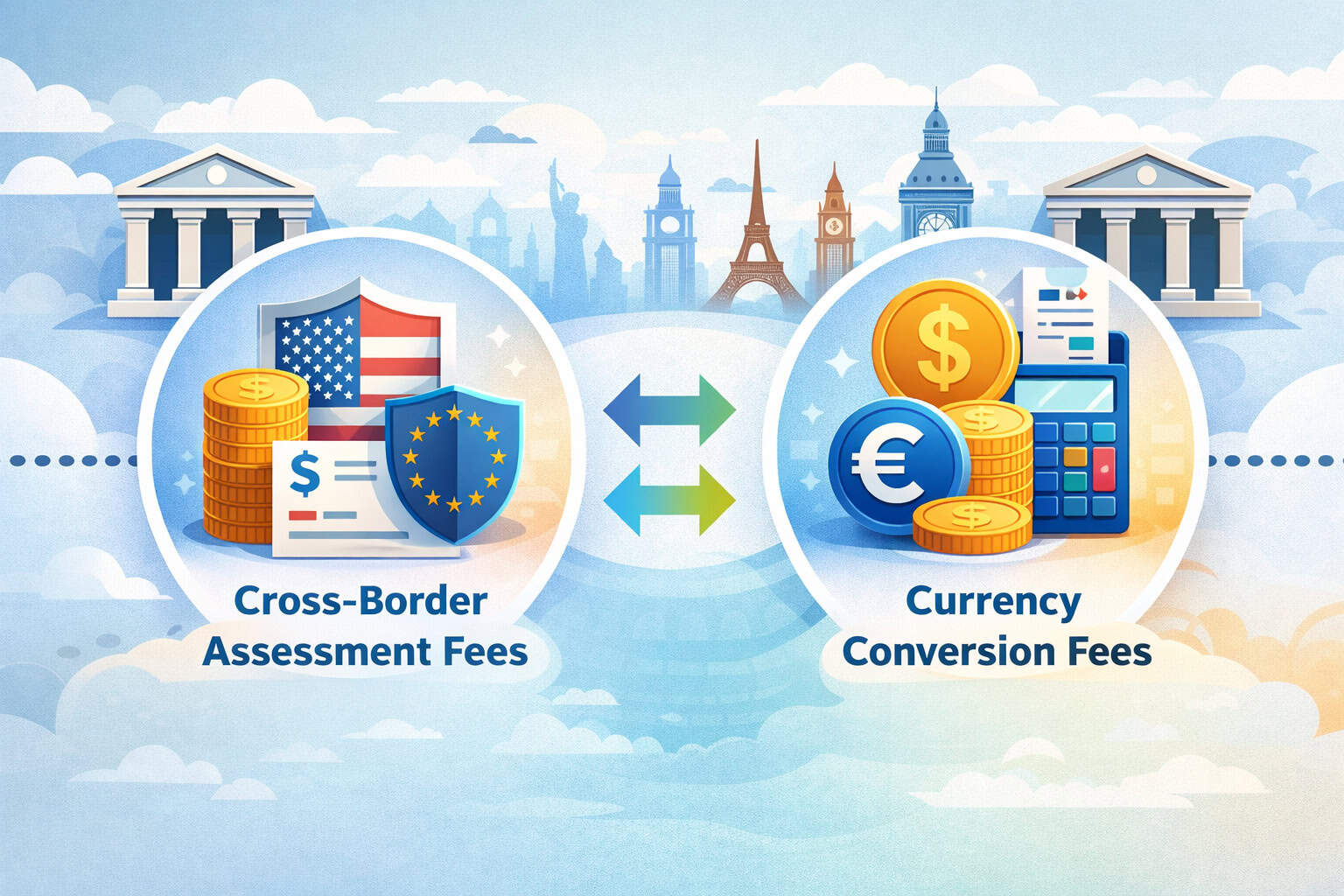
The two most commonly confused categories are cross-border assessment fees (a card-network assessment triggered by “issuer location vs merchant/acquirer location” logic) and currency conversion fees (the cost of converting from one currency to another, typically driven by the conversion rate and any applied markup/spread).
This guide explains cross-border assessment fees vs currency conversion fees in plain English, using current card-network terminology and a merchant-statement lens.
We’ll also show where these charges appear, what triggers them, how the payment flow determines timing, and what to ask your processor so you can reconcile international activity without guesswork.
For dynamic currency conversion (DCC) and multi-currency setups, we’ll call out compliance-oriented best practices based on card-network guidance.
The core idea: “Cross-border” is about who’s where; “conversion” is about which currency is used
When an international card transaction happens, two independent questions decide most of the “extra fees”:
- Are the issuer and the merchant/acquirer in different regions?
Answer: If yes, card networks may assess cross-border / international service assessments (a type of card network assessment passed through your acquirer/processor). Mastercard explicitly describes an acquirer cross-border assessment based on differing merchant and cardholder country codes. - Is currency conversion required somewhere in the chain?
Answer: If yes, someone is converting currency (issuer, acquirer/processor, or a DCC provider). The “currency conversion fee” you perceive is usually the combination of (a) the exchange rate applied and (b) any FX markup/spread or explicit conversion fee charged by the entity performing conversion.
Networks also publish guidance describing DCC as a service that converts from merchant currency to cardholder billing currency in real time and is subject to network rules.
Because these questions are independent, you can see:
- a cross-border assessment without conversion (transaction billed and settled in the same currency), or
- conversion without a cross-border assessment (rare, but possible in multi-currency or special acquiring setups), or
- both together (common for international ecommerce).
Definitions (and who charges what)
What cross-border assessment fees are (card-network assessments passed through your acquirer)
Cross-border assessment fees are card-network assessment charges that apply when a transaction is considered “international” by network rules—most commonly when the issuer location differs from the merchant/acquirer location.
They are not interchangeable and are not your processor’s discretionary fee, even though they usually appear on your processor statement.
Networks publish these assessments in their fee schedules. Mastercard describes an Acquirer Cross-Border Assessment that applies when merchant and cardholder country codes differ.
Visa similarly publishes acquiring assessment schedules that include additional international acquiring assessments for cards issued outside the merchant’s acquiring region.
Operationally, these are:
- Assessed by the card network (brand/scheme)
- Billed to the acquirer/processor
- Passed through to you as a statement line item (often grouped under “assessments,” “network fees,” or “pass-through fees”)
Cross-border assessments can vary by:
- brand/network
- card type and product
- how the transaction is classified (presentment currency, processing region, channel, etc.)
Importantly, cross-border fees can apply even if the customer pays in your pricing currency. Why? Because the trigger is usually the issuer vs merchant/acquirer location, not whether a currency conversion happened.
What currency conversion fees are (FX cost + markup/spread, charged by whoever converts)
Currency conversion fees are not a single universal line item set by card networks. They describe the cost of converting one currency into another. That cost can show up in different places depending on who performs the conversion:
- Issuer-side conversion: The cardholder is billed in one currency, and the issuer converts to the cardholder’s billing currency when posting the transaction.
The issuer may also add a foreign transaction fee (issuer fee) or combine it into one “international transaction fee.” Consumer-facing issuer guidance commonly distinguishes foreign transaction fees from conversion costs. - Acquirer/processor conversion: You present/settle in a different currency than your pricing currency, and your processor converts (often visible as an FX rate difference or a separate “FX” line item).
- Dynamic Currency Conversion (DCC): The conversion happens at checkout so the customer sees and pays in their billing currency. Network guidance describes DCC as real-time conversion governed by network rules and associated disclosures/requirements.
In practice, the “currency conversion fee” is usually:
- not a network assessment
- not interchange
- mostly the effect of FX markup/spread over a reference rate, sometimes plus explicit per-transaction conversion charges (depending on provider and contract)
Where foreign transaction fees fit (issuer fee vs merchant-side fees)
A foreign transaction fee is most commonly an issuer fee charged to the cardholder, not the merchant. Issuers may apply it when:
- The transaction is deemed international, and/or
- The transaction involves currency conversion, depending on issuer policy.
Many issuer explanations treat “foreign transaction fee” as a cardholder statement charge that may be separate from conversion impacts.
For merchants, the closest “analog” is not the issuer’s foreign transaction fee—it’s the cross-border assessment and other network/acquirer international assessments that appear on the merchant statement. Those are different charges, triggered and billed differently.
Fee glossary: what it’s called, who charges it, when it triggers, where it shows up
Below is a practical glossary you can hand to finance/ops teams doing statement reviews. Labels vary by processor, but the “who/when/where” logic stays consistent.
| Term (common label) | Who charges it | When it triggers | Where it shows up |
|---|---|---|---|
| Cross-border assessment / International service assessment / Cross-border fee | Card network → billed to acquirer → passed to merchant | Issuer location differs from merchant/acquirer location under network rules | Merchant statement (assessments/pass-through/network fees) |
| International acquiring assessment (brand-specific naming varies) | Card network → acquirer → merchant | International card classification; may vary by presentment currency and processing region | Merchant statement (assessments/network fees) |
| Currency conversion fee / FX fee / FX markup | Entity performing conversion (issuer, acquirer/processor, DCC provider) | Currency conversion is performed and a markup/spread or fee applies | Cardholder statement (issuer conversion/fees) and/or merchant settlement reports (processor FX) |
| Foreign transaction fee (issuer fee) | Issuer | Transaction classified as international and/or involves conversion per issuer policy | Cardholder statement |
| Dynamic Currency Conversion (DCC) | DCC provider/acquirer (service governed by network rules) | Customer chooses to pay in billing currency at checkout | Cardholder receipt shows billing currency; merchant statement may show DCC-related pricing/fees |
| Assessments / pass-through fees (umbrella label) | Network fees passed through by acquirer/processor | Applies when network fee events occur (assessments, access fees, etc.) | Merchant statement sections labeled “pass-through,” “network,” or “assessments” |
| Interchange (high-level) | Issuer (paid by acquirer on merchant’s behalf) | Most card transactions; varies by card type, channel, data, etc. | Merchant pricing breakdown; may be bundled depending on plan |
Where these fees show up on statements (merchant vs cardholder) and why labels vary
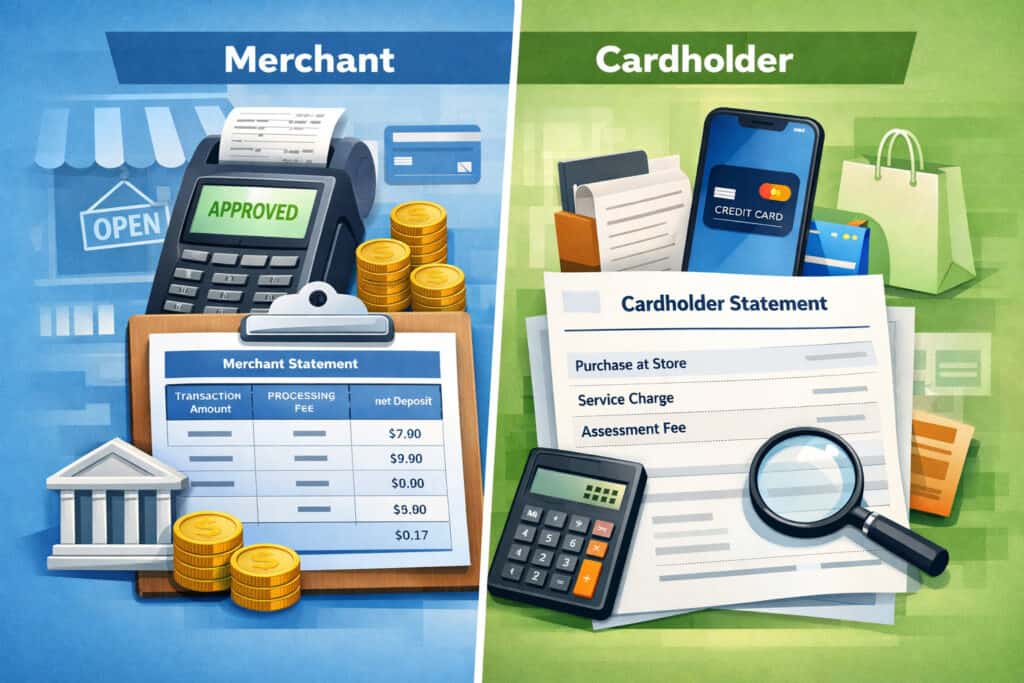
Merchant statements: why cross-border assessments look like “mystery add-ons”
On the merchant side, you typically receive a monthly statement (or daily settlement report) that includes:
- your processing markup (what your provider earns), plus
- pass-through costs like interchange and network assessments, plus
- other fees tied to specific message types or compliance programs.
Many acquirers explicitly describe “pass-through fees” as regulated by the payment card networks and subject to change by those networks. That’s why these items can appear as separate line items even when your “rate” looks unchanged.
Common statement labels for cross-border/network assessments include:
- “International Service Assessment” / “ISA”
- “Cross Border Assessment”
- “International Acquirer Assessment”
- “Network Assessments”
- “Card Brand Fees”
The same underlying fee may show differently depending on:
- whether your processor aggregates fees by brand
- whether they present per-transaction detail vs monthly totals
- whether they label by network program name vs internal code
Currency conversion-related charges, if you settle in multiple currencies or use a processor FX service, often appear in:
- settlement summaries (net funds by currency)
- FX rate reports (applied rate vs reference)
- separate “FX markup” or “conversion” lines
In other words: cross-border is often a clean line item; conversion often hides inside the rate and settlement math unless your provider makes it explicit.
Cardholder statements: why customers see “foreign transaction fee” even when you don’t
Cardholders may see:
- the converted amount in their billing currency
- a separate foreign transaction fee line item (issuer fee)
- sometimes a combined “international transaction fee”
Issuer-facing explanations commonly differentiate these concepts, and the key point for merchants is: the issuer’s fee is not your merchant fee.
If you use DCC, the cardholder may see:
- a billed amount already in their billing currency, plus
- disclosures on the receipt/checkout flow describing the conversion choice and rate, as required by network rules and DCC program guidance.
What triggers each fee (and why “same currency” doesn’t mean “no international fees”)

Cross-border triggers: issuer vs merchant/acquirer location mismatch
Cross-border assessments generally trigger when the network determines the issuer and merchant/acquirer are in different regions. Mastercard’s acquirer cross-border assessment description is explicit about differing merchant and cardholder country codes.
Practical triggers you’ll see in the wild:
- Customer uses a card issued abroad on your site
- Merchant account acquired in one region, but cardholder issued elsewhere
- Some setups classify “international” at clearing/presentment, even if authorization looked normal
Currency conversion triggers: settlement currency vs billing currency mismatch
Currency conversion occurs when:
- the transaction is authorized/presented in one currency, but
- either the cardholder billing currency or the merchant settlement currency is different, and
- someone must convert.
This is where terms matter:
- Cardholder billing currency: what the issuer ultimately bills the customer in
- Presentment currency: the currency used in clearing/presentment (what gets sent through network clearing)
- Settlement currency: the currency your acquirer settles to you (what hits your payout)
If you price in one currency but settle in another, conversion may occur on the merchant side. If you price in a foreign currency but settle in your home currency, you’ve created an FX event. If you use multi-currency pricing, you can create multiple FX paths depending on customer choice and routing.
DCC triggers: conversion at checkout with active cardholder choice
Dynamic Currency Conversion (DCC) is different because it:
- converts at checkout from merchant currency to cardholder billing currency in real time, and
- is governed by network rules and program guidance, including how it must be offered and disclosed.
DCC is not simply “doing FX.” It’s a structured program with compliance expectations:
- the cardholder must be able to choose
- the receipt/checkout must show required rate and currency details (exact disclosure requirements depend on program/rules)
Cross-border vs currency conversion: side-by-side comparison (merchant lens)
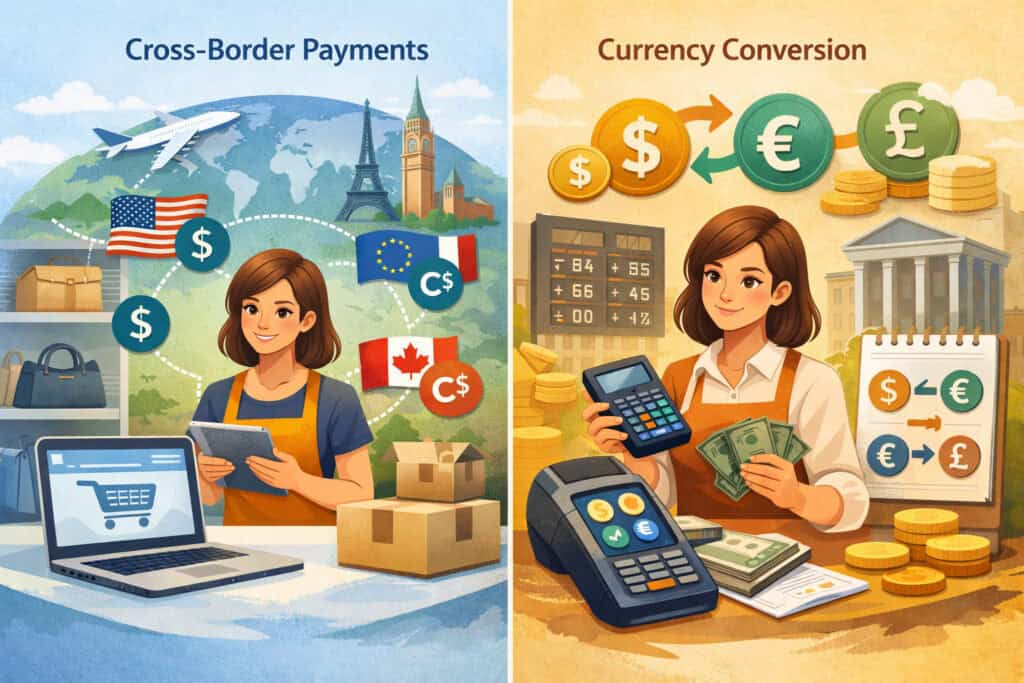
| Category | Cross-border assessment fees | Currency conversion fees |
|---|---|---|
| What it is | Network assessment for international classification | Cost of converting between currencies (rate + markup/spread and/or fee) |
| Primary driver | Issuer location vs merchant/acquirer location mismatch | Billing/settlement/presentment currency mismatch (someone converts) |
| Who sets it | Card network fee schedule | Issuer, acquirer/processor, or DCC provider contract + FX markets |
| Who pays (typical) | Merchant (passed through by acquirer) | Cardholder (issuer conversion/fees) and/or merchant (processor FX) |
| Where it appears | Merchant statement as “assessments/pass-through/network fees” | Often embedded in applied FX rate; may also appear as explicit FX fee line |
| Can it apply without FX? | Yes | No (by definition) |
| Is it “foreign transaction fee”? | No (different charge) | Sometimes related on cardholder side; issuer may call it foreign transaction fee |
| DCC relationship | DCC can still be cross-border depending on issuer vs merchant/acquirer locations | DCC is a conversion method governed by network rules |
How the payment flows (authorization → clearing/presentment → settlement) and where fees attach
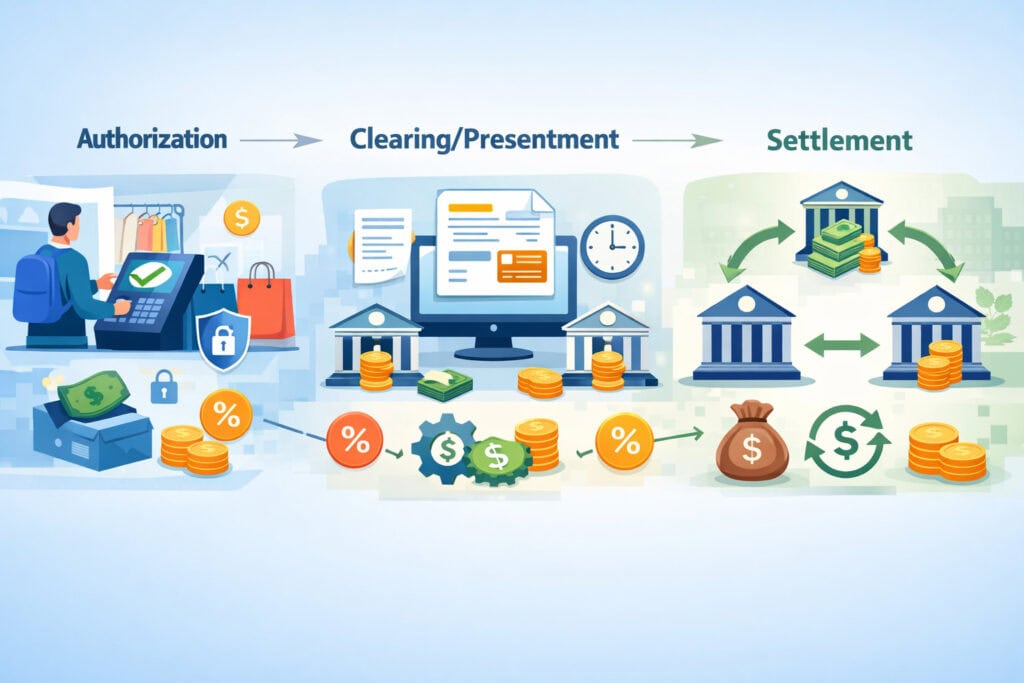
Understanding when each system knows what is crucial. International fee confusion usually happens because authorization happens fast with limited final details, while clearing/presentment and settlement determine final classification and amounts.
Step 1: Authorization (fast “can I approve?” decision)
During authorization:
- the customer submits payment details
- your gateway/acquirer sends an authorization request through the network
- issuer approves/declines
At this stage, you may not see:
- final clearing amount
- final presentment currency decisions (especially if multi-currency logic exists)
- how the network will classify the transaction for certain assessments
For ecommerce, authorization data quality matters (AVS, CVV, 3DS where applicable), but cross-border assessments typically aren’t “decided” solely by those risk signals. Instead, the transaction’s issuer/merchant region relationship and clearing attributes drive the eventual assessments.
Step 2: Clearing / presentment (the “what actually happened” message)
In clearing/presentment:
- the final transaction details are submitted for clearing
- presentment currency is established
- the network calculates certain assessments based on clearing attributes
This is where cross-border assessments most reliably attach, because the network has the necessary attributes to apply fee schedule logic.
If conversion is happening:
- issuer-side conversion happens when the issuer posts the transaction to the cardholder (based on issuer timing and applied rates), or
- merchant-side conversion happens when your acquirer/processor converts settlement totals.
DCC is distinct because the conversion is performed earlier (at checkout), but the transaction still proceeds through clearing with defined currency fields and required indicators governed by network DCC rules and guidance.
Step 3: Settlement (money movement and merchant statement math)
Settlement is when:
- funds move from issuer → network → acquirer → you
- your payout currency is finalized
- your statement aggregates interchange, assessments, and any processor fees
Acquirers often disclose that network pass-through fees may change and are billed as they occur.
This is why you might see:
- a cross-border assessment total by brand for the month
- FX settlement adjustments
- chargeback/dispute fees that look unrelated but are tied to international volumes
Common scenarios and which fees apply (quick “if this, then that” mapping)
| Scenario | What the customer sees at checkout | Currency conversion occurs? | Cross-border assessment likely? | Other common fees |
|---|---|---|---|---|
| Card issued abroad; you charge in your pricing currency | Customer pays in your pricing currency | Maybe (issuer converts to billing currency if different) | Yes, often (issuer vs merchant/acquirer mismatch) | Cardholder may see issuer foreign transaction fee |
| Card issued abroad; you charge in foreign currency | Customer pays in foreign currency | Yes (either issuer conversion or customer billing differs) | Yes, often | FX spread + possible issuer fee; merchant may see FX if settlement differs |
| Multi-currency pricing (customer chooses currency) | Customer selects currency at checkout | Depends on choice and settlement setup | Depends on issuer vs merchant/acquirer | FX spread varies; reporting complexity increases |
| DCC offered and accepted | Customer pays in billing currency shown by DCC | Yes (DCC provider converts) | Often still yes (international classification can remain) | DCC program pricing; compliance requirements |
| Customer card billed in your currency but issuer is abroad | Customer pays in your currency | Possibly none on cardholder side if billing currency matches | Yes, can still apply | Cross-border appears on merchant statement even “no FX” |
| Refund on an international transaction | Refund in original currency path | FX may reverse at a different rate/time | Cross-border may or may not reverse depending on network/acquirer handling | Reconciliation and fee reversals vary by contract |
Worked examples (using a $100 equivalent purchase) with ranges/placeholders—not fake rates
These examples show how to do the math without inventing fee rates. Use your processor’s network fee report and FX applied-rate report to plug in the actual values.
Example 1: Card issued abroad, charged in your pricing currency (customer billed in a different currency)
- Purchase amount at checkout: 100.00 (your pricing currency)
- Presentment currency: your pricing currency
- Settlement currency to you: your pricing currency (no merchant-side FX)
What fees can apply:
- Cross-border assessment on merchant statement:
- Calculation: 100.00 × [Network Cross-Border Assessment %]
- Cardholder conversion: issuer converts 100.00 into billing currency using issuer-applied rate (timing matters).
- Applied amount: 100.00 × [Issuer Applied FX Rate]
- Cardholder foreign transaction fee (issuer fee) may apply:
- Calculation: Converted Amount × [Issuer FTF %]
Where confusion happens: You see a cross-border line item even though you “did no conversion.” That’s normal because cross-border is about issuer vs merchant/acquirer location mismatch, not whether FX happened.
Example 2: Card issued abroad, charged in a foreign currency, you settle in your pricing currency (merchant-side FX)
- Checkout: customer pays 100.00 (foreign currency)
- Settlement: you receive payout in your pricing currency
What fees can apply:
- Cross-border assessment (likely): 100.00 × [Network Cross-Border %] (applied on assessable volume as defined in your network fee schedule/report)
- Merchant-side FX spread/markup:
- Reference: 100.00 × [Mid-Market Rate] = 100.00_equiv
- Applied settlement: 100.00 × [Processor Applied Rate] = 100.00_settled_equiv
- FX impact: 100.00_settled_equiv − 100.00_equiv (this is the “hidden fee” if not itemized)
What the cardholder sees: They may see the original foreign-currency amount (or a conversion if their billing currency differs) plus any issuer foreign transaction fee depending on issuer policy.
Where confusion happens: Ops teams often attribute the payout shortfall to “cross-border,” when the bigger driver is sometimes the FX applied rate and timing.
Example 3: Card issued abroad, charged in your pricing currency, but you use multi-currency settlement
- Checkout: 100.00 (your pricing currency
- Settlement: acquirer settles international cards into a different currency bucket (multi-currency settlement)
Possible outcomes:
- You see merchant-side conversion during settlement, even though checkout currency looks “domestic.”
- You may also see cross-border assessments because issuer vs merchant/acquirer mismatch still exists.
How to calculate FX impact:
- 100.00 × [Settlement Conversion Rate]
- FX impact depends on the reference rate you compare against and whether your provider discloses the spread.
Example 4: DCC offered and accepted (customer pays in billing currency at checkout)
- Checkout: customer sees 100.00 equivalent shown in their billing currency via DCC
- Conversion: performed at checkout by DCC provider; governed by network rules and program guidance
Fees/impacts:
- DCC includes an FX rate that may differ from a reference rate (the difference is the FX markup/spread).
- Merchants may receive compensation or pricing adjustments depending on contract (varies; treat as contractual, not “guaranteed savings”).
- Cross-border assessment may still apply because issuer vs merchant/acquirer mismatch can remain true even when billing currency is “localized.”
Compliance note: DCC should be an active choice with clear receipt/checkout disclosures. Network guidance describes DCC programs and performance expectations.
Example 5: Refund after conversion (why refunds don’t “match” and why fees may not fully reverse)
- Original sale: 100.00 equivalent with cross-border assessment and some FX path
- Refund: processed days later; conversion may use a different rate/timing
What can happen:
- Cardholder receives a refund amount that differs slightly in billing currency due to rate movements and issuer posting logic.
- Merchant may or may not see full reversal of certain assessments depending on network/acquirer handling and timing (this varies; your contract and provider reporting matter).
Interchange and assessments (high-level) and why international cards can change your effective cost
International cost is often a stack:
- Interchange (issuer-related; depends on card type, channel, data quality)
- Assessments (network fees like cross-border/international assessments)
- Processor markup (your pricing plan)
- FX (issuer-side, merchant-side, or DCC)
Mastercard’s interchange explainer is useful at a high level: interchange is paid by the acquirer to the issuer and is distinct from network revenue. Meanwhile, acquirers describe assessments as pass-through fees regulated by networks.
Why it matters:
- If your ops team only monitors “blended rate,” you’ll miss whether cost increases are driven by mix shift (more international cards), routing/settlement changes, or FX spread.
- International ecommerce often has more variability due to region, card product, and channel classification.
MCC and region impacts (high-level) without overpromising
Your merchant category (MCC) and how transactions are classified can influence:
- interchange category eligibility
- risk programs and data requirements
- dispute/chargeback patterns
Cross-border assessments, however, are primarily network schedule-driven based on international classification. The main “control knobs” you have are routing/acquiring setup, currency strategy, and product/checkout configuration—not arbitrary negotiation.
Chargebacks and disputes for international cards (brief but practical)
International cards can introduce operational friction:
- cardholders may not recognize your descriptor (especially with localized descriptors)
- DCC disputes can arise if the choice/disclosure wasn’t clear
- refund timing and FX differences can look like “short refunds,” triggering complaints
Your best defenses:
- clear descriptors and receipts
- fast, documented refund policies
- logging checkout currency choice (especially for multi-currency and DCC)
DCC programs specifically emphasize compliant presentation and cardholder experience expectations in network guidance.
Tips to reduce international processing costs (without promising miracles)
1) Choose a settlement currency strategy that matches your business model
If you run subscriptions or digital services, consider whether you want:
- single-currency settlement for simplicity, or
- multi-currency settlement to reduce FX frequency and improve reporting by market.
Either can work. The key is to model FX exposure and understand where conversion occurs (issuer vs merchant-side). Ask for:
- a settlement-by-currency report
- applied FX rate methodology and any markup/spread
2) Consider local acquiring where relevant (and where your provider can support it cleanly)
Local acquiring can reduce certain “international classification” effects in some setups, but it adds operational complexity:
- multiple merchant accounts
- local compliance and payout operations
- tax and accounting implications
- potential changes to authorization and dispute handling
Treat it as a strategic decision, not a quick fix.
3) Optimize routing/provider capabilities for card-not-present international fees
For ecommerce:
- ensure you pass consistent billing/shipping fields where appropriate
- use strong authentication tooling where required/beneficial
- reduce declines by using network tokenization and smart retries (when available)
While these don’t directly change cross-border assessment triggers, they can improve approval rates and reduce the cost of retries and disputes.
4) Make pricing and receipts transparent (reduce support cost and dispute risk)
Transparency reduces “hidden fee” perception:
- show the transaction currency clearly
- show whether conversion is happening and who is providing it
- for DCC, ensure the cardholder actively chooses and that disclosures are clear per network guidance
5) Avoid or handle DCC responsibly
DCC can be appropriate in some travel-heavy or global customer contexts, but it is often misunderstood. If you offer it:
- treat it as a compliance-controlled feature
- QA the checkout UX and receipts
- monitor complaint rates and dispute reasons
Network DCC guidance exists because execution quality matters.
6) Monitor by region and card type (high-level) using statement tagging
Build a reporting view that tags each transaction by:
- issuer region (or at least “domestic vs international”)
- presentment currency
- settlement currency
- whether DCC or multi-currency pricing was used
Then you can isolate:
- cross-border assessment totals
- FX impact totals
- cardholder-complaint correlation
Merchant checklist table: reduce/avoid fees and improve transparency
| Checklist item | Why it helps | What to ask/verify with your provider | Owner |
|---|---|---|---|
| Export network fee detail (assessments) by brand | Separates cross-border assessments from markup | “Provide a line-item assessment report with fee program names and totals.” | Finance/Ops |
| Export applied FX rate report | Quantifies FX spread vs reference | “How is FX rate determined, and what markup/spread is applied?” | Finance |
| Confirm presentment vs settlement currency rules | Prevents “surprise” merchant-side conversion | “When do you convert: at clearing or at settlement?” | Payments Ops |
| Decide on single vs multi-currency settlement | Controls FX frequency and accounting | “Which currencies can we settle in, and what are payout timelines?” | Finance |
| Review DCC offer UX and receipts | Reduces disputes and compliance risk | “Show me your DCC compliance checklist and receipt fields.” | Compliance/Ops |
| Tag transactions by international indicators | Makes costs measurable | “Can you pass issuer region/country code indicator in reporting?” | Data/BI |
| Create refund reconciliation rules for FX | Reduces support escalations | “How are FX refunds handled; do assessments reverse?” | Finance |
| Audit statement labels and map them to glossary | Stops misclassification | “Which of these line items are network pass-through vs processor markup?” | Finance/Ops |
Common misconceptions and mistakes (and how to avoid them)
Misconception 1: “Cross-border fees are the same as currency conversion fees”
They’re not. Cross-border assessments are network fees triggered by issuer vs merchant/acquirer location mismatch. Currency conversion fees are FX costs created when currencies differ and someone converts. Mastercard’s published cross-border assessment definition is location-based, not currency-based.
Fix: In your reporting, create two buckets:
- “International classification / network assessments”
- “FX impact / conversion”
Misconception 2: “If I bill in my currency, there’s no international cost”
Billing in your currency can eliminate merchant-side conversion, but it does not stop a cross-border assessment trigger when the issuer is abroad. Cross-border is about who’s where, not only currency.
Fix: Track issuer region indicators and compare to assessment totals.
Misconception 3: “DCC always saves customers money” (or “DCC is always bad”)
Reality is more nuanced:
- DCC changes who converts and when, and it introduces program requirements.
- It may reduce cardholder uncertainty (seeing billing currency at checkout), but it can also increase cost if the offered rate includes a higher markup/spread than the issuer path.
Network guidance exists because DCC must be presented and disclosed properly.
Fix: If you enable DCC, treat it as an A/B-tested, complaint-monitored feature with compliance QA.
Misconception 4: “Refunds reverse everything cleanly”
Refunds can:
- occur at different FX rates/times
- reverse principal but not always reverse every fee identically, depending on rules and provider handling
- create reconciliation drift when you have multi-currency settlement
Fix: Build refund reconciliation logic that expects small FX variance and demands clear provider reporting for assessment reversals.
FAQ
Q1) Are cross-border fees the same as foreign transaction fees?
Answer: No. Cross-border fees on your merchant statement are typically network assessments passed through by your acquirer. Foreign transaction fees are typically issuer fees charged to the cardholder.
Q2) Who pays cross-border assessment fees—merchant or customer?
Answer: In most acquiring setups, the merchant pays because the network bills the acquirer and it’s passed through as a merchant statement cost.
Q3) When do currency conversion fees apply?
Answer: They apply when a conversion occurs—meaning billing, presentment, or settlement currencies differ and someone converts. The “fee” is often the FX markup/spread embedded in the applied rate, and/or an explicit conversion charge depending on the provider.
Q4) What is dynamic currency conversion and is it worth it?
Answer: DCC converts at checkout so the customer can pay in their billing currency. It’s governed by network rules and guidance regarding how it’s offered and disclosed. Whether it’s “worth it” depends on customer experience goals, complaint rates, your contract economics, and your compliance execution.
Q5) Why did I get a cross-border fee on a transaction billed in my currency?
Answer: Because cross-border assessments are often triggered by issuer vs merchant/acquirer location mismatch, not by conversion. Mastercard’s cross-border assessment definition is based on differing location codes.
Q6) Can I avoid cross-border fees entirely?
Answer: Not reliably, because they are network-defined assessments tied to international issuer/merchant relationships. You can sometimes reduce incidence through acquiring strategy (e.g., local acquiring structures), but that introduces operational complexity and won’t eliminate international classification in all cases.
Q7) How do refunds affect cross-border and FX fees?
Answer: Refunds can create FX differences due to timing and rate changes. Assessment reversals vary by provider reporting and network handling. Build processes to reconcile refunds as their own category.
Q8) Do debit and credit cards have different international fees?
Answer: They can. Interchange and some network assessments can vary by card product and category. Treat “debit vs credit” as a reporting dimension and verify in your provider’s detailed fee reports.
Q9) How do I spot these fees on my processing statement?
Answer: Look for sections labeled assessments, network fees, or pass-through fees, and search for terms like “cross-border,” “international service,” or “international acquiring.” Many acquirers describe these as network-regulated pass-through charges.
Q10) What should I ask my processor about international pricing?
Answer: Ask for:
- network fee detail by brand/program name
- applied FX rate methodology and markup/spread disclosure
- presentment vs settlement currency rules
- whether DCC is enabled and how disclosures work
Q11) Is “cross-border vs foreign transaction fees explained” the same topic?
Answer: They’re related but different. “Foreign transaction fee” is usually an issuer/cardholder concept; “cross-border” is usually a merchant/network assessment concept. Use separate buckets when explaining them.
Q12) What’s the difference between cross-border fees and currency conversion fees in one sentence?
Answer: Cross-border fees are network assessments for international issuer/merchant mismatch; currency conversion fees are FX costs when currencies must be converted.
Q13) Do card-not-present international fees work differently?
Answer: Ecommerce (card-not-present) tends to have more variability due to risk programs, data quality, and routing. The core distinction still holds: cross-border is classification-based; conversion is currency-based.
Q14) Can multi-currency pricing reduce costs?
Answer: It can improve customer experience and reduce cardholder uncertainty, but it can also increase operational complexity and shift where FX happens. Model outcomes and validate with applied-rate reporting.
Q15) If I disable DCC, will customers stop seeing international fees?
Answer: Not necessarily. They may still see issuer foreign transaction fees or issuer conversion impacts. DCC changes the conversion method; it doesn’t automatically remove issuer policy fees.
Conclusion
Cross-border assessment fees and currency conversion fees are often lumped together as “international fees,” but they come from different parts of the card ecosystem and show up differently in your reporting.
Cross-border assessments are card network assessments that typically trigger when the issuer location differs from the merchant/acquirer location, so they can appear even when a transaction is billed in your pricing currency and no merchant-side conversion occurs.
Currency conversion fees, on the other hand, only exist when a conversion actually happens—whether at the issuer when the cardholder is billed, at the processor when settlement occurs in a different currency, or through dynamic currency conversion (DCC) at checkout under card-network program rules.
The fastest way to remove confusion is to reconcile international activity in two buckets: network assessments tied to cross-border classification, and FX impact tied to the applied exchange rate and any markup/spread.
When you do that, the “extra” statement charges become predictable and explainable: if the card is issued abroad, expect cross-border assessments; if billing, presentment, or settlement currencies differ, expect conversion impact somewhere; and if DCC is offered, treat it as a compliance-controlled feature that changes who converts and what the cardholder sees.