By Samuel Ward March 1, 2026
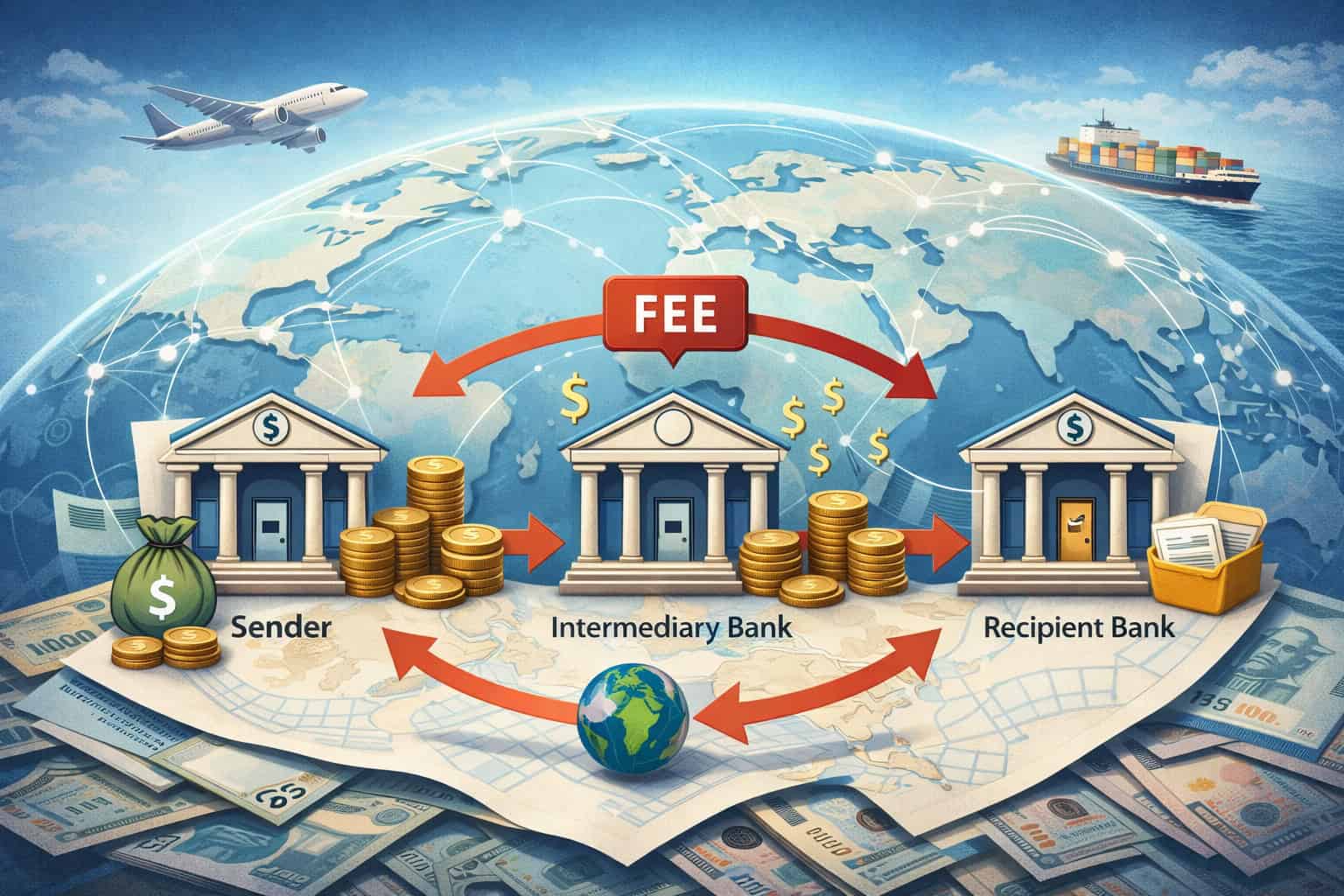
If you’ve ever sent an international wire and heard, “We received it… but it’s short,” you’ve run into the most frustrating part of cross-border payments: intermediary bank fees in international wire transfers.
These fees (often called correspondent bank fees, lifting fees, or “deduct charges”) can be taken mid-route—after the money leaves your bank but before it arrives at the recipient’s bank.
The result is a mismatch between what you sent and what the recipient received, plus extra time spent reconciling invoices, payroll, vendor credits, or project milestones.
This 2026 guide explains international wire transfer intermediary fees in plain language: why they exist, where the fees come from, how they’re deducted, and how you can reduce surprises with better payment instructions and smarter routing choices.
What intermediary and correspondent banks are (and why they exist)

An intermediary bank (also called a correspondent bank) is a bank that helps move money between two banks that don’t have a direct relationship in the needed currency or clearing channel.
In a perfect world, your bank and the recipient’s bank would have a direct pathway to settle every currency to every destination. In reality, banks maintain a limited set of correspondent relationships—accounts they hold with other banks to send and receive funds.
These accounts are often described as “nostro/vostro” accounts in banking operations (your bank’s account at another bank, and vice versa).
When a direct route isn’t available, your payment is routed through one or more correspondent banks that do have the right accounts, currency access, or settlement connections.
Each intermediary is providing a service: validating message formats, screening for compliance, routing to the next bank, and settling through their own accounts.
That service can come with fees—especially when the payment requires extra handling such as repairs (fixing missing beneficiary details), manual compliance review, currency conversion, or special routing constraints.
Some intermediary fees are charged separately; others are deducted from the principal (the amount you intended to send), which is why the recipient sees less.
Where intermediary bank fees come from and how they’re deducted
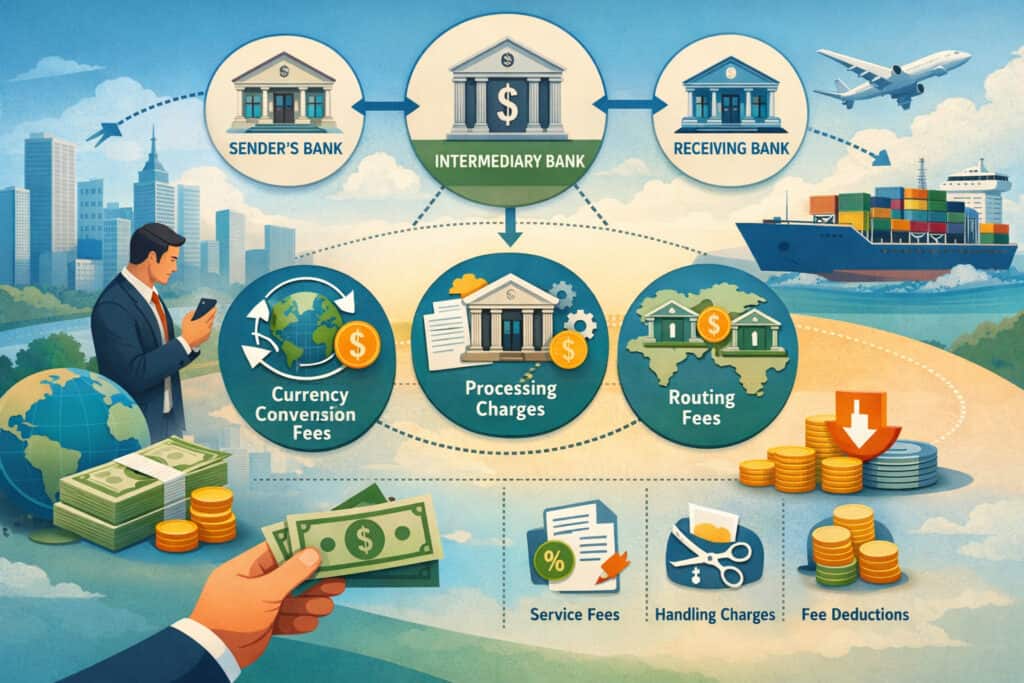
Intermediary bank fees in wire transfers typically arise because each bank in the chain has its own pricing for processing incoming/outgoing cross-border payments. Unlike a simple domestic transfer where one network handles end-to-end settlement, international wires can pass through multiple institutions with separate fee rules.
Here’s how the deductions usually happen operationally:
- Fee charged to sender separately (debit fees): Your bank may charge an outgoing wire fee as a separate debit from your account.
- Fee deducted from the principal (deduct fees / lifting fees): A correspondent bank may subtract its fee from the amount being forwarded.
- Fee charged by the receiving bank: The recipient’s bank may take an incoming wire fee before crediting the recipient.
Whether the intermediary fee is deducted from principal depends heavily on:
- The charge option selected (SHA vs OUR vs BEN)
- The routing path your bank chooses (or is forced to use)
- Whether the payment is “straight-through” or requires manual repair
- Whether the payment triggers compliance review or conversion handling
Some institutions publish example lifting fee schedules that show how intermediary charges can scale by amount (for certain routing arrangements).
For instance, one bank’s wire FAQ document shows sample intermediary fee add-ons for specific intermediary routes and tiers (e.g., amounts in ranges may require adding 10–30 units of the sending currency to preserve principal).
Also note: “fees” aren’t just bank charges. Your total cost can include:
- Sender bank fees
- Intermediary/correspondent fees
- Receiving bank fees
- FX spread / exchange rate markup if currency conversion happens anywhere in the chain
You can reduce unpleasant surprises by explicitly confirming: Which fees are charged separately, and which can be deducted from principal? And: Where will FX conversion happen?
Fee glossary: what you might be paying (and where it shows up)
Below is a practical glossary you can use when reviewing fee disclosures, payment confirmations, or wire investigations.
| Fee category | Who charges it | Where you’ll see it | Common labels | How it impacts the recipient |
|---|---|---|---|---|
| Sender bank fee | Your bank | Separate debit from your account or included in quote | Outgoing wire fee, transfer fee, handling fee | Usually does not reduce amount received (unless your bank deducts from principal before sending) |
| Intermediary bank fee | Correspondent bank(s) in the routing and correspondent banking network | Often not shown on your bank’s receipt; may appear later in tracer results | Intermediary fee, correspondent bank fees, lifting fees, deduct charges | Can reduce principal mid-route so recipient receives less |
| Receiving bank fee | Recipient’s bank | Recipient’s account statement or advice | Incoming wire fee, receiving fee, credit fee | Can reduce the credited amount (or be charged separately) |
| FX spread / markup | Any bank or provider that converts currency | Embedded in exchange rate applied | FX margin, spread, rate markup | Can materially change total cost even if wire fees are low |
| Compliance/repair fee (sometimes) | Any bank in chain | Rarely visible upfront; may be charged separately | Repair fee, investigation fee, amendment fee | May cause delays and/or additional deductions |
How an international wire transfer works step-by-step (initiation → compliance → routing → settlement → receipt)
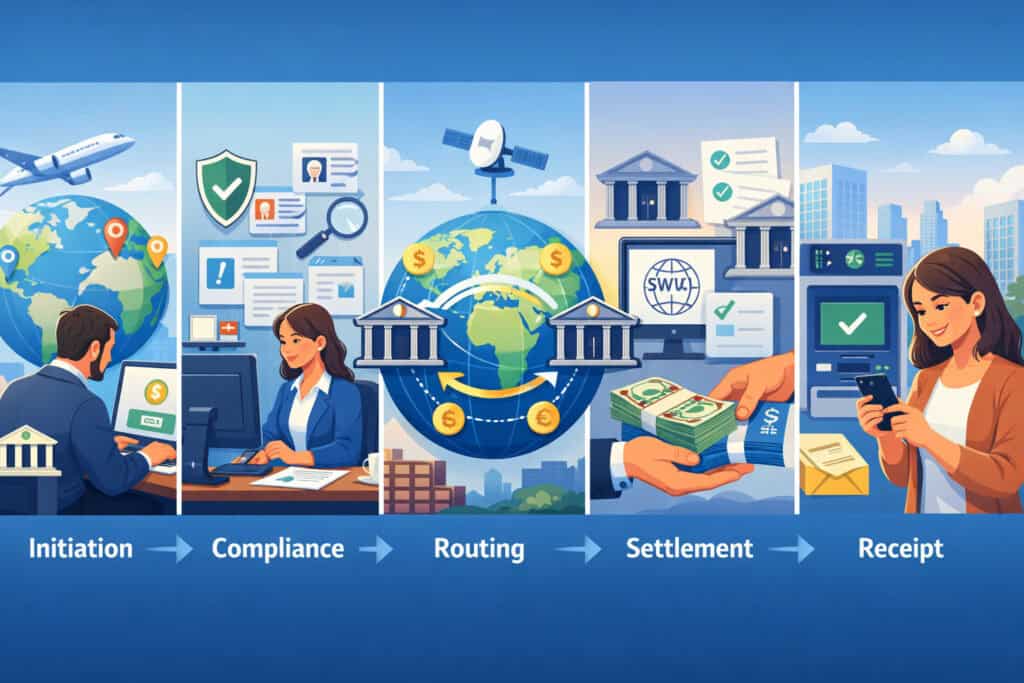
Understanding the operational path is the fastest way to make hidden fees in international wire transfers feel less mysterious. While banks differ in internal systems, the end-to-end flow generally follows the same stages.
1) Initiation: payment creation and message formatting
Your bank collects payment instructions: beneficiary name, account number (or IBAN), bank identifier (SWIFT/BIC), amount, currency, purpose/notes, and fee option (SHA/OUR/BEN).
For many cross-border wires, your bank sends a standardized message (often a SWIFT payment message) containing fields that instruct how fees should be handled. Many banks still refer to the fee instruction using the classic codes OUR, SHA, and BEN in the “details of charges” field.
If details are incomplete—like a mismatched beneficiary name, missing bank identifier, or unclear account format—the payment may be rejected or repaired later, which increases delay risk and sometimes fees.
2) Compliance screening: sanctions, AML checks, and payment repairs
Before the wire is released (and sometimes again while in-flight), banks run compliance checks for sanctions and financial crime controls. This can include:
- Name screening (ordering party, beneficiary, intermediaries)
- Keyword screening in payment notes
- Risk-based review of amounts, patterns, and counterparties
If screening flags something, the payment may be paused for manual review. A common operational issue: “false positives” when a name is common, or when address details are missing. Some bank guidance explicitly recommends providing complete beneficiary address details and other identifiers to reduce screening delays.
Compliance steps don’t automatically create intermediary fees, but they can trigger delays, requests for more information, and occasional repair/investigation charges depending on bank policy.
3) Correspondent routing: selecting the chain of banks
If your bank cannot settle directly with the beneficiary bank in that currency, it routes via one or more correspondent banks. This is where intermediary bank fees in international wire transfers most commonly appear.
Routing decisions depend on:
- Currency and settlement access
- Which correspondent accounts exist between banks
- Operational cut-off times
- Risk and compliance constraints
- Message requirements (some corridors require extra structured data)
- Cost and service-level expectations
You typically don’t see the full chain at the moment you click “send.” Even if your bank discloses “may involve intermediaries,” the exact intermediaries can vary day to day.
4) Settlement: moving value between banks
Behind the scenes, banks settle through their accounts with each other. The message instructs payment details; settlement moves the actual value. Intermediary fees can be:
- Applied as a separate debit to your bank (especially under OUR)
- Deducted from the amount passed onward (common under SHA/BEN)
- Taken by the recipient’s bank upon credit
5) Receipt and posting: credit to beneficiary
Finally, the beneficiary bank posts the incoming payment (sometimes after internal checks or required data validation). At this stage, the recipient may see:
- A short credit (fees deducted mid-route)
- A full credit but separate incoming fee charged
- A delayed posting pending additional information
Modern tracking is improving transparency. SWIFT’s Global Payments Innovation (gpi) capability is designed to provide end-to-end tracking, status visibility, and improved fee transparency for participating institutions.
SHA vs OUR vs BEN explained (and what “OUR” does/doesn’t guarantee)
The fee instruction you choose is one of the most important levers for controlling surprises—but it’s also the most misunderstood.
In many bank formats, the fee option appears as OUR / SHA / BEN in the charges field of the payment message (often referenced as the “details of charges” field).
Charge options comparison table (SHA/OUR/BEN)
| Option | Who pays which fees | What the recipient typically receives | Pros | Cons | Best use |
|---|---|---|---|---|---|
| SHA (Shared) | Sender pays sender bank fees; recipient may bear intermediary + receiving fees (often via deductions) | Often less than sent due to deductions | Lower upfront cost for sender; common default | Recipient short-paid; unpredictable reconciliation | Vendor payments where invoice allows net-of-fees (or you can true-up) |
| OUR (Sender pays) | Sender intends to pay transfer charges (including intermediaries) | More likely to receive full principal, but not guaranteed in all cases | Cleaner reconciliation; better vendor experience | Higher sender cost; some receiving banks may still charge receipt fees separately | Payroll, critical suppliers, contract amounts that must match exactly |
| BEN (Beneficiary pays) | Recipient bears most/all fees; fees often deducted from principal | Net of fees (short-paid) | Lowest sender cost | High recipient frustration; hard to predict shortfall | Rarely recommended for business payments unless explicitly agreed |
What OUR does (and doesn’t) guarantee
Operationally, “OUR” means the sender agrees to bear charges—but the real-world outcome depends on how each bank implements fee collection.
- Under OUR, intermediary charges are intended to be paid by the sender (often billed separately rather than deducted).
- However, some receiving banks may still charge receipt fees even when OUR is used—sometimes as a separate fee rather than reducing the wire amount. Some payment providers explicitly note that beneficiary banks can reserve the right to charge receipt fees even when charges are set to OUR.
That’s why businesses sometimes see an “OUR” wire still arrive short—or arrive full but the recipient reports an incoming fee afterward. The key is to set expectations: OUR improves predictability, but it does not always deliver a perfect “no-fee” experience end-to-end.
Why fees feel “hidden” (multiple banks, variable routing, unknown chains, and FX conversions)
People call them “hidden fees” because they often don’t show up where you expect: on the confirmation screen of the sending bank.
Here are the most common reasons hidden fees happen:
1) You don’t control the full chain
Even if you provide correct beneficiary details, the sending bank may choose among multiple correspondent paths. That choice can change based on:
- Liquidity and cut-off times
- Service issues with a correspondent
- Currency settlement constraints
- Risk/compliance restrictions
- Network outages or message format requirements
This variability makes fee outcomes inconsistent—especially under SHA or BEN, where intermediaries may deduct charges from principal.
2) Fees can be “off-message” or applied during processing
Some deductions don’t appear in the initial payment confirmation because they occur later, inside another bank’s processing. Even when message standards include charge-related fields (like the charge option indicator), the actual fee amount may not be known upfront to the sender.
3) FX conversion can happen in unexpected places
A major driver of “recipient got less than expected” isn’t always an explicit wire fee—it’s FX spread.
FX can occur:
- At the sending bank (you send converted funds)
- At an intermediary bank (conversion mid-route)
- At the receiving bank (converted on receipt)
If conversion happens mid-chain, you may face both:
- fee deductions and
- a less favorable conversion rate than you expected
Some bank guidance notes that certain intermediary routing arrangements may convert funds automatically under certain conditions, and even special instructions may not fully guarantee that conversion won’t occur.
4) Shared-cost defaults encourage deductions
In many business banking setups, SHA is the default. That means the recipient commonly bears intermediary and receives fees—often through deductions from principal. In that setup, the sender has limited visibility into what the recipient will net.
Real-world examples with simple math (fee ranges shown transparently)
The goal here is realism without fake statistics. Fee outcomes depend on route, currency, and bank policies—so think of these as “how it typically plays out” examples, not promises.
Example 1: 10,000 vendor payment with SHA (shared fees)
Scenario: You send 10,000 in the payment currency to a vendor using SHA.
Possible costs and deductions:
- Sender bank outgoing fee: charged separately (not part of the 10,000)
- Intermediary lifting fee(s): may be deducted from principal
- Receiving bank incoming fee: may be deducted or charged separately
Some banks publish illustrative lifting-fee tiers that fall in the range of about 10–30 (in the relevant currency unit) depending on amount bands and intermediary route.
Simple math illustration:
- Amount instructed: 10,000
- Intermediary deducts: 20
- Receiving bank deducts: 15
- Recipient credited: 9,965
Operational takeaway: Under SHA, it’s normal for the recipient to receive less than instructed because intermediary and receiving charges are often borne by the beneficiary side (frequently as deductions).
Example 2: OUR payment where the recipient still sees deductions—why?
Scenario: You send 10,000 with OUR, expecting the recipient to receive exactly 10,000.
What can still happen:
- The payment arrives for 10,000, but the recipient’s bank charges a separate incoming fee afterward.
- Or an intermediary/receiving bank deducts anyway due to how fees are applied on that route, then bills your bank later (or fails to bill your bank), creating a mismatch.
Some providers explicitly warn that beneficiary banks may still charge receipt fees even for OUR payments, sometimes as separate charges.
How to explain this to a stakeholder:
- “OUR is the instruction about who should pay transfer charges, but it doesn’t force every bank globally to waive all receipt charges.”
- “OUR improves predictability, but we still need confirmation of receiving-bank fees and route behavior.”
Example 3: Multi-currency vs same-currency wires (how FX changes total cost)
Scenario A (same-currency): You send 10,000 in the currency the recipient account holds.
- You face wire fees (sender/intermediary/receiving), but no conversion is needed.
Scenario B (multi-currency): You send 10,000 in your local currency, and the recipient is credited in a different currency.
- Now you have wire fees plus FX spread somewhere in the chain.
- FX could be applied at a bank you don’t directly interact with (intermediary or receiving bank), which reduces transparency.
Operational takeaway: Even when intermediary fees are small, FX spread can dominate total cost. The best practice is to decide where conversion should happen and confirm the applied rate mechanism (quoted rate, mid-market plus margin, or bank “card rate” style).
How to reduce or avoid surprises (practical steps that actually work)
Reducing hidden fees in international wire transfers isn’t about magic—it’s about improving information quality, fee instructions, and routing predictability.
1) Provide complete beneficiary information (to avoid repairs and delays)
Errors and missing details increase the chance of:
- payment repairs (“message repair”)
- manual compliance review
- rejection/return
- extra fees and longer posting times
At minimum, collect and validate:
- Beneficiary full legal name (match account records)
- Beneficiary address (as complete as possible)
- Account format (local account number or IBAN where used)
- Bank identifier (SWIFT/BIC)
- Any required routing codes (for example ABA routing may be used in some systems as a bank identifier)
- Invoice/reference and purpose of payment (clear, neutral wording)
Some bank guidance explicitly notes that providing more complete beneficiary information can help reduce screening delays—particularly for common names.
2) Choose the right charge option and document it
If you select SHA, plan for short payments and reconciliation. If you select OUR, confirm how your bank collects intermediary fees and whether the receiving bank may still charge receipt fees.
Also align this choice with contract language:
- “Net of fees” clauses (recipient bears fees)
- “Full invoice amount must be received” clauses (sender bears fees)
- Payroll requirements (exact credits)
3) Ask about correspondent coverage and preferred routes
One of the most effective questions you can ask your bank is:
- “Do you have a preferred correspondent route for this beneficiary bank and currency that minimizes deductions?”
Some banks can recommend (or prefer) certain intermediary partners for specific corridors, even if the final choice is yours.
This can improve:
- fee predictability
- processing speed
- fewer compliance interruptions
- fewer unexpected conversions
4) Control FX conversion location (when possible)
If you can send in the recipient’s account currency, you may avoid:
- mid-chain conversion surprises
- extra FX spread
- “auto-convert” behavior noted in some routing arrangements
If you must send multi-currency:
- request a clear FX quote (rate + margin)
- confirm whether conversion occurs at send, mid-route, or on receipt
5) Use tracking and transparency tools when available
SWIFT gpi is designed to improve transparency with real-time tracking and better visibility into payment status and delays.
Ask your bank:
- “Is this wire sent with gpi tracking?”
- “Can you share the tracking reference used for investigations?”
6) Consider alternatives to wires (high-level)
Wires remain the go-to for high-value, urgent, or contract-sensitive payments—but they aren’t always the best for recurring lower-value flows.
Depending on your needs, alternatives may offer:
- clearer pricing
- better fee transparency
- improved delivery certainty for routine payments
A major bank’s international payments guide contrasts wires with lower-cost options for certain non-urgent use cases and notes that wires can involve higher fees and lifting-fee impacts.
Common scenarios and where fees show up (so you can set expectations)
Use this table to map your payment type to where fees commonly appear and what controls help most.
| Scenario | Why businesses use wires | Where fees usually show up | Biggest surprise risk | Best control |
|---|---|---|---|---|
| Business-to-business vendor invoice | Speed, finality, contract requirements | Intermediary deductions + receiving fee; sometimes FX | Recipient nets less than invoice | Use OUR for exact invoices; confirm preferred route |
| Contractor/freelancer payments | Cross-border service delivery | SHA deductions; receiving bank incoming fee | “Short paid” disputes | Agree on net/gross terms; include fee clause in contract |
| Payroll for remote staff | Exact credits matter | Receiving bank fees; compliance delays | Delays or exact-amount mismatch | Use OUR + complete beneficiary info + templates |
| High-value one-time purchase | Settlement certainty | Intermediary chain variability | Unexpected mid-route fees | Ask for principal preservation route; verify instructions |
| Refunds/returns and recalls | Correcting errors | Investigation/recall fees; receiving bank handling | Fees on top of original fees | Collect full documentation; confirm recall pricing |
| Multi-currency settlement | Recipient wants a different currency | FX spread + possible intermediary conversion | FX cost bigger than wire fee | Control where FX happens; request rate transparency |
Troubleshooting: missing funds, delays, tracer requests, and what to collect
When a recipient gets less than expected—or doesn’t get the wire at all—your goal is to move from “guessing” to “documented investigation.”
Step 1: Confirm what was actually sent (not what was intended)
Collect from the sender side:
- Payment confirmation (amount, currency, value date)
- Beneficiary details used (name, account/IBAN, SWIFT/BIC)
- Fee option selected (SHA/OUR/BEN)
- Your internal reference / invoice number
- Any bank-provided reference identifiers
If your bank can provide a message copy or structured details (often referred to operationally as the payment message details), it helps your case.
Step 2: Confirm what the recipient actually received
Ask the recipient for:
- Credit advice or account statement entry
- Amount credited, date/time posted
- Any fees charged separately
- Any bank notes referencing incoming wire charges
This matters because sometimes the wire arrives in full but the receiving bank charges a separate receipt fee afterward (a scenario some providers warn can happen even for OUR).
Step 3: Identify whether this is a “fee deduction” issue or an “FX/rate” issue
- If the recipient got less in the same currency, suspect fee deductions.
- If the recipient got a different currency amount than expected, suspect FX conversion or FX spread at some point in the chain.
Step 4: Request a tracer (payment investigation)
A tracer request typically asks banks in the chain to confirm:
- current status (in transit, rejected, credited)
- timestamps of processing
- any deductions or charges taken
- reasons for delays or holds
If your wire is gpi-enabled, banks may have improved visibility into tracking and processing steps.
Step 5: If a recall/refund is needed, expect fees and time
Recalls can incur fees and are not always guaranteed, especially if funds have already been credited and used. Also, some deductions or intermediary charges may not be refundable because they reflect services already performed.
Best practices for businesses (templates, approvals, reconciliation, and transparency)
International wires are operationally heavy. The best-run finance teams treat them like controlled workflows.
1) Create standardized wire templates (with controlled edits)
Maintain a “beneficiary master” that includes:
- Legal entity name + address
- IBAN or account format + validation notes
- SWIFT/BIC (and any routing identifiers)
- Preferred currency for settlement
- Default charge option per vendor contract
- Standard remittance/reference format
Lock down who can edit templates and how changes are approved. This prevents “one-character mistakes” that create costly investigations.
2) Use tiered approvals for high-risk wires
Set rules like:
- Amount thresholds requiring dual approval
- New beneficiary requires a second reviewer
- Changes to beneficiary bank details require verification
- OUR selection requires confirmation of business justification
This reduces fraud risk and also reduces avoidable fees caused by incorrect details.
3) Reconcile wires with a “net receipt” mindset
For SHA and BEN payments, build reconciliation logic that expects:
- recipient may receive less than instructed
- deductions may not be visible on sender confirmation
- invoice settlement may require “true-up” adjustments
4) Improve fee transparency in payment instructions and contracts
Add clear contract language:
- Who bears intermediary and receives fees?
- Is payment considered complete when sent or when received?
- If short-paid, who covers the difference and how quickly?
This one change eliminates most vendor disputes.
5) Track exception reasons and fix root causes
Keep a simple log of:
- most common delay reasons (missing address, mismatched beneficiary name, compliance review)
- most common fee issues (unexpected routing, receiving fee surprises, FX conversion location)
- which banks/routes produce consistent results
Over time, you’ll shift from reactive problem-solving to predictable execution.
Fee-reduction checklist (before sending, what to request, what to verify)
Use this table as a practical pre-flight checklist.
| Step | Before sending | What to request from your bank | What to verify after sending |
|---|---|---|---|
| Beneficiary data | Full name, complete address, correct account/IBAN, SWIFT/BIC | Validation guidance for formats | Confirmation shows correct beneficiary + bank identifiers |
| Fee option | Decide SHA vs OUR vs BEN based on contract | Explain how fees are collected on this corridor | Fee option recorded correctly on confirmation |
| Routing | Confirm recipient bank currency/account capability | Preferred correspondent route to reduce deductions | Any route notes or tracking references available |
| FX control | Decide where conversion should occur | Rate quote and where conversion occurs (send/mid-route/receive) | Credited currency matches expectation |
| Tracking | Capture references for investigations | gpi tracking availability and identifiers | Status updates for delays or exceptions |
| Documentation | Attach invoice/ref in remittance info | Bank requirements for purpose/notes | Recipient can match payment to invoice quickly |
FAQ
Q1) What are intermediary bank fees in international wire transfers?
Answer: Intermediary bank fees are charges taken by correspondent banks that help route your wire through the banking network when the sender’s bank and recipient’s bank can’t settle directly. These fees may be charged separately or deducted from the principal while the payment is in transit—leading to the recipient receiving less than expected.
In many cases, you won’t see the exact intermediary fee amount at the moment you send the wire because the fee is applied later by a bank you don’t directly bank with. This is why intermediary bank fees in international wire transfers often feel “hidden,” even though they are a normal part of correspondent routing.
Q2) Why did the recipient receive less money than I sent?
Answer: Most short payments come from one of two causes:
- Fee deductions from principal: An intermediary bank or the receiving bank subtracts charges as the wire moves through the chain (common with SHA or BEN).
- FX conversion effects: If the payment is converted into another currency mid-route or on receipt, the applied exchange rate (FX spread) can reduce the final value.
If the recipient received less in the same currency you sent, suspect lifting fees or receiving fees. Some published bank guidance shows that intermediary lifting fees can occur and may scale by amount tier on specific routes.
Q3) What’s the difference between intermediary fees and FX fees?
Answer: Intermediary fees are explicit processing charges taken by correspondent banks for routing/settlement services. They can be charged separately or deducted from the payment amount.
FX fees are not always labeled as “fees.” Instead, they often show up as a less favorable exchange rate than the reference market rate (the “FX spread” or markup). FX costs can exceed wire fees, especially when conversion happens at a bank you didn’t expect (mid-route or on receipt).
If your payment involves currency conversion, ask where conversion occurs and how the rate is determined.
Q4) Does OUR guarantee the recipient gets the full amount?
Answer: Not always.
OUR is an instruction that the sender bears charges (including intermediary charges). Many banks describe OUR as “charges borne by the originator.” However, some providers explicitly note that beneficiary banks may still charge receipt fees even when OUR is used, sometimes as separate charges.
So OUR improves predictability, but it doesn’t universally force every bank in the chain to waive every possible fee.
Q5) How can I estimate intermediary fees before sending?
Answer: You can’t always estimate them precisely, but you can narrow the range by doing three things:
- Ask your bank whether the payment will use a predictable correspondent route.
- Ask whether they can apply “principal preservation” handling (no deductions from principal).
- Ask the recipient’s bank what their incoming wire fee policy is.
Some banks publish illustrative intermediary fee schedules for certain routes/tiers, which can help you set expectations (for example, tiered lifting fees by amount).
Q6) Can I choose the intermediary bank?
Answer: Sometimes—partially.
Some banks allow you to specify an intermediary bank in instructions, but many still route based on their own correspondent network and risk rules. Certain bank FAQs indicate they can recommend a preferred intermediary partner, though the final choice may still depend on the sender.
The most practical approach is to ask for the bank’s “preferred route” for your beneficiary and currency, rather than trying to force a specific intermediary.
Q7) How do I track an international wire?
Answer: Start by requesting your bank’s payment reference identifiers and confirmation details. If your bank supports SWIFT gpi tracking, they may be able to provide better end-to-end visibility into status and delays. SWIFT describes gpi as providing real-time tracking and improved transparency.
If there’s a delay, ask your bank to confirm:
- last known status
- whether the payment is pending compliance review
- whether repairs are required due to missing beneficiary information
Q8) Are intermediary fees charged on refunds or recalls?
Answer: They can be. Recalls and refunds are operationally complex and may involve:
- investigation fees
- message amendment/repair fees
- processing fees by banks in the chain
Even if a payment is returned, fees already charged for processing or routing may not be reversible because services were performed. Treat recall fees as a separate cost category and ask your bank’s policy before initiating a recall.
Q9) What information reduces delays and extra fees?
Answer: The most effective “delay reducer” is complete, accurate beneficiary information:
- full legal name
- complete address
- correct account/IBAN format
- SWIFT/BIC (and any required routing identifiers)
- clear remittance reference
Some bank guidance specifically recommends providing complete beneficiary details to reduce screening delays, especially for common names.
Q10) When should I use alternatives instead of wires?
Answer: Consider alternatives when:
- the payment is lower value and non-urgent
- you need predictable pricing and fee transparency
- you pay the same counterparties repeatedly
A major bank’s international payments guide notes that certain non-urgent methods can be lower cost than wires and that wires can involve lifting-fee impacts.
Wires still make sense for high-value, time-sensitive, or contractually strict payments—especially when you need finality and bank-grade settlement.
Q11) What are lifting fees?
Answer: “Lifting fees” is a common term for intermediary deductions taken by correspondent banks as the payment moves through the network. They’re called “lifting” because the fee is “lifted” out of the payment amount.
Some published bank documentation uses the term “lifting fees” and provides examples of how such fees may be applied.
Q12) Are receiving bank fees the same as intermediary fees?
Answer: No. Receiving bank fees are charged by the recipient’s bank for accepting/posting an incoming wire. Intermediary fees are charged by banks that route/settle the wire before it reaches the recipient’s bank.
Both can reduce what the recipient nets, but they occur at different points and may be priced differently.
Conclusion
When international wires go “short,” it’s almost always one (or more) of these buckets:
- Sender bank fees (charged to you, usually separately)
- Intermediary/correspondent fees (may be deducted mid-route)
- Receiving bank fees (charged by the recipient’s bank)
- FX spread / exchange rate markup (embedded in conversion rate anywhere in the chain)
Your best tools in 2026 are still operational fundamentals: clean beneficiary data, the right charge option, predictable routing, and clear FX control—plus better tracking where available (including gpi capabilities).