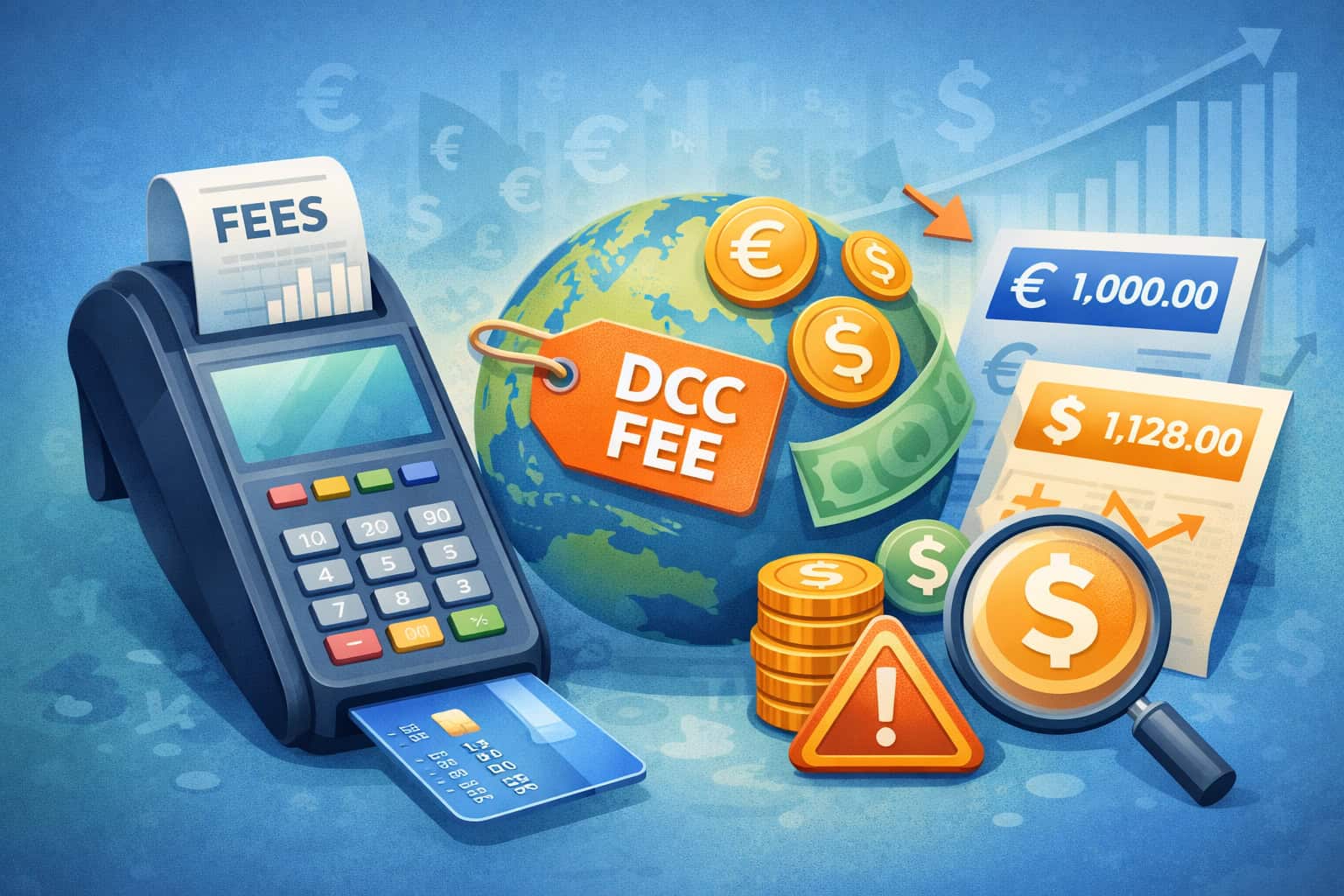
Dynamic Currency Conversion (DCC) shows up when you’re paying with a card and the checkout experience offers to charge you in your card’s billing currency instead of the local currency where the merchant (or ATM) is located.
It can feel convenient—especially when the screen promises a “guaranteed rate” or shows a familiar currency amount—but it can also change the true cost of the purchase in ways that are easy to miss.
This guide breaks down DCC (Dynamic Currency Conversion) fees: what DCC is, where it appears, how the exchange rate is set, who gets paid, and how it compares to foreign transaction fees and cross-border fees.
You’ll also get practical scripts, checklists, and examples you can use at a terminal, in an online checkout flow, or at an ATM—without fearmongering and without made-up stats.
What Dynamic Currency Conversion is (and what it isn’t)
DCC is a checkout service that lets you choose the currency used to bill your card for a cross-currency purchase. Instead of the transaction being processed in the merchant’s local currency and then converted by your card issuer, DCC converts the amount right at the point of interaction and charges you in your card’s billing currency.
It’s important to separate three ideas that often get blended together:
- Billing currency choice (DCC): “Do you want to pay in your billing currency or local currency?”
- Exchange rate mechanics: “Which exchange rate gets applied—and what markup or FX spread is embedded?”
- Other international fees: issuer foreign transaction fees, and merchant-side network cross-border assessments.
DCC is also not the same thing as multi-currency pricing. Multi-currency pricing is when a merchant intentionally lists prices in multiple currencies and settles those prices as part of their pricing strategy.
DCC is a specific card-acceptance feature where conversion happens during card payment processing, with specific disclosures expected on-screen and on receipts. Card networks describe DCC as an optional service that must present the cardholder with a real choice and show key information like amounts in both currencies and the exchange rate used.
If you only remember one thing from this section: DCC is a currency choice at checkout, not a required fee. In most cases, you can decline it and pay in local currency instead.
Where DCC (Dynamic Currency Conversion) happens: in-store terminals, online checkout, and ATMs
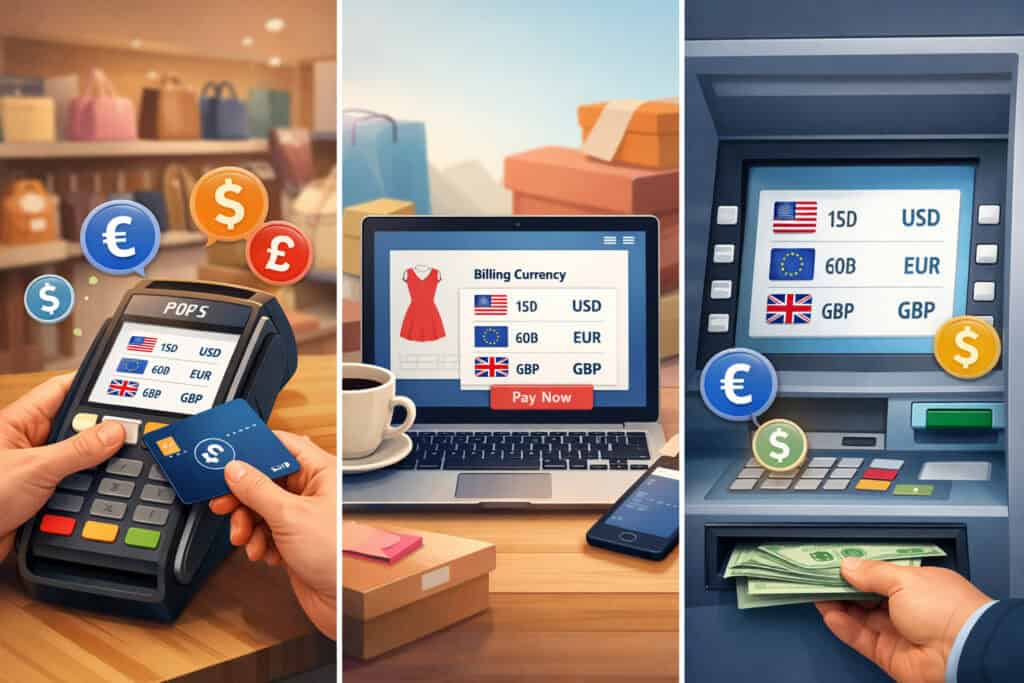
DCC appears in three common places: physical point-of-sale (POS) terminals, ecommerce checkout pages, and ATMs. The user experience differs, but the core idea is the same: you’re being offered a choice of cardholder billing currency vs local currency.
In-store card terminals: the POS terminal DCC prompt
At a physical terminal, DCC is usually presented after the terminal detects your card was issued in a different currency zone than the merchant’s pricing currency. You might see a prompt like:
- “Pay in your currency?”
- “Pay in [billing currency] or [local currency]?”
- “Guaranteed rate—accept conversion?”
The terminal may show:
- Amount in local currency
- Amount in your billing currency
- An exchange rate used for conversion
- A line item indicating markup or “commission” (wording varies)
Networks and DCC providers are expected to present the choice clearly and not default the selection on your behalf.
Why this matters: if the terminal operator hits the “billing currency” option for you (or if the interface nudges you), you can end up paying a higher applied rate than your issuer’s conversion would have produced.
Online checkout: “pay in your currency” banners and hidden toggles
In ecommerce, DCC can look like a helpful currency switcher that appears late in checkout. Common patterns include:
- A pop-up offering to “convert to your currency” so you “know the exact amount”
- A radio button labeled “Pay in [your currency] (recommended)”
- A “guaranteed rate” message with fine print beneath
- A default selection that’s easy to miss on mobile
Unlike a physical terminal, online DCC can be easier to overlook because:
- The currency choice may be buried under an “order summary” accordion
- The disclosure text can be smaller than the call-to-action
- You may not see the exchange rate unless you expand details
Card acceptance documentation describing DCC offers typically includes the requirement to show both currency amounts, the exchange rate, and any markup—so shoppers can make a real decision.
ATM DCC: the “guaranteed rate” on cash withdrawals
ATMs can also offer DCC—often at the most time-pressured moment, when you just want cash. The ATM might display:
- “Continue with conversion?”
- “Accept exchange rate?”
- “Guaranteed amount in your currency”
- “Decline conversion” (sometimes phrased as “continue without conversion”)
When you accept an ATM DCC, you’re letting the ATM operator (and their DCC provider) set the conversion rate for the withdrawal. Networks describe DCC as an optional choice at ATMs too, with disclosure expectations similar to POS transactions.
ATM withdrawals can involve multiple cost layers (issuer cash-advance fees, ATM operator fees, and interest rules), so DCC is only one part of the picture. Still, it’s the part you usually control at the moment: choose to proceed in local currency (decline conversion) if you want your issuer’s rate path instead.
How DCC fees work in international payments (and where the markup hides)

If you’re focused on understanding DCC charges on credit cards, the key is this: DCC changes who sets the exchange rate for your purchase.
When you pay in local currency (decline DCC), the purchase is processed in that local currency and later converted by your issuer (using the issuer’s method, typically influenced by network rates and issuer policies).
When you accept DCC, the conversion happens earlier and the DCC provider’s applied rate becomes part of the transaction amount you authorize.
The currency you choose at checkout changes the billing path
A cross-currency card purchase has a few steps, but the currency choice affects them immediately:
- Local currency chosen: Authorization amount is local; conversion occurs later; statement shows local amount plus converted billing currency amount.
- DCC chosen (billing currency): Authorization amount is already in billing currency; the merchant/acquirer submits the billing-currency amount; conversion is “locked” by DCC terms.
This is why DCC can feel like certainty: you see the billing currency amount right away. But certainty isn’t the same as savings.
Exchange rate (mid-market vs applied rate): why “spread” matters
Many people compare DCC to the mid-market exchange rate they see in a finance app. Mid-market is essentially a midpoint reference rate—not necessarily the rate any one party must give you.
DCC often uses an applied rate that includes:
- A conversion service component
- A currency conversion markup / FX spread embedded in the rate
- Sometimes a separately disclosed “markup” line (implementation varies)
Visa’s consumer-facing guidance notes that the DCC display should show both currencies, the exchange rate, and any additional fees or markup—because that’s where the cost difference usually lives.
Why “guaranteed rate” messaging can be misleading
“Guaranteed rate” sounds like a benefit. Sometimes it can be—if you truly need to know the exact billing-currency amount at purchase time. But it can be misleading for two reasons:
- The guarantee is about predictability, not competitiveness. A rate can be guaranteed and still be worse than your issuer’s conversion route.
- The comparison baseline isn’t shown. You’re rarely shown what your issuer would do, so it’s hard to compare in real time.
Mastercard’s DCC guidance frames DCC as an optional service that allows the cardholder to choose local currency instead—specifically so the cardholder can choose the issuer conversion route if they prefer.
Who charges DCC and who gets paid (provider, merchant/acquirer, issuer)
DCC isn’t usually charged by your card issuer. It’s typically implemented on the merchant/acquirer side, often via a specialized merchant/acquirer DCC provider that supplies the technology, pricing engine, and required messaging.
Here’s the common arrangement at a high level:
- DCC provider: Powers the conversion offer, calculates the applied rate, enables receipt/terminal disclosures, and participates in revenue share.
- Acquirer (merchant’s processor): Sponsors the merchant’s acceptance and routes transactions into the card networks; may enable DCC as a feature.
- Merchant (or ATM operator): Presents the DCC choice to you at checkout and may receive a share of DCC revenue.
- Issuer (your bank): Issues your card, posts the transaction, and may still charge issuer-side fees depending on card terms.
Network-facing explanations emphasize that merchants/ATMs should give cardholders a choice and display key details (local and billing currency amounts, exchange rate, and markup).
Why the “who gets paid” matters to consumers and finance teams
For travelers and ecommerce shoppers, the practical point is: the party offering DCC can have a financial incentive for you to accept it. That doesn’t mean every offer is abusive, but it explains why DCC prompts can be persistent or framed as “recommended.”
For merchants and ops teams, it matters because:
- DCC can increase revenue per transaction
- But it can also increase disputes, refunds complexity, and customer dissatisfaction if disclosures aren’t clear
- It can create support burden (“Why was my bill higher than expected?”)
DCC vs foreign transaction fees: how they stack (and why declining DCC doesn’t guarantee “no fees”)

A foreign transaction fee (sometimes called an issuer FX fee) is usually charged by the card issuer, based on your card’s terms. It may apply when you buy something in a foreign currency or when a transaction is processed by a foreign merchant entity, depending on issuer policy.
Issuer FAQs commonly tell cardholders to check their card’s specific terms to see whether foreign transaction fees apply or are waived.
The common misunderstanding
Many cardholders assume:
- “If I decline DCC, I will avoid all international fees.”
The reality is more nuanced:
- Declining DCC means you avoid merchant-side conversion pricing.
- You may still pay an issuer foreign transaction fee if your card’s terms apply.
- The exchange rate used may still differ slightly from a mid-market reference rate due to how card networks and issuers set rates.
So you can have situations where:
- Decline DCC + issuer foreign transaction fee applies (still often cheaper than accepting a poor DCC rate, but it depends on your card terms and the DCC applied rate).
- Accepting DCC + issuer foreign transaction fee still applies (yes, this can happen depending on issuer rules; DCC is not automatically a waiver of issuer fees).
- Decline DCC + no issuer foreign transaction fee (often the cleanest outcome for cost, if your card has favorable terms).
Mastercard’s description of DCC notes that paying in local currency routes conversion via the issuer, which is separate from issuer fee policy.
DCC vs cross-border fees (network assessments) in one clear explanation
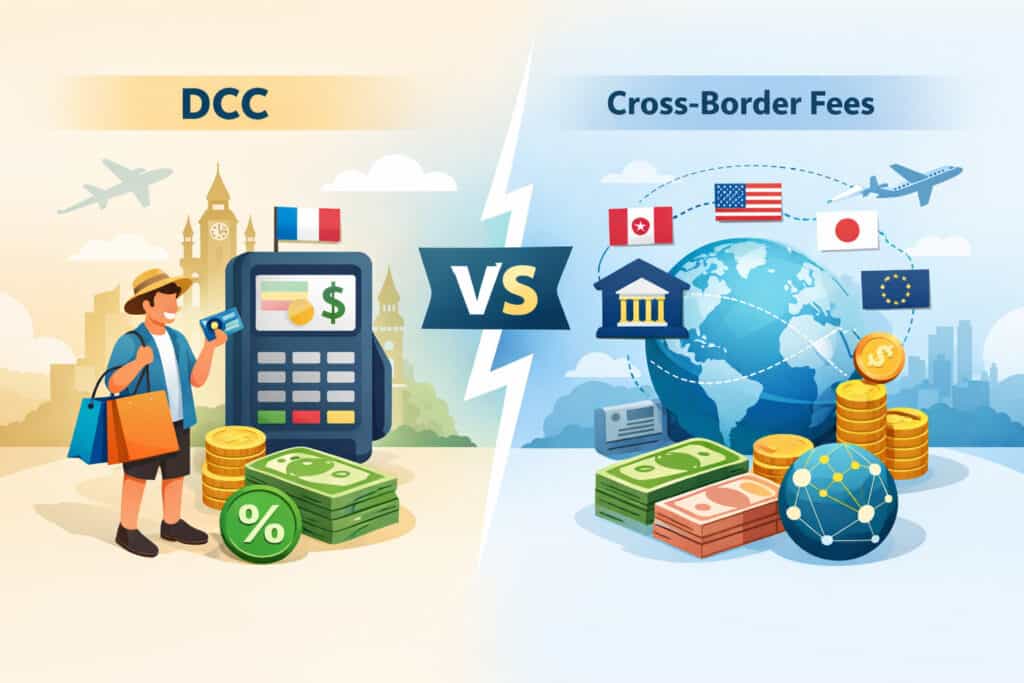
Cross-border fees are often talked about alongside DCC, but they’re not the same thing.
- DCC is a cardholder-facing currency conversion choice at checkout.
- Cross-border fees are generally network assessments tied to international acceptance and routing. They typically affect the merchant-side cost structure (acquirer/merchant), not the cardholder as a visible “DCC fee” line item.
In other words, a merchant can incur cross-border assessments even when the cardholder declines DCC. And a cardholder can accept DCC without ever seeing anything labeled “cross-border fee,” because those costs are usually embedded in merchant pricing and acquiring arrangements.
This distinction matters for finance/ops teams who are modeling costs:
- DCC is a feature that can add revenue (and risk).
- Cross-border assessments are a structural cost of certain transaction types.
Step-by-step payment flow: authorization → clearing → settlement (where DCC is chosen)
To understand how DCC fees work in international payments, it helps to map DCC onto the card payment lifecycle.
Step 1: Authorization (the moment you choose the currency)
Authorization is when the terminal or checkout asks your issuer, “Approve this amount?” This is also the moment when DCC choice matters most:
- If you choose local currency, the authorization request is in local currency.
- If you choose DCC (billing currency), the authorization request is in your billing currency using the DCC applied rate.
This is why screenshots and receipts are powerful: they capture the moment you agreed (or didn’t agree) to the conversion terms.
Visa’s consumer DCC guidance highlights the expectation that merchants/ATMs display both amounts, the exchange rate, and any fees/markup, and that the cardholder gets a choice to accept or decline.
Step 2: Clearing (the transaction details get finalized)
Clearing is when transaction details are submitted through the network. If DCC was selected, the clearing message typically reflects that billing-currency amount and includes DCC-related data elements depending on implementation.
If local currency was selected, the transaction clears in local currency and the issuer later converts it to billing currency for posting.
Step 3: Settlement (funds move and statements get posted)
Settlement is when money moves between institutions. For cardholders, the visible outcome is:
- The posted transaction amount on your statement (sometimes with additional lines like issuer fees)
- Possibly a separate issuer foreign transaction fee line, if your card charges it
- A posted exchange rate outcome (not always shown explicitly)
What happens if you decline DCC? The purchase still goes through normally. You’re not “declining the transaction”—you’re declining the merchant-side conversion service and choosing local-currency processing instead.
Real-world examples (simple math, realistic scenarios, no fake stats)
These examples use simple numbers to show mechanics, not to claim typical rates. The point is to make the hidden FX spread visible.
Scenario 1: Retail POS purchase equivalent to $100
Assume the local price is L 10,000 and your billing currency is $.
Also assume:
- A mid-market reference rate that day is L 100 = $1.00
- Your issuer conversion ends up close to that reference rate after network/issuer processing
- A DCC offer uses an applied rate of L 107 = $1.00 (worse for you)
Option A: Pay in local currency (decline DCC)
- You authorize L 10,000
- Issuer converts later: L 10,000 ÷ 100 = $100.00 (illustrative)
- Your statement posts around $100.00, plus any issuer foreign transaction fee if your card has one
Option B: Pay in $ with DCC (accept DCC)
- DCC converts at applied rate: L 10,000 ÷ 107 = $93.46?
- Careful: this is where people get turned around. If the quote is “L 107 = $1,” then $1 buys fewer local units, meaning the local amount costs more dollars:
- $ amount = L 10,000 ÷ 100 = $100.00 at 100
- $ amount = L 10,000 ÷ 93.46 = $107.00 if the effective relationship is worse
A clearer way: express dollars per local unit.
- If $1.00 = L 100, then $0.01 = L 1
- If $1.00 = L 93.46, then $0.0107 = L 1
- Local amount L 10,000 × $0.0107 = $107.00
So DCC can push the billing amount above what your issuer route would produce, because the applied rate embeds the markup.
Scenario 2: Hotel deposit or pre-authorization (why DCC can show up twice)
Hotels often run a pre-authorization (a “hold”) for incidentals. DCC can complicate this because:
- The pre-auth might be done one day and the final charge later
- Exchange rates move day to day
- The DCC applied rate at check-in might not match what’s used at final settlement
Payment providers warn that rates fluctuate and that the rate presented at one moment may differ from what applies later, which can confuse cardholders if not explained clearly.
What to watch for:
- Two different currency conversion screens (deposit and final bill)
- Receipts showing conversion details that don’t match
- A final amount that differs from the “guaranteed” impression you got earlier
Scenario 3: Ecommerce checkout with a default currency toggle
You’re shopping online. The product page is in local currency, but at payment you see:
- A pre-selected option: “Pay in $ (recommended)”
- A small line: “Rate includes markup”
If you accept:
- The merchant (via DCC provider) submits a billing currency amount based on its applied rate.
If you decline and pay local currency:
- Your issuer handles conversion later; you might still see an issuer foreign transaction fee depending on card terms.
Scenario 4: ATM withdrawal with DCC plus an operator fee
You withdraw cash and the ATM offers:
- “Guaranteed $ amount” with “Accept conversion”
- An ATM operator fee displayed separately
If you accept DCC:
- You pay the operator fee (if any), plus the DCC applied rate outcome.
If you decline conversion:
- You still may pay the operator fee, but conversion routes through your issuer’s process.
Scenario 5: Refunds and returns (why DCC can make refunds feel off)
If you return a purchase:
- The merchant refunds the transaction as processed
- If DCC was used, the refund is in the DCC billing currency amount (as processed)
- Your issuer may still post the refund with timing and conversion details that differ from your expectations (especially if any issuer fee rules apply)
This is why documenting the original transaction details matters.
How to identify DCC on receipts and statements (what to save)
DCC is easiest to spot on receipts, because that’s where disclosures tend to appear closest to the decision point.
Common wording and red flags on receipts
Look for phrases like:
- “Dynamic Currency Conversion”
- “DCC”
- “Markup”
- “Commission”
- “Converted amount”
- “Exchange rate applied”
- “Cardholder currency”
- “Billing currency”
- “Guaranteed rate”
Visa guidance notes that DCC displays should show both currency amounts and the exchange rate and any markup or fee, so receipts often include some version of these details when DCC is correctly implemented.
What to screenshot or keep (for disputes or internal audits)
Whether you’re a consumer or a finance/ops team, save:
- Terminal screen photo showing the currency choice and rate (if allowed and safe)
- Merchant receipt showing:
- amount in local currency
- amount in billing currency
- exchange rate
- markup/fee language (if shown)
- Online checkout screenshot showing the currency toggle and any “recommended” label
- ATM screen capture (if your device allows notes immediately after) and ATM receipt
When DCC might make sense (rare, but real)
Most of the time, the simplest guidance is: choose local currency. But there are a few situations where accepting DCC can be rational—if you evaluate it like an analyst rather than reacting to the prompt.
1) Budgeting certainty for a specific billing-currency target
If you must know the exact billing-currency amount in the moment—maybe you’re near a spending limit, managing a tight trip budget, or reconciling a corporate card policy—DCC can provide immediate certainty. You’re paying for predictability.
This only makes sense if:
- The exchange rate is clearly shown
- Any markup is disclosed
- You accept that the rate might not be the best available
2) Corporate travel policy or expense tooling constraints
Some organizations prefer predictable billing-currency amounts to simplify expense categorization, reduce FX variance, or align with internal budgeting. In these cases, DCC can reduce the mismatch between transaction time and posting time.
If you’re in finance/ops, the key is to document:
- When DCC is allowed (if ever)
- What approvals are required
- How travelers should capture receipts and exchange-rate disclosures
3) If your card has no issuer FX fee and the DCC markup is clearly lower
This is the hardest case to evaluate in real time, but it’s theoretically possible. The logic:
- If your card has no issuer foreign transaction fee (check your card terms)
- And the DCC offer shows a clearly disclosed markup that is demonstrably smaller than the overall cost you’d otherwise incur
- Then DCC might be competitive
But you need a real comparison. Some consumer and acceptance guidance stresses that DCC should show rate and markup to enable informed choice.
How consumers can avoid DCC (POS, hotel desks, online checkout, ATMs)
Avoiding DCC usually comes down to one habit: always choose local currency—and watch for UI patterns that try to steer you elsewhere.
At a terminal: what to say and what to press
- When prompted, choose local currency
- If asked by staff, say: “Please charge me in local currency.”
- If the terminal shows a “guaranteed rate,” look for the option that continues without conversion
- Keep the receipt and check it for exchange-rate disclosures
Visa and Mastercard guidance describe DCC as optional and emphasize cardholder choice, which supports the idea that local currency is a valid selection at checkout.
At hotels: set expectations early
At check-in:
- Ask for local currency processing for both deposit and final bill
- If staff offer to “help” by converting, repeat: “No conversion—local currency.”
- Confirm what currency will be used for the final settlement
This reduces surprises where a deposit is handled one way and the final bill another.
Online checkout: slow down at the last step
- Expand “order summary” panels
- Look for currency toggles, banners, or radio buttons
- Avoid “recommended” labels unless you’ve verified the rate and markup
- Screenshot the currency choice screen
ATM guidance: decline conversion, not the withdrawal
- Choose the option that proceeds in local currency
- Ignore persuasion language like “guaranteed”
- Keep the ATM receipt
- Separately evaluate whether withdrawing cash is cost-effective given issuer cash-advance rules and ATM fees
What merchants should know (brief but useful): trust, disclosure, and alternatives
If you’re a merchant, product owner, or operations lead, DCC can look attractive because it can create incremental revenue. But the long-term cost can show up in reputation, refunds, and support load if the experience isn’t transparent.
Disclosure and consent best practices (general)
Even without citing region-specific laws, strong practice aligns with card network expectations:
- Present a real opt-in choice (no pre-selected “accept” that’s hard to notice)
- Show:
- amount in local currency and billing currency
- both currency symbols/codes
- the exchange rate applied
- any markup/fee language (as applicable)
- Print the key details on the receipt (or include them digitally)
Visa’s public guidance explicitly calls out these disclosure elements and that merchants/ATMs should not choose for the cardholder. Mastercard DCC guidance similarly emphasizes the cardholder choice of currency.
Customer trust impact
DCC complaints often sound like:
- “I didn’t agree to this”
- “Why was the exchange rate so bad?”
- “The terminal pushed me into it”
- “The receipt doesn’t match what I saw”
These are preventable with:
- Staff scripting
- UI that doesn’t nudge
- Clear receipts and consistent workflows
Transparency and refunds
If DCC is enabled:
- Train staff on how to explain it neutrally
- Ensure refunds follow clear rules and are communicated upfront
- Provide customer support with the ability to retrieve DCC receipts and on-screen prompts for dispute handling
Alternatives to consider (high-level)
- Multi-currency pricing: transparent pricing strategy (not a last-second prompt)
- Local acquiring strategies (where available): can reduce certain friction points for international shoppers
- Better checkout disclosure: even if DCC is offered, make local currency the easy, obvious option
DCC glossary (quick reference)
| Term | Meaning | Where you’ll see it |
|---|---|---|
| DCC (Dynamic Currency Conversion) | Optional service that converts a purchase into the cardholder’s billing currency at checkout | POS terminals, ecommerce checkout, ATMs |
| Cardholder billing currency | The currency your card account is billed in | Card statements, DCC prompts |
| Local currency | The currency the merchant or ATM operator normally prices in | Store receipts, ATM screens |
| FX spread / currency conversion markup | Difference between a reference rate and the applied rate used for conversion | Often embedded in DCC exchange rate |
| Mid-market rate | Reference midpoint rate often shown in finance apps; not always the applied rate you receive | Finance apps, rate comparisons |
| Applied exchange rate | The conversion rate actually used to compute your billed amount | DCC receipt/terminal screen, statement details |
| “Guaranteed rate” messaging | Language emphasizing certainty of the shown converted amount | POS/ATM prompts, online pop-ups |
| Opt-in / consent | The cardholder must actively choose DCC rather than being defaulted | Terminal UX, checkout UX |
| DCC provider | Company enabling DCC and pricing engine; often revenue-shares | Merchant agreements, acquirer enablement |
| DCC disclosure | Required/expected details shown to cardholder (both amounts, rate, markup/fees) | On-screen prompts and receipts |
DCC vs paying in local currency: pros/cons, who benefits, and when it may help
| Option | Pros | Cons | Who benefits most | When it may help |
|---|---|---|---|---|
| Pay in local currency (decline DCC) | Conversion handled by issuer route; avoids merchant-side DCC pricing | You may not know final billed amount until posting; issuer FX fee may still apply | Often the cardholder (cost control) | Default choice when optimizing for cost predictability over time |
| Pay in billing currency with DCC (accept DCC) | Immediate billing-currency amount shown; can aid budgeting | Applied rate may include markup; “guaranteed” doesn’t mean best; can increase complaints if poorly disclosed | Merchant/ATM operator and DCC provider (revenue share) | Rare cases: strict budgeting certainty, specific corporate policy, clearly favorable disclosed terms |
DCC vs foreign transaction fee vs cross-border fees (who charges, who pays, where it appears)
| Fee type | What it is | Who charges it | Who pays it | Where it appears |
|---|---|---|---|---|
| DCC / dynamic currency conversion fees | Merchant/ATM-side conversion choice that affects applied exchange rate | DCC provider + merchant/acquirer arrangement | Cardholder (via worse applied rate or disclosed markup) | On-screen prompt, receipt, billed amount |
| Foreign transaction fee (issuer fee) | Fee based on card terms for certain international transactions | Card issuer | Cardholder | Statement fee line or bundled posting |
| Cross-border fees (network assessments) | Network-level assessments tied to international routing/acceptance | Card networks (assessments via acquirer) | Typically merchant/acquirer | Merchant statements, acquirer reporting (not usually shown as a “DCC fee” to cardholder) |
“Spot-and-decline” checklist (POS, online checkout, ATM)
| Where | Spot it (red flags) | Decline it (what to choose) | What to save |
|---|---|---|---|
| POS terminal | “Pay in your currency,” “guaranteed rate,” two currency amounts | Choose local currency / “without conversion” | Receipt + photo of prompt if possible |
| Online checkout | Currency pop-up, “recommended” billing currency option, hidden toggle | Select local currency and expand rate details | Screenshot of currency toggle + final summary |
| ATM | “Guaranteed amount,” “accept conversion,” persuasive wording | Choose decline conversion / proceed in local currency | ATM receipt + note of screen wording |
| Hotel desk | “We can charge you in your currency,” deposit + final bill in different currencies | Ask for local currency for both deposit and final charge | Both receipts (deposit and final) |
Chargeback/dispute basics for DCC (brief, practical)
Disputes involving DCC often come down to consent and disclosure. Networks expect DCC to be an informed choice with key information shown at the time of selection.
If you believe DCC was applied without your agreement:
- Collect evidence
- Receipt showing DCC details (or lack of them)
- Screenshot of terminal/checkout flow if you have it
- Any emails or order confirmations with currency selection
- Contact the merchant first
- Ask for a copy of the transaction record and receipt
- Request clarification on the currency option you selected
- Then contact your card issuer
- Explain that you did not consent to DCC (if that’s the case)
- Provide the evidence
- Ask what dispute path applies for “incorrect currency conversion choice” or “incorrectly processed transaction”
FAQs
Q1) What are DCC (Dynamic Currency Conversion) fees?
Answer: DCC (Dynamic Currency Conversion) fees are not always a single line item labeled “fee.” More often, DCC changes the cost of your purchase through the exchange rate applied at checkout.
When you accept DCC, the transaction is billed in your card’s billing currency using the DCC provider’s applied rate, which can include a currency conversion markup / FX spread. Proper DCC presentations should show both currency amounts, the exchange rate, and any markup or fee disclosures so you can make an informed choice.
Q2) Is DCC the same as a foreign transaction fee?
Answer: No. DCC is a checkout currency conversion choice typically enabled by the merchant/acquirer and a DCC provider. A foreign transaction fee is usually an issuer fee based on your card’s terms.
You can decline DCC and still pay a foreign transaction fee, depending on your issuer. Conversely, you can accept DCC and still be charged issuer fees if your card terms apply.
Q3) Why did I get a DCC charge when I paid by card?
Answer: Usually because the merchant or ATM offered to bill you in your billing currency and the transaction was processed using that conversion. Sometimes cardholders accept DCC without realizing it due to confusing prompts, rushed checkout, or default selections.
Check your receipt for DCC wording, an exchange rate, and the presence of both local and billing currency amounts—those are common indicators when DCC was applied.
Q4) How do I decline DCC at a terminal?
Answer: Look for the option that keeps the transaction in local currency. If the screen shows two currency choices, select the local currency option.
If the buttons are confusing, ask the cashier: “Which option is local currency?” Networks describe DCC as optional, with the cardholder receiving a choice rather than the merchant choosing on the cardholder’s behalf.
Q5) Can DCC happen at an ATM?
Answer: Yes. ATMs can offer DCC on withdrawals by offering to convert the withdrawal into your billing currency. The ATM may present “guaranteed” messaging or show a final billing-currency amount. If you want your issuer route, choose to proceed in local currency (often phrased as “decline conversion”).
Q6) Does choosing local currency avoid all international fees?
Answer: Not necessarily. Choosing local currency avoids merchant-side DCC conversion pricing, but issuer foreign transaction fees can still apply depending on your card’s terms.
Also, ATM withdrawals may involve additional rules like cash-advance fees and ATM operator fees. Local currency selection is still the default best practice for avoiding DCC markup, but it doesn’t automatically eliminate every possible international cost.
Q7) How can I tell if DCC was applied after the fact?
Answer: Start with the receipt: look for DCC language, an exchange rate, and both currency amounts. On statements, DCC can be harder to spot because you may only see the billing-currency amount that was submitted.
If the receipt shows a conversion rate and billing-currency amount at checkout, that’s a strong sign DCC was used. If you don’t have a receipt, ask the merchant for the transaction receipt details and then compare it to your statement posting.
Q8) Are DCC fees refundable if I return the purchase?
Answer: Refund behavior depends on the merchant’s refund processing and the transaction’s original currency path. If the transaction was processed using DCC, the refund is typically processed along that same path (as the original processed amount).
That can make refunds feel different than expected, especially if the original purchase involved multiple steps (like deposits). Always keep the original DCC receipt and the refund receipt so you can reconcile what was processed.
Q9) Can I dispute an unwanted DCC charge?
Answer: Possibly—especially if you believe you did not consent or the required disclosures were missing or unclear. Disputes are fact-specific, so your best move is to gather evidence (receipts, screenshots) and contact the merchant first, then your issuer.
Network guidance emphasizes that DCC should present clear choice and key disclosures, which can be relevant when consent is in question.
Q10) What should merchants disclose about DCC?
Answer: At a high level, strong practice (aligned with card network expectations) is to show the purchase/withdrawal amount in both currencies, display the exchange rate used, and disclose any additional markup or fee—while making it clear the cardholder has a choice to accept or decline. Receipts should reflect these details so the customer can verify what they selected.
Q11) If I accepted DCC once, will it automatically apply next time?
Answer: Not automatically in a universal sense. Each DCC offer is typically tied to the specific merchant/ATM, the transaction context, and how the point-of-interaction is configured.
However, a merchant staff member might repeat the same flow, and some online checkouts may remember a currency preference through cookies or account settings. Don’t assume a previous choice carries over—look for the currency option every time.
Q12) Is DCC always more expensive?
Answer: Not “always,” but it often can be because the applied rate may include a markup. The practical point is that DCC is a priced service that’s convenient for predictability, not a guaranteed savings product.
If you can’t clearly see the exchange rate and any markup, you’re not positioned to verify whether it’s competitive at that moment.
Q13) Why do some checkouts push DCC as “recommended”?
Answer: Because DCC can generate revenue for the merchant/ATM operator and the DCC provider under their commercial arrangement. That incentive can influence how the option is presented.
This is exactly why clear opt-in and disclosure standards matter: they let the cardholder choose based on cost and preference rather than interface pressure.
Conclusion
For most travelers, ecommerce shoppers, and finance/ops teams, the simplest, most reliable rule is:
Choose local currency unless you have a specific reason not to.
DCC (Dynamic Currency Conversion) fees often show up as an exchange rate difference rather than a cleanly labeled fee. The “guaranteed rate” benefit is about predictability, not necessarily value.
When in doubt, decline DCC and let your issuer handle conversion—then separately evaluate whether your card charges a foreign transaction fee based on its terms.