
If you sell to customers in more than one currency, you’ve probably felt the “surprise gap” that shows up after launch: approval rates that vary by region, refunds that don’t match the original amount, unexpected FX conversion fees, and finance teams stuck reconciling payouts that don’t tie cleanly to orders.
That’s where multi-currency merchant accounts come in. Done right, they help you charge customers in the currency they expect, control when and how conversion happens, and reduce operational chaos across settlement, payouts, and accounting.
Done poorly, they can add unnecessary complexity, create hidden FX exposure, and make month-end close harder—not easier.
This guide explains what a multi-currency merchant account is, how multi-currency merchant accounts work end-to-end, and the real-world tradeoffs behind multi-currency payment processing.
It also separates the universal concepts (networks, presentment, settlement, interchange-related pass-throughs) from what varies by provider (pricing model, routing logic, payout options, reporting).
Key terms you’ll see in multi-currency processing
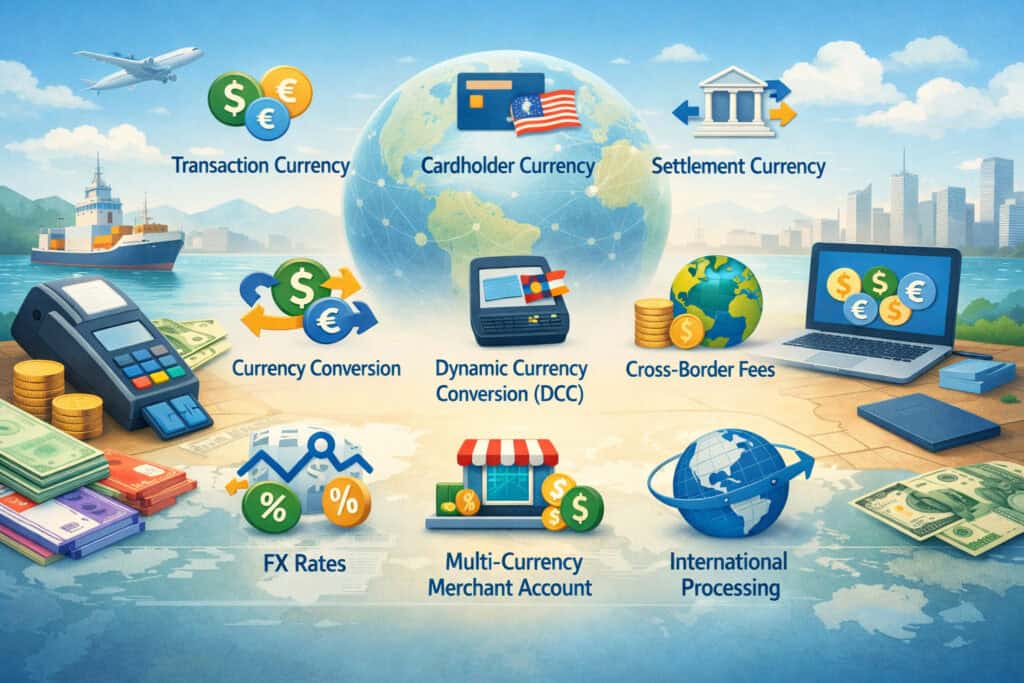
Before getting into setups, align on the vocabulary. Many “surprises” happen because teams mix up presentment currency (what the customer sees) with settlement currency (what you receive). Another common mismatch is confusing a “multi-currency checkout” (your pricing experience) with “multi-currency settlement” (your treasury reality).
Below is a working glossary you can share with your finance and ops stakeholders.
| Term | Plain-language meaning | Why it matters in multi-currency |
|---|---|---|
| Presentment currency | The currency the customer is charged in (the amount shown at checkout and on their card statement). | Impacts customer trust, conversion, refund expectations, and sometimes authorization behavior. |
| Settlement currency | The currency your acquiring/processor settles to your merchant account. | Determines whether you hold foreign currency, when conversion happens, and FX exposure. |
| FX conversion fees / exchange rate spread | The difference between the “reference” rate and the rate applied to convert funds (plus any explicit conversion fee). | Often the biggest cost driver. Can appear at checkout, at settlement, or at payout—sometimes more than once if you’re not careful. |
| Cross-border fees (high-level) | Network and/or issuer-related assessments when a transaction is considered cross-border (based on merchant/acquirer location vs issuer). | Multi-currency alone doesn’t eliminate these; local acquiring may reduce some cross-border classification but depends on setup. |
| Local acquiring vs international acquiring | Processing through an acquirer in/for the buyer’s region (local) vs processing through your primary/acquirer region (international). | Can affect approval rates, soft declines, routing options, and sometimes fee components. |
| Dynamic currency conversion (DCC) | A checkout/terminal feature that offers the buyer conversion into their “home” currency at the point of sale. | Often misunderstood as “multi-currency.” It’s a different model with different incentives and disclosures. |
What a multi-currency merchant account is (and what it isn’t)
A multi-currency merchant account is a payment processing setup that supports accepting card payments in multiple currencies and/or settling proceeds in multiple currencies—without forcing every transaction to be converted immediately into a single currency.
At a practical level, multi-currency capability usually includes one or more of the following:
- Multi-currency presentment: You can charge customers in their currency (local currency pricing), so checkout totals and card statements match what shoppers expect.
- Multi-currency settlement: You can receive funds in multiple currencies (payout currencies) and hold balances before converting, often with currency-specific sub-ledgers.
- Currency routing/smart routing: Your provider can route transactions by currency, region, or performance rules—sometimes choosing between local acquiring vs international acquiring.
What it is not:
- Not the same as “multi-currency checkout” alone: You can show multiple currencies at checkout but still settle everything in one currency with automatic conversion behind the scenes. That’s a present only.
- Not a guarantee of lower fees or better approvals: Multi-currency can improve outcomes, but results depend on your customer mix, your category, your fraud profile, issuer behavior, and whether your setup supports local acquiring.
- Not the same as DCC: DCC is a specific conversion offer presented to the player that often includes a disclosed markup and requires particular messaging. Multi-currency presentment is your pricing in a currency; DCC is an immediate conversion service offered at payment time.
For ecommerce brands and SaaS companies, multi-currency is typically about reducing friction (clear pricing, fewer surprises) and giving finance teams control (when to convert, how to reconcile). For service businesses, it’s often about invoice alignment and reducing disputes when clients expect to pay in a specific currency.
How multi-currency merchant accounts work end-to-end
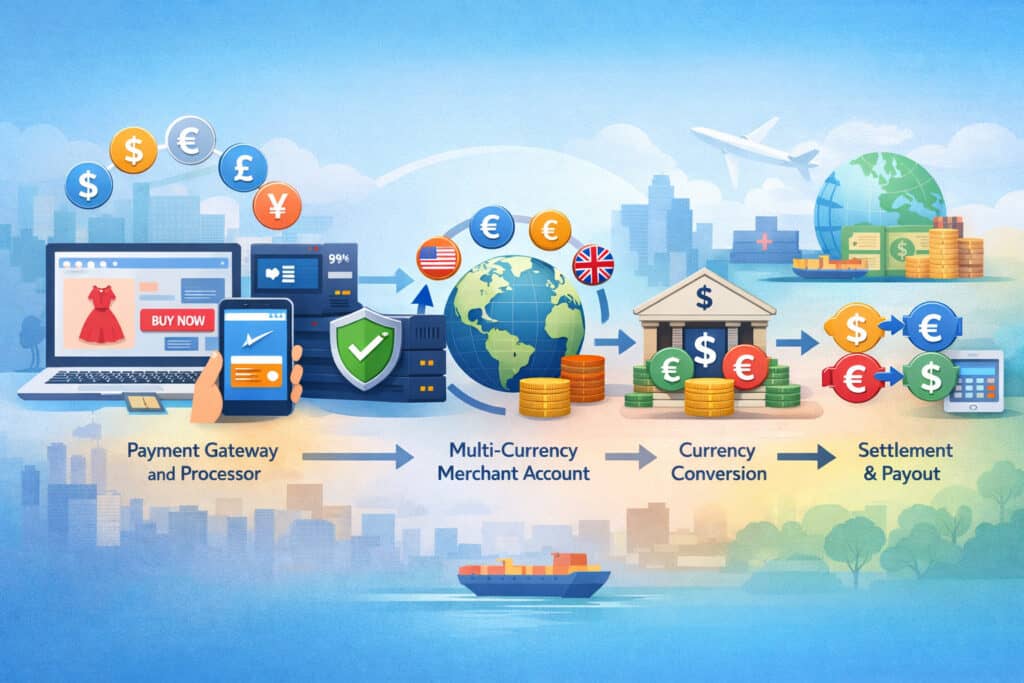
To understand costs and outcomes, you need the full lifecycle: checkout currency selection → authorization → clearing/presentment → settlement → payouts. Each step can introduce a currency decision—and each decision can affect approvals, fees, or accounting.
Checkout and currency selection
In multi-currency checkout, your site or app displays prices in a selected currency. That selection can be driven by:
- Customer choice (a currency selector)
- Location or browser signals (with a way to override)
- Account settings (common in SaaS)
- A pricing rule engine (e.g., region-based price books)
At checkout, you set the transaction’s presentment currency and amount. If your customer pays with a card, the authorization request is sent with that currency code and amount.
What can go wrong here:
- If your pricing rules are inconsistent (different rounding per SKU, tax inclusive vs exclusive differences), you can create “micro-mismatches” that complicate refunds and reconciliation.
- If you show a currency but later convert behind the scenes without clear messaging, customers may feel misled—even if technically correct.
Authorization (the real-time “approval” moment)
Authorization is where the card issuer approves or declines the transaction. The issuer sees the currency and amount, your merchant details, and risk signals (including fraud checks like CVV, address checks where applicable, and 3D Secure flows).
Approval rates can be influenced by:
- Currency familiarity (some issuers are more comfortable approving local-currency charges)
- Merchant/acquirer region alignment (local acquiring can help in some cases)
- Fraud profile and authentication (3DS can reduce issuer risk concerns in certain scenarios)
- Descriptor clarity (especially for cross-border purchases)
You won’t control issuer logic, but your setup can reduce avoidable friction.
Clearing and presentment (how the transaction “finalizes”)
After authorization, the transaction moves into clearing. This is where the final amount is presented through the network rails for settlement. In most standard setups, the presentment currency matches what you authorized—unless you’re using a model that converts at a different stage.
At this stage, you may see:
- Network assessments and pass-through components (provider dependent in how they bundle/describe them)
- Cross-border classification (high-level) depending on where your merchant is acquired relative to the issuer
Clearing is also where some disputes originate if the customer claims the final amount differs from expectations.
Settlement and merchant account balances
Settlement is when funds are credited to your merchant account (or processor balance). This is where multi-currency settlement becomes tangible.
Common patterns:
- Single-currency settlement: Regardless of presentment currency, everything is converted into one settlement currency automatically.
- Multi-currency settlement: Funds are credited in the presentment currency (or a defined set of currencies) to separate balances.
This is also where you must watch for the “double conversion” problem: for example, you present in Currency A, settle in Currency B, then your bank receives in Currency C—each step could add FX spread.
Payouts to your bank and settlement timelines
Finally, payouts transfer funds from the processor/acquirer environment to your bank account(s). Payout currencies and settlement timelines vary by provider, currency, and risk profile. Some providers allow:
- Payout to bank accounts in the same currency (reducing conversion events)
- Payout conversion at provider rates (convenient, but you must understand the spread)
- Holding balances and converting on demand (more control, more treasury responsibility)
The two big models: presentment vs settlement (and how providers combine them)

When people ask “how multi-currency merchant accounts work,” they’re usually asking about two separate capabilities that can be combined.
Model 1: Multi-currency presentment
Multi-currency presentation means the customer pays in their currency. Your site/app sets the currency at checkout, and the card is charged in that currency. This supports:
- Local currency pricing and cleaner customer experience
- Lower confusion at the bank statement level
- Potential improvements in card acceptance rates internationally (not guaranteed, but often helpful)
However, presentation alone does not mean you avoid FX. If you still settle in one currency, conversion happens—just later.
Where this model shines:
- Ecommerce with international traffic where transparent pricing improves conversion
- SaaS with regional plans, especially when customers expect stable monthly billing in their currency
- Service businesses issuing invoices with agreed currency terms
Model 2: Multi-currency settlement
Multi-currency settlement means you receive proceeds in multiple currencies and hold them as balances (or settle to currency-specific bank accounts). This can reduce FX surprises by letting you decide:
- When to convert
- How much to convert
- Whether to net refunds and chargebacks in the same currency
But it also introduces complexity:
- Reconciliation and accounting for multi-currency requires exchange rate handling and clear gain/loss logic
- Treasury operations must manage balances, liquidity, and conversions
- Forecasting becomes multi-currency, which can affect budgeting and reporting
Where this model shines:
- Businesses with meaningful costs in the same foreign currency (natural hedging)
- Marketplaces or platforms paying sellers in multiple currencies
- SaaS businesses with large subscription volume in key currencies
Combining presentment and settlement
Many modern providers allow you to present in multiple currencies and settle in multiple currencies, but the exact combination varies:
- Some support many presentment currencies but only a few settlement/payout currencies.
- Some support multi-currency settlement only via internal balances, not direct bank payouts.
- Some offer “local account details” (virtual IBANs or local account numbers) for collections and payouts, which can simplify treasury flows.
What to ask your provider:
- Which currencies can be used for presentment?
- Which currencies can be used for settlement?
- Which currencies can be used for payouts?
- Can you control FX timing (auto-convert vs manual)?
- Are there separate FX conversion fees vs built-in exchange rate spread?
Benefits and tradeoffs in 2026: what you gain, what you take on
Multi-currency setups are not purely a payments decision—they’re an operating model choice. The upside is real, but the tradeoffs are too.
Benefits: customer experience, conversion, and smoother international sales
When customers see prices in their currency, you reduce cognitive friction:
- Clear totals at checkout
- Fewer “I didn’t expect that amount” support tickets
- Better trust signals for first-time buyers
For subscription companies, billing in local currency can reduce churn triggers tied to “unexpected” bank conversion differences month to month. It also improves invoice clarity for procurement teams.
Benefits: approval rates and routing optionality
Card acceptance rates internationally can improve when issuers see:
- Currency and merchant details that align with what they expect
- Lower perceived fraud risk (often helped by strong authentication and fraud tooling)
If your provider supports currency routing / smart routing and local acquiring vs international acquiring, you may also gain flexibility to route transactions in a way that reduces soft declines in certain corridors. This is provider-specific and depends on network and acquiring coverage.
Tradeoffs: FX exposure and treasury complexity
If you move from auto-conversion to holding multiple currencies, you take on FX exposure:
- Balances can fluctuate in value relative to your reporting currency
- Conversions require policy: when you convert, who approves, and what rate source you accept
Even if you don’t treat this as “hedging,” you’re managing real operational risk. Many teams solve this with simple rules (e.g., convert on a schedule, keep a buffer balance, convert only what’s needed for payouts).
Tradeoffs: reconciliation overhead and reporting
Multi-currency increases the number of “dimensions” finance must reconcile:
- Orders in presentment currency
- Payouts in one or more currencies
- Fees charged in potentially different currencies
- Refunds and chargebacks that might land in later periods
This is solvable, but you need:
- A clear reporting cadence
- Consistent exchange rate methodology for accounting entries
- A way to match payouts to invoices/orders reliably
Fees explained (without invented rates)
Multi-currency costs are rarely just “one fee.” They’re a stack, and where each fee appears depends on your provider model. The goal isn’t to memorize network rules—it’s to know where costs hide.
FX markup/spread: the quiet cost center
FX conversion fees / exchange rate spread can show up as:
- A markup embedded in the rate (spread)
- An explicit conversion fee
- A mix of both
Key questions:
- When conversion happens, what’s the rate source?
- Is the markup fixed, tiered, or variable by corridor?
- Can you see the effective rate in reporting?
The biggest pitfall is multiple conversions. For example:
- Customer charged in Currency A
- Provider converts to Settlement Currency B
- Bank converts incoming payout to Currency C
That’s two conversion events, two spreads.
Cross-border fees (high-level) and network assessments
Some fees are related to how networks and issuers classify transactions. High-level, cross-border fees may apply when the issuer and merchant/acquirer are in different regions. Your provider may bundle these into a single “processing fee,” break them out, or pass them through.
What matters to you:
- Are cross-border or network assessments separated in reporting?
- Do they vary by card type or issuer region?
- Can local acquisition reduce cross-border classification in your most important corridors?
Provider conversion fees and payout/withdrawal fees
Providers may charge for:
- Converting balances (explicit fee)
- Withdrawing funds to bank accounts (payout fee)
- Faster payout schedules (where offered)
- Receiving bank fees on your side (bank receiving fees; high-level and bank-specific)
Because pricing is provider-specific, you should evaluate on total cost of ownership:
- FX costs
- Processing costs
- Payout costs
- Operational cost (reconciliation time, tooling, support burden)
Multi-currency account vs single-currency account: operations, reporting, and risk
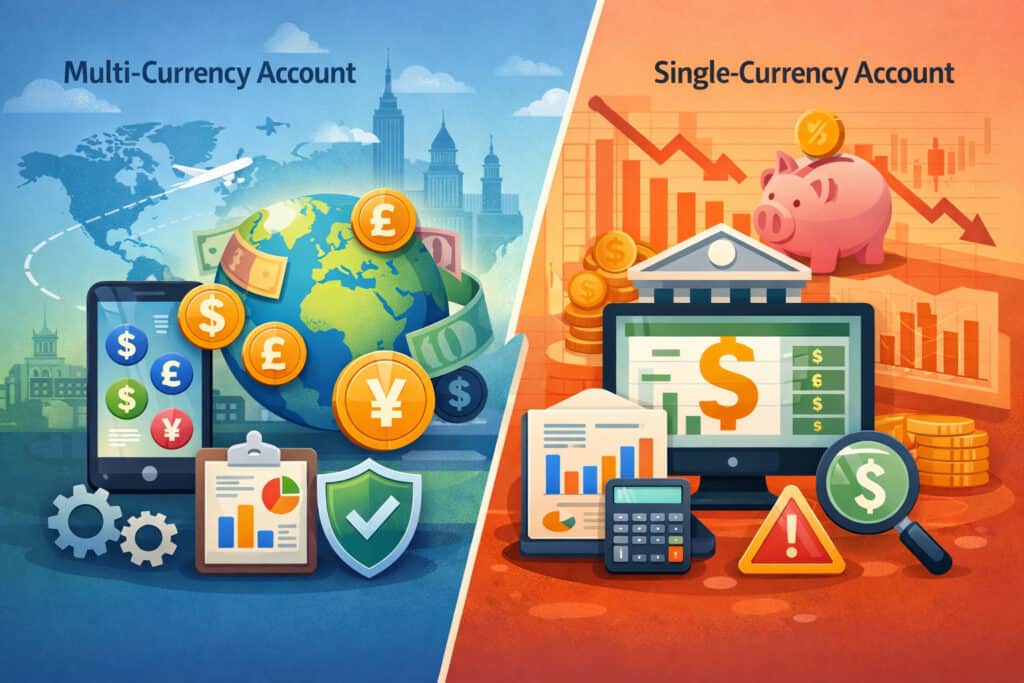
The decision isn’t just “can we accept multiple currencies?” It’s “how much complexity do we want in exchange for control?”
| Dimension | Single-currency account (auto-convert) | Multi-currency merchant account (presentment and/or settlement) |
|---|---|---|
| Customer pricing | May show local currency but often converts behind the scenes | Supports local currency pricing more cleanly; clearer presentment currency control |
| FX visibility | FX often bundled and harder to audit | More transparency if settlement balances and rates are reportable |
| Treasury complexity | Low—funds arrive in one currency | Medium to high—balances, conversions, payout currencies, controls |
| Reconciliation | Simpler but may obscure FX impact | More complex but more accurate if implemented well |
| Refund behavior | Refund amounts can diverge due to issuer FX or conversion | Better alignment if refunds occur in the same currency balance; still FX differences possible |
| Scaling internationally | Quick to launch; may underperform in some corridors | Better for mature global growth with clear finance processes |
| Risk exposure | Lower FX exposure; less control | Higher control; potential FX exposure and policy requirements |
Multi-currency checkout vs DCC: why they’re not the same
These terms get conflated constantly. They shouldn’t be.
Multi-currency checkout (local currency pricing)
Multi-currency checkout is your decision to price and charge in a currency. You set the currency, show the total, and the customer authorizes that amount in that currency.
This is often implemented via:
- Currency selector
- Location-based currency defaults
- Price books per region
- Rounding rules and tax rules per market segment
The customer experience is straightforward: “You are paying X in Currency Y.”
Dynamic Currency Conversion (DCC)
DCC is typically a feature at the point of payment that offers the payer conversion into their “home” currency. The conversion is performed as part of the payment experience and usually includes a disclosed rate and markup.
Key differences:
- Where it happens: DCC is a conversion service at payment time; multi-currency checkout is pricing and charging in a chosen currency.
- Who benefits: DCC economics vary; it’s not inherently better for the customer, and it requires careful disclosure.
- What it solves: DCC can reduce uncertainty for the payer by showing a home-currency amount, but it can also increase cost for them versus issuer conversion.
Why it matters for your business
If your goal is customer trust and fewer disputes, multi-currency checkout is usually the cleaner model. DCC can be appropriate in certain contexts, but it’s not a substitute for multi-currency presentment and settlement controls.
Refunds, partial refunds, and chargebacks in a multi-currency world
Refunds and disputes are where multi-currency complexity becomes visible to customers and to finance. Even with a perfect setup, the refunded amount on the customer’s statement can differ due to exchange rate movement and issuer conversion policies.
Why refund amounts may differ after FX
Common reasons:
- The original charge was in one currency, but the issuer converts to the cardholder’s billing currency using the issuer’s rate on the posting date.
- A refund may be processed on a different day with a different exchange rate.
- Some providers convert refunds differently depending on whether you hold a balance in the presentment currency.
- Fees may or may not be refunded depending on provider policies and network rules.
Even if you refund the exact presentment amount, the customer might see a different net amount in their home currency. That’s often outside your control.
Best practices for transparency and fewer escalations
Use clear language in refund policies:
- “Refunds are processed in the original transaction currency.”
- “Your bank may apply a different exchange rate at the time of refund.”
- “Any currency conversion fees charged by your bank are outside our control.”
Operationally:
- Refund in the original presentment currency when possible.
- Keep the transaction and refund linked by stable IDs in your system.
- For partial refunds, document rounding rules and tax/proration handling.
Chargeback management for international payments (brief)
International chargebacks can involve:
- Higher “friendly fraud” risk in certain corridors
- Confusion about descriptors, especially with cross-border purchases
- Shipping and delivery disputes where tracking evidence is critical
To reduce chargebacks:
- Use clear descriptors and customer support contact info
- Provide strong proof of delivery where applicable
- Use fraud tools (3DS where appropriate, velocity checks, device signals)
Who needs a multi-currency setup (and who doesn’t)
Not every business needs full multi-currency settlement. Many should start with presentment and graduate to settlement as volume grows.
Ecommerce brands
You likely benefit from multi-currency presentment if:
- You have significant international traffic
- Cart abandonment or support tickets suggest price confusion
- You want localized promotions and price psychology (ending prices, rounding)
You may benefit from multi-currency settlement if:
- You have meaningful refunds/returns in certain currencies
- You pay suppliers, logistics, or ad platforms in the same currency
- Your payout fees and conversions are a measurable cost center
SaaS and subscription companies
Presentment is often valuable for:
- Stable, predictable monthly billing in the customer’s currency
- Reducing customer complaints about bank conversion variability
- Aligning invoices for procurement teams
Settlement becomes valuable if:
- You have high volume in a few currencies
- You manage churn and refunds at scale
- You need cleaner revenue recognition and dispute netting in currency
Service businesses and high-ticket transactions
Presentment helps when contracts and invoices are in a specific currency. Settlement helps when:
- You regularly invoice in a foreign currency
- You want to avoid converting every payment immediately
- You need to pay subcontractors or partners in that currency
Marketplaces and platforms
Marketplaces are often the strongest case for multi-currency settlement because you may:
- Collect in multiple currencies
- Pay out to sellers in multiple currencies
- Need detailed audit trails and reconciliation by currency and user
Who may not need it (yet)
You might keep a simpler model if:
- International volume is small or sporadic
- You price everything in one currency and customers accept it without friction
- Your finance team is not ready to manage multi-currency accounting
- Your provider’s multi-currency reporting is weak (which can be worse than single-currency)
Step-by-step setup guide (2026-ready)
Here’s a practical path to implement multi-currency without creating operational debt. This applies whether you’re an ecommerce brand, SaaS company, or service business—just adapt the currency list and billing flows.
1) Choose target currencies based on demand and operational readiness
Start with evidence:
- Revenue by region (or by customer billing address)
- Support tickets related to pricing/FX
- Decline rates by issuer region (where available)
- Refund and chargeback patterns by region
Pick a small set:
- Your highest-revenue non-default currency
- One currency tied to meaningful cost outflows (ads, logistics, contractors)
- One “growth” currency where you expect expansion
Avoid launching too many currencies before your pricing and accounting systems can handle them.
2) Decide your settlement strategy: hold vs convert
This is the key decision. Options include:
- Auto-convert to a single currency: simpler treasury, less FX exposure, less control.
- Hold balances in multiple currencies: more control, better refund alignment, more complexity.
- Hybrid: hold key currencies, auto-convert the rest.
Define policy:
- Conversion frequency (daily/weekly/monthly)
- Approval controls (who can convert, thresholds)
- Buffer balances for refunds and chargebacks
3) Connect bank accounts by currency (high-level)
Depending on provider capabilities, you might:
- Use your existing bank accounts that can receive those currencies
- Open currency-specific accounts
- Use virtual IBANs / local account details (collection accounts) where offered
The objective is to reduce unnecessary conversions and simplify payouts. If your bank converts incoming foreign currency automatically, you may still experience spread—so validate how your bank handles incoming wires/ACH-like rails and whether you can maintain foreign currency balances.
4) Set pricing rules, rounding, and tax display logic
Pricing is a product decision and a finance decision.
Create rules for:
- Currency-specific rounding (e.g., ending prices)
- Subscription price books and proration logic
- Discounts and coupon math in each currency
- Tax inclusive vs exclusive display (as required by your market strategy)
Consistency matters more than perfection. Inconsistent rounding is a top cause of reconciliation headaches.
5) Configure reporting, accounting exports, and reconciliation workflow
Before going live:
- Confirm what transaction IDs persist across authorization → capture → refund → payout
- Ensure exports include currency fields for presentment and settlement
- Decide how you will record exchange rates (provider rate, bank rate, or accounting system rate)
- Establish a monthly cadence for FX gain/loss recognition (plain-language explanation below)
If you use a subscription billing platform, ensure it can store the invoice currency and map payments correctly.
6) Test transactions, refunds, and edge cases
Test like a finance team—not just like QA:
- Purchase in each currency
- Full refund and partial refund in each currency
- Chargeback simulation (where possible) or at least reporting review
- Payout reconciliation: can you tie payout lines to orders and refunds?
Common scenarios and the best multi-currency setup
Different business models call for different combinations of presentment, settlement, and routing. Use this matrix to choose a sensible default.
| Scenario | Goal | Recommended setup | Why it works |
|---|---|---|---|
| Sell in local currency, settle in one currency | Better conversion + simple treasury | Multi-currency presentment + single-currency settlement | Customers see local currency pricing, while finance keeps a single settlement flow. |
| Settle in multiple currencies | Reduce FX surprises and control conversion timing | Multi-currency presentment + multi-currency settlement + defined conversion policy | Lets you hold balances for refunds/expenses and convert on schedule. |
| Subscriptions | Predictable billing and fewer customer complaints | Currency-specific price books + consistent presentment currency + optional multi-currency settlement for top currencies | Reduces monthly variability due to issuer conversion; simplifies invoicing. |
| Marketplaces/platforms | Pay out to sellers in their currency | Multi-currency presentment + multi-currency settlement + multi-currency payout rails + strong reporting | Supports payout currencies and audit trails; reduces conversion churn and disputes. |
Accounting and reconciliation for multi-currency (without the pain)
Finance teams usually don’t mind multi-currency—what they mind is ambiguous data. Your goal is to ensure every payment event has a clear currency context and can be matched across systems.
Currency gains/losses
If you hold balances in multiple currencies, the value of those balances changes relative to your reporting currency. When you eventually convert or report, you may have:
- A gain (the foreign currency strengthened relative to your reporting currency)
- A loss (the foreign currency weakened)
You don’t need to become an FX trader to manage this. You just need:
- A consistent policy for when rates are recorded
- A consistent policy for when gains/losses are recognized in your accounting workflow
Many teams choose a simple approach: record revenue at the rate on the transaction date (or invoice date), and record conversions at the rate on the conversion date, with the difference tracked as gain/loss.
How to match payouts to invoices/orders
To reconcile cleanly, you need stable linkages:
- Order/invoice ID in your commerce or billing system
- Payment transaction ID from your provider
- Payout ID and payout line item IDs
- Refund/chargeback IDs that map back to the original payment
Best practices:
- Store both presentment and settlement currency fields in your database
- Capture fee line items per transaction and per payout
- Ensure your accounting export can group by currency and by payout date
Statements and reporting cadence
Define how often you reconcile:
- Daily: useful for fraud monitoring and operational cash flow
- Weekly: common for payout and refund monitoring
- Monthly: required for close, gain/loss recognition, and audit trails
If your provider’s reporting changes format frequently, that’s a risk. In 2026, prioritize providers with:
- Versioned exports or stable schemas
- Webhooks/events that include currency fields
- Clear documentation of payout timelines and fee application
Risk and compliance basics: protect approvals and reduce surprises
Multi-currency doesn’t replace good risk controls—it often increases the need for them, because cross-border transactions can attract more scrutiny from issuers and fraudsters.
Fraud tools (high-level): AVS/CVV, 3DS, and smart controls
Key controls include:
- CVV checks: Helps validate card-present risk signals.
- AVS checks: Where supported, address verification can reduce certain fraud patterns, but coverage varies by region.
- 3D Secure (3DS): Adds authentication that can improve issuer confidence in some situations and reduce certain dispute types, depending on rules and implementation.
- Velocity limits, device fingerprinting, and behavioral checks: Helps prevent bot-driven fraud and account takeover.
Use risk-based logic rather than blanket rules. For example:
- Stronger authentication for high-risk orders or high-ticket items
- Lower friction for repeat customers with good history
PCI compliance basics (brief): don’t store card data
PCI compliance is about protecting cardholder data. The safest operational posture is:
- Don’t store raw card numbers on your servers
- Use tokenization via your payment provider
- Restrict access permissions and maintain audit trails
Even if your provider handles most PCI scope, your implementation choices matter (e.g., whether you embed hosted fields vs handle sensitive fields yourself).
Permissions and audit trails
In a multi-currency settlement model, controls matter:
- Who can initiate conversions?
- Who can add/change payout bank accounts?
- Who can adjust routing or currency rules?
- Are changes logged with timestamps and user identity?
Good audit trails reduce both fraud risk and internal mistakes—two common sources of “surprises.”
Implementation and risk checklist (setup, compliance, reconciliation, refunds)
Use this checklist as your internal implementation plan and as a vendor evaluation tool.
| Area | What to set up | Why it matters | Owner |
|---|---|---|---|
| Currency scope | Select target currencies, document why, set rollout phases | Prevents overreach and incomplete coverage | Finance + Product |
| Presentment rules | Multi-currency checkout, price books, rounding rules | Reduces customer confusion and refund disputes | Product + Engineering |
| Settlement strategy | Decide hold vs convert; define conversion policy | Controls FX exposure and cash flow | Finance/Treasury |
| Payout configuration | Bank accounts by currency or payout conversion settings | Avoids double conversion; improves predictability | Finance/Ops |
| Reporting & exports | Ensure currency fields in exports; stable IDs; payout statements | Makes reconciliation possible at scale | Finance + Data |
| Refund handling | Refund in original currency where possible; messaging for FX differences | Reduces escalations and chargebacks | Support + Finance |
| Chargeback workflow | Evidence templates, descriptor clarity, timelines by region | Improves dispute outcomes | Risk/Ops |
| Fraud controls | CVV/AVS/3DS strategy; velocity rules; monitoring | Protects approvals and loss rates | Risk + Engineering |
| PCI basics | Tokenization; avoid storing card data; access controls | Reduces compliance scope and breach risk | Security + Engineering |
| Audit trails | Permissions, approvals, and logging for currency and bank changes | Prevents internal errors and fraud | Security + Finance |
FAQs
Q1) What is a multi-currency merchant account?
Answer: A multi-currency merchant account is a payment processing setup that supports taking payments in multiple currencies and/or settling proceeds in multiple currencies.
Some setups only support multi-currency presentment (charging customers in their currency), while others support multi-currency settlement (receiving and holding multiple currencies before payout or conversion).
The key is understanding whether your provider supports presentment, settlement, payouts, and reporting across currencies—because “multi-currency” can mean different things in different products.
Q2) Do I need separate bank accounts for each currency?
Answer: Not always. Some providers can convert and pay out to a single bank account in one currency. Others support payouts to bank accounts in multiple currencies, and some offer local account details (virtual IBANs or local account numbers) to receive and hold funds.
Whether you need separate bank accounts depends on your settlement strategy: if you want to hold and spend in a currency, a same-currency bank account can reduce conversion events. If you’re fine converting everything, you may not need separate accounts—but you should still understand the FX spread applied.
Q3) Is it better to charge customers in their currency?
Answer: Often, yes for customer experience. Local currency pricing can reduce checkout friction, improve trust, and make invoices clearer for business customers.
It may also help card acceptance rates internationally in some scenarios, especially when combined with good fraud controls and appropriate routing. However, it can increase complexity for pricing strategy and accounting, so the “best” approach depends on your operational maturity and volume.
Q4) How do exchange rates and FX spreads work?
Answer: When money is converted from one currency to another, the applied rate usually differs from a public “reference” rate. The difference is the exchange rate spread, and some providers also add explicit FX conversion fees.
The important part is where conversion happens (checkout, settlement, or payout) and whether it can happen more than once in your flow. The best practice is to ensure you can see the effective rate and any explicit fees in reporting so finance can reconcile costs.
Q5) Can I avoid cross-border fees with multi-currency processing?
Answer: Multi-currency presentment alone does not eliminate cross-border fees. Cross-border classification (high-level) depends on factors like issuer region and where your transactions are acquired/processed.
In some cases, local acquiring can reduce cross-border classification for certain transactions, but it’s provider-specific and depends on acquiring coverage and network rules. The practical approach is to evaluate your top corridors and ask providers how transactions are routed and classified.
Q6) How do refunds work when FX rates change?
Answer: Refunds are typically processed in the original transaction currency. If the customer’s account is in a different currency, their bank may convert the refund using the exchange rate on the refund posting date, which may differ from the original purchase date.
As a result, the net amount in the customer’s home currency can be slightly different. The best practice is transparency: communicate that FX differences may occur due to bank conversion, and ensure your support team can explain the difference clearly.
Q7) What’s the difference between multi-currency checkout and DCC?
Answer: Multi-currency checkout (local currency pricing) is when you price and charge in a selected currency and the customer authorizes that currency amount. DCC (dynamic currency conversion) is a conversion offer at payment time that typically converts into the payer’s home currency using a disclosed rate and markup.
DCC is not the same as multi-currency settlement, and it has different disclosure expectations and customer impact. If your goal is simpler pricing and fewer surprises, multi-currency checkout is often the clearer model.
Q8) Does multi-currency improve approval rates?
Answer: It can, but it’s not guaranteed. Approval rates depend on issuer behavior, risk signals, fraud controls, and routing. Multi-currency presentation can help reduce confusion and align transaction details with customer expectations.
If your provider supports currency routing / smart routing and local acquiring, you may see improvements in specific corridors. The best approach is to test: compare approval rates by currency and by routing strategy while keeping fraud controls consistent.
Q9) How do I reconcile multi-currency payouts in accounting?
Answer: You need consistent identifiers and currency fields. At minimum, track: presentment currency, settlement currency, payout currency, transaction IDs, refund IDs, and payout IDs. Then define your accounting policy for exchange rates and gain/loss recognition.
Many teams reconcile by payout: match payout line items to orders/invoices, record fees, and handle conversion differences as FX gain/loss. The easier your provider makes exporting stable data, the easier reconciliation becomes.
Q10) Which currencies should I support first?
Answer: Start with evidence: your top currencies by revenue, traffic, and support volume. Many businesses begin with the top 1–3 currencies that represent the majority of international demand.
Add currencies in phases after confirming: pricing rules, rounding, refund handling, and payout reconciliation all work smoothly. “More currencies” is not always better if it increases operational burden without meaningful revenue impact.
Q11) Can I offer multi-currency pricing without multi-currency settlement?
Answer: Yes. That’s a common first step. You can present prices in multiple currencies and charge customers in their currency while still settling everything into one currency via automatic conversion.
This improves the customer experience but may not reduce FX-related costs. It can still reduce “surprise” support tickets if the customer’s statement matches the currency they selected.
Q12) What is currency routing or smart routing?
Answer: Currency routing (sometimes called smart routing) is when a provider routes transactions through different acquiring paths based on rules—like currency, region, card type, or performance signals.
The goal is often to improve acceptance rates or reduce processing friction. This is highly provider-specific: routing options, coverage, and transparency vary widely. If routing is part of your strategy, ask for reporting that shows which route was used and how it affected approvals.
Q13) How do chargebacks differ for international payments?
Answer: International payments can have higher chargeback risk due to descriptor confusion, delivery disputes, and customer expectations around returns and refunds.
Strong practices include clear descriptors, fast support responses, strong fulfillment evidence, and risk controls like 3DS for higher-risk transactions. Also ensure your chargeback workflow can handle multi-currency evidence and representation documentation consistently.
Q14) Do multi-currency merchant accounts affect settlement timelines?
Answer: They can. Settlement timelines depend on your provider’s payout schedule, risk settings, currency, and banking rails. Some currencies or payout methods may take longer or have different cutoffs.
If timing matters (payroll, vendor payments, cash flow), confirm payout schedules per currency and ensure you understand any holds, reserve policies, or cutoff times that affect when funds reach your bank.
Conclusion
Multi-currency merchant accounts work best when you match the setup to your operating reality. If your priority is a smoother customer experience and clearer pricing, start with multi-currency presentment (local currency pricing) while keeping settlement simple.
If you have meaningful volume in a few currencies—or regular refunds, disputes, or expenses in those currencies—add multi-currency settlement so you can control when conversion happens and reduce avoidable “double conversion” moments.
To decide what’s right for you, pressure-test your flow from checkout to payout. Focus on where currency changes hands (presentment → settlement → payout), how approval rates vary by corridor, and whether finance can reconcile payouts without manual workarounds.
The “best” model isn’t the one with the most currencies—it’s the one your team can run reliably every month.