Offshore merchant accounts can sound like a shortcut—until you look closely at what they are actually designed to do: support cross-border processing, offshore acquiring, and multi-currency settlement for businesses with international customers, complex risk profiles, or global operational needs.
Used correctly, they can improve payment acceptance and settlement flexibility. Used poorly (or sourced from the wrong provider), they can create serious exposure: payout delays and fund holds, heavier KYC/AML requirements, tougher underwriting for high-risk merchants, and contractual terms that are hard to unwind.
This guide is written for business owners and finance/ops teams evaluating offshore payment processing in 2026. It separates facts from opinion, avoids hype, and focuses on compliance, transparency, and practical risk management.
What an offshore merchant account is (and what it isn’t)
An offshore merchant account is a card-processing merchant account where the acquiring relationship (the acquiring bank and/or acquiring institution that sponsors card acceptance) is established outside your day-to-day operating market, often to serve cross-border sales and settlement needs.
It’s a way to accept card payments through an acquiring setup that may be better positioned for international cardholders, certain risk categories, or multi-currency payout structures.
What it is:
- A payment acceptance setup linked to an acquiring partner that can support cross-border processing and sometimes local acquiring routes for certain customer segments.
- A structure that may offer multi-currency settlement (e.g., receive payouts in multiple currencies) or alternative settlement routing.
- A risk-managed relationship governed by strict underwriting, ongoing monitoring, and contract terms that protect the acquiring side from losses.
What it isn’t:
- Not a way to “avoid” compliance checks. Any provider suggesting “no KYC” or “no underwriting” is a red flag.
- Not a method to hide beneficial ownership. Beneficial ownership verification and UBO/BO (ultimate beneficial owner/beneficial owner) disclosure are standard and increasingly strict.
- Not an appropriate tool to process prohibited or restricted products. Card networks and acquirers enforce prohibited industry policies and monitoring.
- Not “better” by default than domestic or multi-currency merchant accounts; it’s a tradeoff with specific operational and risk implications.
Opinion (risk-analyst perspective): Most teams underestimate the operational overhead (reconciliation, disputes, reserve accounting, policy enforcement) and overestimate how much an offshore setup alone improves approval rates.
The best outcomes usually come from pairing the right acquiring strategy with strong merchant discipline: accurate descriptors, clear policies, fraud controls, and mature chargeback workflows.
How offshore merchant accounts work end-to-end (onboarding → payouts → reserves)
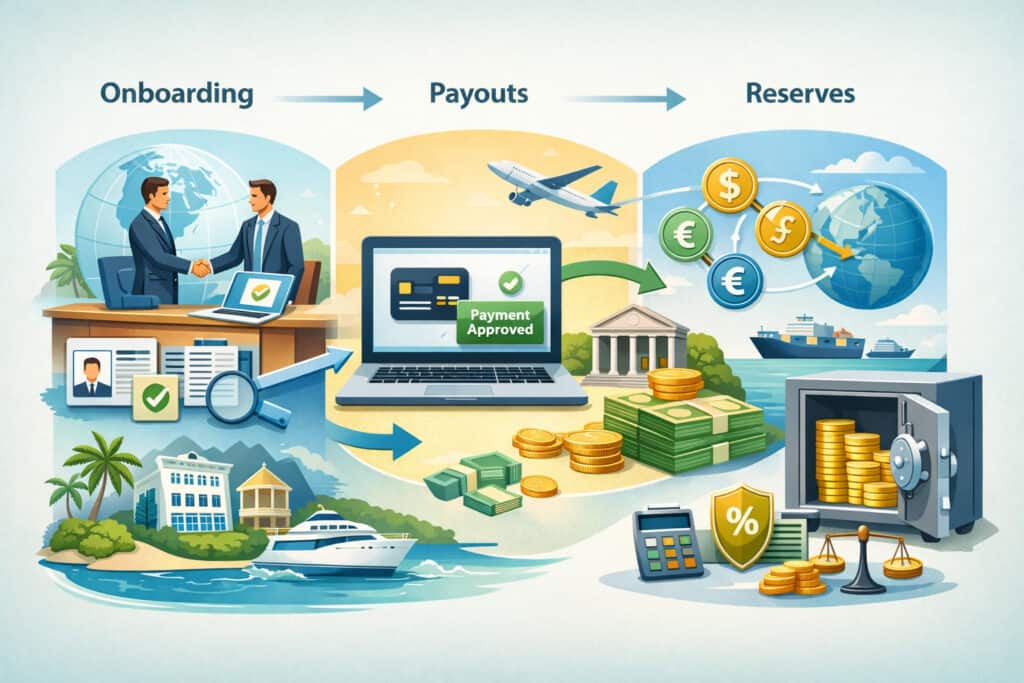
Understanding how offshore merchant accounts work end-to-end helps you evaluate whether a provider is legitimate and whether the operating model fits your business. While the exact flow varies by provider, the sequence is consistent: onboarding/KYC → underwriting → processing → settlement → payouts → reserves.
1) Onboarding & KYC/AML requirements
You submit identity and business documentation. The provider verifies your company, your control persons, and your beneficial owners.
Expect screening for sanctions and prohibited activity, plus checks on your website and customer-facing policies. This stage is about “who you are” and “what you sell,” as well as whether you can operate transparently.
2) Underwriting (including high-risk evaluation)
Underwriting assesses “how you operate,” including chargeback risk, fulfillment model, billing practices (one-time vs recurring), and historical performance if you have prior processing.
Underwriters classify your business by MCC code and risk category (high level), set volume and ticket thresholds, and decide whether reserves are required (including a rolling reserve model).
3) Transaction processing
When a customer pays, the payment processor routes authorization requests through the card network to the issuer for approval/decline. Offshore acquiring can sometimes influence routing options, but it does not override issuer decisions.
Fraud controls like AVS/CVV and 3DS (high-level) can materially affect approval quality, dispute rates, and issuer trust.
4) Settlement & funding
Approved transactions are captured and settled in batches. Settlement timing can be longer in cross-border scenarios due to additional layers (currency conversion, compliance checks, risk monitoring). Your provider may pay out in one currency, multiple currencies, or according to a settlement schedule.
5) Payouts, holds, and reserves
Payouts may be delayed or partially held if your account has a reserve, if dispute ratios spike, or if the acquirer flags unusual activity. Reserve accounting matters: you should be able to reconcile reserve deductions, releases, and chargeback debits clearly.
Payment processor vs acquiring bank: who does what (and why it matters offshore)

Many teams use “processor” and “acquirer” interchangeably. In reality, the payment processor vs acquiring bank distinction is one of the most important concepts for offshore setups, because it determines who holds risk, who sets enforcement rules, and who can freeze or terminate an account.
Payment processor (or payment facilitator / gateway stack)
This is the technology and operational layer that connects your checkout, gateway, fraud tools, and transaction routing. The processor provides reporting, dispute tools, tokenization, and sometimes risk monitoring.
Some processors are also payment facilitators that onboard merchants under a master arrangement, which can simplify setup but still requires KYC and monitoring.
Acquiring bank / acquiring institution
The acquirer sponsors your ability to accept card payments, interfaces with card networks, and is ultimately responsible for ensuring merchants follow network and compliance rules.
If disputes, fraud, or prohibited activity occur, the acquirer bears financial and regulatory exposure—so the acquirer sets many of the tightest controls: reserves, volume caps, and termination rights.
Why this matters offshore
In offshore merchant account structures, the acquiring relationship may be less familiar to your internal team. You should still insist on clarity:
- Who is the acquiring partner?
- Is the acquiring identity disclosed contractually?
- Who controls reserve decisions?
- Who adjudicates termination or “high-risk review” actions?
- Who is responsible for chargeback monitoring programs (high-level) compliance?
Opinion (practical governance): If your provider can’t clearly identify the acquiring institution (or hides behind vague “banking partners”), you’ll struggle during disputes, audits, or payout interruptions. Transparency now saves weeks later.
Legitimate use cases vs red flags (what offshore is for—and what it should never be for)
Offshore structures exist for legitimate commercial reasons. They also attract bad actors marketing them as a way to “get around” rules. It’s critical to separate legitimate use cases from red flags, both for compliance and for the long-term stability of your payments.
Legitimate reasons businesses consider offshore processing
- Global customer base: You sell internationally and need stronger acceptance patterns for cross-border cardholders.
- Multi-currency settlement needs: You want to receive payouts in multiple currencies to match expenses, reduce conversion frequency, or simplify treasury operations.
- Local acquiring for higher approvals (high-level): Some providers offer routing options that can improve approvals for certain customer segments by aligning with regional issuer preferences—without bypassing any network rules.
- Entity structure considerations (general): Some businesses have legitimate operational entities aligned to where teams, suppliers, or fulfillment operate, and want payment settlement to match the structure.
Red flags (what offshore should not be used for)
- Evading taxes or reporting.
- Bypassing KYC/AML requirements or hiding beneficial ownership.
- Processing restricted or prohibited products under misleading descriptors or hidden websites.
- Circumventing network rules, brand standards, or consumer protection obligations.
Offshore merchant account requirements: what underwriters expect in 2026

Offshore merchant account requirements have tightened in recent years due to increased network scrutiny, financial crime controls, and consumer-protection enforcement. Underwriters generally want to see three things: who you are (KYC), how you operate (risk model), and whether customers will complain (dispute risk).
Typical categories of requirements include:
- Business formation documents and proof of good standing (or equivalent).
- Beneficial ownership verification (UBO/BO) and identity checks for control persons.
- Processing history (if any)—statements, chargeback ratios, refund rates, and prior reserve structures.
- Financials—bank statements, P&L snapshots, cash flow stability, and evidence you can cover refunds/chargebacks.
- Website and policies—clear refund/cancellation/shipping, privacy disclosures, contact information, and accurate product descriptions.
- Product/service description + delivery/fulfillment proof—how you deliver value, timelines, tracking, digital access logs, or service milestones.
- Compliance attestations—acknowledgement of prohibited industries (general), screening controls, and agreement to ongoing monitoring.
Expect additional questions if you operate in high-risk offshore merchant accounts categories (high-level), such as subscription billing, advance delivery, high average tickets, regulated verticals, or products with elevated refund/chargeback patterns.
Offshore merchant account requirements checklist (documents + why they’re needed)
Below is a practical checklist you can use to prepare an international merchant account setup package. Requirements vary, but this table captures the most common documentation and why underwriters ask for it.
| Requirement / Document | What it proves | Why it matters to underwriting (2026 lens) |
|---|---|---|
| Business formation documents | Legal existence and ownership structure | Confirms the merchant is a real entity and matches the contract counterparty |
| Proof of operational address | Operating footprint and contactability | Reduces fraud risk and supports dispute handling/consumer inquiries |
| Beneficial ownership (UBO/BO) disclosure | Who ultimately controls/benefits | Enables beneficial ownership verification and financial crime screening |
| IDs for owners/control persons | Identity verification | Core KYC/AML requirements and sanctions screening input |
| Bank statements (recent months) | Cash flow and refund capacity | Shows you can cover refunds, chargebacks, and reserve requirements |
| Financial statements (as available) | Business viability | Supports volume approvals, ticket limits, and long-term stability |
| Processing history statements | Past performance | Underwriters evaluate dispute/refund ratios and prior termination issues |
| Product/service description | What you sell and how it’s delivered | Helps classify MCC code and risk category (high-level) and spot prohibited activity |
| Fulfillment evidence (tracking, access logs, milestones) | Delivery behavior | Reduces “item not received” or “service not provided” disputes |
| Website screenshots + live URL review | Customer-facing transparency | Underwriters verify policies, claims, and contact details |
| Refund/cancellation/shipping policies | Consumer expectations | Clear policies reduce disputes and support representment evidence |
| Privacy policy + data handling summary | Data governance | Supports data privacy and PCI compliance basics expectations |
| Chargeback management plan (brief) | Operational readiness | Shows you can respond to disputes and monitor ratios |
| Compliance attestations | Acknowledgement of restrictions | Confirms you will screen prohibited industries and follow rules |
Risks of offshore merchant accounts: practical, operational, and contractual

The risks of offshore merchant accounts are not theoretical. Most show up as operational friction (funding delays, reserves, reconciliation complexity) and contractual asymmetry (the provider can act quickly; merchants often can’t). A balanced evaluation should cover at least these categories:
1) Fund holds, reserves, and payout unpredictability
Offshore setups frequently involve reserves because cross-border disputes can arrive later, refunds may be harder to execute cleanly across currencies, and enforcement is stricter when fraud signals appear. A rolling reserve can materially affect working capital. You also may see payout delays and fund holds triggered by sudden volume changes, marketing spikes, or shifts in ticket size.
2) Longer settlement times and operational cash planning
Cross-border settlement can include additional steps: compliance checks, currency conversion timing, and layered risk monitoring. Even if the provider advertises fast payouts, real-world timing can vary by chargeback risk, seasonality, and account age.
3) Higher dispute exposure in cross-border environments
International customers may be more likely to dispute due to shipping timelines, language gaps, unclear descriptors, or customer support delays. Issuers may scrutinize cross-border transactions differently. If you don’t have strong policies and proof of delivery, your dispute loss rate can rise quickly.
4) FX costs and reconciliation complexity
FX is not just “a fee.” It’s often a spread/markup embedded in conversion rates, plus operational overhead: matching settlement currencies to invoices, handling partial refunds, and tracking reserve balances across currency conversions.
5) Provider quality risk and scams
Offshore marketing attracts low-quality intermediaries. If the acquiring identity is unclear, fees are vague, or “approval” sounds too easy, you risk losing money and time—sometimes with frozen funds and no credible escalation path.
6) Contract lock-ins and termination risk
Contracts may include termination clauses that allow rapid shutdowns for policy breaches, ratio spikes, or “reputational risk.” If you don’t understand triggers and timelines, you can lose processing capacity during peak revenue windows.
Risk matrix: warning signs and mitigation steps
Use this matrix during provider selection and ongoing monitoring. It’s designed to translate risk into observable warning signs and concrete mitigation actions.
| Risk type | Warning signs | Mitigation steps (practical) |
|---|---|---|
| Reserve / liquidity risk | High reserve with unclear release terms; sudden hold triggers; vague reserve accounting | Negotiate written reserve terms; model worst-case cash impact; reconcile reserve ledger monthly |
| Payout delay risk | “Instant payouts” claims with no SLA; inconsistent funding cadence; unexplained delays | Get payout timing in writing; set cash buffer; maintain backup processing option |
| Chargeback ratio risk | Cross-border spikes; unclear descriptors; slow customer support responses | Improve descriptor + receipts; tighten policies; build chargeback workflow and evidence library |
| FX / reconciliation risk | Multiple conversion steps; unclear FX rates; settlement currency mismatch | Ask for FX methodology; align invoicing and settlement; build reconciliation SOPs |
| Provider legitimacy risk | “No KYC” promises; hidden acquiring bank identity; vague fees | Verify acquiring relationship; demand full fee schedule; run references and compliance checks |
| Compliance / prohibited activity risk | Provider encourages “workarounds”; unclear prohibited industries policy | Choose compliance-first provider; maintain product screening; document KYC/AML controls |
| Contract/termination risk | One-sided termination clauses; long lock-in; penalties for volume changes | Review contract carefully; negotiate notice periods; keep alternate acquirer readiness |
| Data security / PCI risk | No PCI guidance; weak security posture; unclear data handling | Use PCI-compliant gateway; tokenize; follow data privacy and PCI compliance basics |
Cost structure explained (without invented rates): fees, FX, reserves, and hidden friction
Offshore pricing is rarely “just a processing rate.” A transparent provider will separate cost drivers and explain how they change with risk, volume, and dispute performance. Here are the main components—without assuming or inventing specific pricing:
Processing fees and cross-border cost layers (high-level)
Your effective cost may include:
- Core processing markup (provider margin)
- Network-related and issuer-related components that can vary by card type and transaction attributes
- Additional cross-border handling layers depending on how the transaction routes and settles
- Monthly/annual account fees, gateway fees, and reporting fees
FX spread / markup and settlement currency choices
FX can be priced as:
- A spread embedded in the conversion rate you receive
- A separate markup line item
- A combination of both, depending on how the provider handles conversion and treasury
Even when the provider offers multi-currency settlement, you still need to understand:
- When conversion happens (authorization, settlement, payout)
- Whether refunds are processed at original rates or current rates
- How FX differences are handled for partial refunds and chargebacks
Reserve models (rolling reserve, capped reserve, and hybrids)
Common reserve structures include:
- Rolling reserve: A percentage of settled volume is withheld and released after a fixed number of days, continuously rolling forward.
- Capped reserve: Withholding continues until a target reserve balance is reached, then may reduce—subject to performance.
- Hybrid: A smaller rolling reserve plus a minimum reserve floor.
Monthly minimums and volume commitments
Some providers include monthly minimum processing commitments, which can create pressure to route more volume than is operationally safe. Volume spikes can also trigger underwriting reviews.
Fees and contract terms to watch: reserves, holds, payout timing, disputes, FX
This table is designed for contract review and side-by-side comparisons. The goal is not to “find the cheapest,” but to identify clauses that can cause real operational pain.
| Fee / Term area | What to look for | Why it matters |
|---|---|---|
| Reserve (rolling or capped) | % withheld, release schedule, reserve triggers, reporting transparency | Determines working capital impact and how quickly funds are accessible |
| Payout timing | Funding cadence, cutoff times, settlement delays, hold triggers | Drives cash planning; unclear terms lead to surprise delays |
| Fund holds / investigations | Conditions for holds, documentation requirements, review timelines | Impacts business continuity during risk reviews |
| Chargeback fees & representment | Per-dispute fees, win/loss handling, evidence requirements | High dispute volume becomes expensive quickly |
| Refund handling | Refund time limits, partial refund rules, FX handling on refunds | Misalignment increases disputes and reconciliation burden |
| FX pricing | Spread methodology, reference rate, conversion timing | Can materially affect margins; impacts forecasting |
| Termination clauses | “For cause” vs “for convenience,” notice periods, fee penalties | One-sided clauses increase shutdown risk |
| Volume/ticket limits | Maximum ticket size, monthly caps, ramp policies | Avoids sudden reviews when marketing or seasonality shifts |
| PCI & security obligations | Merchant responsibilities, breach terms, tokenization support | Security issues can lead to fines, termination, and reputational damage |
Red flags and scam avoidance: what to verify before you sign
Scams in this space often exploit urgency (“your account must be set up today”), complexity (“don’t worry about the bank”), and secrecy (“we can’t disclose details”). A compliance-first approach is your best defense.
Red flags to treat as deal-breakers
- “No KYC” or “no underwriting” promises: Real offshore acquiring requires KYC/AML checks. Anything else is either non-compliant or unstable.
- Vague fee schedules: If fees can’t be listed clearly—or if the provider refuses a full schedule—expect surprises.
- Unclear acquiring bank identity: You should know who the acquiring institution is, at least contractually, and how escalation works.
- Unrealistic approval guarantees: Approvals depend on issuers, risk controls, and accurate setup—not marketing promises.
- Pressure to misrepresent products or descriptors: Misrepresentation is a fast path to termination and funds being held during investigation.
What to verify (practical due diligence)
- Ask for a written overview of the acquiring relationship and responsibilities.
- Demand a complete fee schedule and contract draft before onboarding.
- Confirm dispute handling workflows and reporting access.
- Validate that the provider supports mainstream fraud tools and compliance monitoring.
- Run a pilot volume ramp rather than moving all volume at once.
How to reduce risk if going offshore: policies, fraud controls, and operational discipline
If you choose offshore processing, your job is to reduce uncertainty for issuers and acquirers. That means making customer experiences predictable, disputes defensible, and compliance visible.
Strengthen refund policies and customer support
Clear policies reduce disputes. Aim for:
- Visible refund/cancellation terms before purchase
- Fast, documented customer support responses
- Easy-to-find contact methods on receipts and checkout
Use fraud tools intelligently (high-level)
Core tools include:
- AVS/CVV checks where applicable
- 3DS for scenarios where issuer authentication reduces fraud and can improve dispute outcomes
- Velocity checks and device fingerprinting (if supported)
- Manual review for high-risk orders (high tickets, mismatched data, proxy usage signals)
Build proof of delivery / performance
For physical goods: tracking, carrier scans, delivery confirmation. For digital goods/services: access logs, download timestamps, IP/device logs, milestone sign-offs, and service tickets. This evidence is essential for representation and for underwriting confidence.
Run chargeback management like an operational function
A sustainable workflow includes:
- Daily dispute monitoring
- Categorized root-cause analysis (fraud vs service vs fulfillment)
- A response library and evidence checklist
- Policy adjustments based on patterns (not guesswork)
Contract review checklist (non-negotiables)
- Clear reserve terms and release timelines
- Written payout cadence and hold triggers
- Termination clauses that allow notice and remediation where possible
- Transparent dispute fees and reporting
- A defined escalation pathway
Alternatives to offshore accounts (and when they’re better)
Offshore isn’t the only route to cross-border acceptance. In many cases, alternatives can offer better predictability, faster payouts, and easier compliance alignment—especially if your primary objective is multi-currency settlement or improved approvals without complexity.
Domestic high-risk merchant accounts (when risk profile is the issue)
If you’re categorized as high-risk due to your vertical, billing model, or fulfillment timeline, a specialist domestic provider can sometimes deliver:
- More predictable support and escalation
- Clearer legal alignment and dispute handling
- Comparable fraud and chargeback tooling without cross-border friction
This can be a better fit if your customers are mostly local and offshore is being considered solely due to the risk category.
Multi-currency merchant accounts (when treasury is the main pain point)
If the goal is multi-currency settlement and simplified treasury:
- A multi-currency merchant account or treasury product may solve the problem without shifting acquiring offshore.
- This can reduce reconciliation complexity and improve reporting clarity while keeping your acquiring relationship closer to home.
Local acquiring via supported providers (when approvals are the objective)
Some providers offer access to local acquiring routes via supported networks and compliance frameworks. This can improve acceptance for international customers while maintaining transparency and strong controls.
Improve underwriting readiness (often the highest ROI)
Sometimes the best “alternative” is making your current setup underwriter-friendly:
- Clean up policies and checkout disclosures
- Improve descriptor clarity and receipts
- Reduce disputes through support and fulfillment evidence
- Build processing history gradually with stable metrics
Opinion (what I see work most often): Teams that treat underwriting readiness as a project—rather than a paperwork chore—tend to secure better terms, lower reserves over time, and fewer disruptive holds.
Step-by-step “approval-ready” setup guide for offshore merchant accounts
This is a practical implementation sequence you can run internally. It reduces surprises and helps you evaluate providers objectively.
Step 1: Prepare documents (and make them consistent)
Gather your formation documents, ownership disclosures, IDs, bank statements, and any processing history. Ensure names, addresses, and ownership percentages match across documents. If you have prior processing, summarize performance with context (seasonality, product changes, improvements made).
Step 2: Clean up website and policies before underwriting reviews it
Underwriters will review your customer-facing presence. Update:
- Refund/cancellation/shipping terms (clear timelines, conditions)
- Product descriptions (no vague claims; match what customers receive)
- Contact information (email + phone/chat where possible)
- Privacy disclosures and data handling summary
- Checkout disclosures (billing descriptor, recurring billing terms if any)
Step 3: Define processing limits you can defend
Before you apply, define:
- Expected monthly volume (starting and target)
- Average ticket and maximum ticket
- Refund rate expectations
- Fulfillment timelines (and proof sources)
Your provider will set limits anyway; you want those limits to be realistic and aligned with your operational capacity.
Step 4: Run a pilot and ramp responsibly
Start with controlled volume:
- Stable ticket sizes
- Stable marketing sources
- Enhanced fraud review for high-risk orders
- Daily monitoring of disputes and refunds
Avoid sudden spikes that trigger reviews.
Step 5: Build a compliance + chargeback playbook
Document:
- KYC/AML requirements and internal verification steps (customer screening where relevant)
- Prohibited industries and product screening approach (general)
- Evidence collection SOPs (delivery, service milestones, communications)
- Dispute response procedures and timelines
- Metrics monitoring and escalation triggers
Templates you can adapt for your website and underwriting
These are starting points. Customize them to match your actual operations and ensure they are enforceable and accurate.
Refund policy snippet (clear timelines and conditions)
Refund Policy
We want you to be satisfied with your purchase. If you are not satisfied, you may request a refund within [X] days of the purchase date. Refund eligibility depends on the product or service purchased and whether delivery has occurred.
- Eligible refunds: Requests made within [X] days and for products/services that meet the criteria listed at checkout.
- Non-eligible refunds: Completed services, digital items already accessed/downloaded, or orders marked as delivered (unless defective or materially not as described).
- How to request: Contact us at [support email] with your order number and reason for the request.
- Processing time: Approved refunds are processed within [Y] business days. Depending on your payment method and bank, posting time may vary.
Cancellation policy snippet (services/subscriptions where relevant)
Cancellation Policy
If you have a subscription or recurring service, you may cancel at any time through [account portal link] or by contacting [support email].
- Billing cutoff: Cancellations must be submitted at least [X] days before the next billing date to avoid being charged for the next cycle.
- Access after cancellation: You will retain access until the end of the current billing period unless otherwise stated at checkout.
- Partial periods: Unless required by applicable rules, we do not provide prorated refunds for partial billing periods. Any exceptions will be stated at checkout.
Customer support/contact block for checkout and receipts
Contact & Support
Need help with an order or billing question?
- Email: [support email]
- Phone: [support phone]
- Support hours: [days/times]
- Order support: Please include your order number and the email used at checkout.
We aim to respond within [X] business hours.
“Underwriting cover letter” outline (risk controls + business model)
Underwriting Cover Letter (Outline)
- Business overview: What you sell, who your customers are, and how customers find you (channels).
- Fulfillment & delivery: Timeline, logistics, proof of delivery, and customer onboarding steps.
- Billing model: One-time vs subscription; renewal terms; customer consent and disclosures.
- Risk controls: Fraud tools used (AVS/CVV, 3DS), manual review triggers, velocity limits.
- Customer support: Contact methods, response SLAs, escalation handling.
- Refund/cancellation: Clear policy summary, typical refund rate, how disputes are prevented.
- Processing expectations: Monthly volume, avg/max ticket, seasonality notes, ramp plan.
- Compliance: Prohibited product screening (general), internal controls, and willingness to provide ongoing reporting.
- Past processing history (if any): Key metrics, what improved, and how you’ll maintain stability.
FAQs
Q1) Are offshore merchant accounts legal?
Answer: Yes—offshore merchant accounts can be legal when used for legitimate commerce and operated in compliance with applicable laws, tax rules, card network standards, and KYC/AML requirements.
The legal risk usually comes from how the account is used (misrepresentation, prohibited products, evasion) rather than the offshore structure itself. Always consult qualified legal/tax/compliance professionals for your scenario.
Q2) Why do offshore accounts have higher reserves?
Answer: Because cross-border disputes, refunds, and fraud losses can be harder to predict and may take longer to surface. Acquirers protect themselves with reserves (often a rolling reserve) to ensure funds are available for chargebacks, refunds, and penalties if merchant risk increases.
Q3) What documents are required for offshore merchant account approval?
Answer: Common offshore merchant account requirements include formation documents, beneficial ownership verification (UBO/BO), ID for owners/control persons, bank statements/financials, website and policy reviews, product/service descriptions, and fulfillment proof. If you have processing history, statements and dispute metrics can materially help underwriting.
Q4) How do payouts and settlement times work?
Answer: Settlement typically occurs in batches after transactions are captured. Payout timing depends on provider funding schedules, risk reviews, reserves, and operational checks. Cross-border structures may add layers that extend timing, and holds can occur if volume spikes or disputes increase.
Q5) Do offshore accounts reduce cross-border fees?
Answer: Not automatically. Some routing options can improve acceptance or optimize certain cost components, but cross-border pricing is multi-layered (processing costs, FX, reporting fees, dispute fees). Evaluate total cost, not a single headline number.
Q6) What is a rolling reserve?
Answer: A rolling reserve is a reserve model where a percentage of your settled volume is withheld and released after a fixed number of days on a rolling basis. It creates a moving “buffer” the acquirer can draw from if chargebacks or refunds occur.
Q7) What businesses qualify as “high-risk”?
Answer: High-risk classification depends on factors like dispute rates, subscription billing, advance delivery, high ticket sizes, digital delivery models, refund complexity, and certain regulated or restricted verticals. Underwriters use MCC code and risk category (high-level) to set terms.
Q8) Can I use an offshore account for subscriptions?
Answer: Often yes, but subscriptions increase risk because disputes can occur months after enrollment, especially when cancellation terms are unclear. Underwriters typically require strong disclosures, easy cancellation, consistent descriptors, and robust dispute handling to keep ratios stable.
Q9) How do I avoid chargebacks with international customers?
Answer: Focus on clarity and support: localized checkout disclosures where possible, clear delivery timelines, fast support responses, proof of delivery/performance, and fraud controls like AVS/CVV and 3DS (high-level). Also ensure descriptors and receipts match your brand name and support contacts.
Q10) What are safer alternatives to offshore merchant accounts?
Answer: Safer alternatives can include domestic high-risk merchant accounts, multi-currency merchant accounts (for treasury needs), or local acquiring via supported providers. Often the best results come from improving underwriting readiness and building stable processing history.
Q11) Will an offshore account help approval rates?
Answer: It can in some cases, especially when routing better aligns with certain issuer patterns, but it’s not a universal fix. Approval rates also depend heavily on fraud signals, customer behavior, descriptors, and your dispute/refund performance.
Q12) What should I do if a provider offers “no KYC”?
Answer: Treat it as a serious red flag. Legitimate providers must comply with KYC/AML requirements and beneficial ownership verification. “No KYC” claims often signal non-compliance, instability, or outright fraud risk.
Conclusion
Offshore merchant accounts can be a practical option for businesses that genuinely operate across borders and need offshore acquiring or multi-currency settlement to support international sales.
They tend to work best when your business can demonstrate transparent operations—clear customer-facing policies, reliable fulfillment proof, mature fraud controls, and an organized dispute response process—because those fundamentals reduce chargebacks and lower the likelihood of payout delays, fund holds, and heavier reserve requirements.
They are a poor fit when offshore processing is being pursued as a shortcut around underwriting, compliance screening, or network rules, or when the provider itself lacks transparency about fees, acquiring relationships, reserve terms, and termination triggers.
Before you sign, pressure-test the full operating model (cash flow impact of reserves, settlement timing, FX and reconciliation workload, and contract exit terms), and involve qualified legal, tax, and compliance professionals to confirm your setup aligns with your obligations and risk tolerance.