International payment gateways sit at the heart of modern commerce: they let a customer pay online in their preferred currency and method, while the merchant receives funds with predictable settlement, risk controls, and compliance guardrails.
If you sell digital goods, subscriptions, services, or physical products across borders, international payment gateways are how you convert global demand into completed transactions—without building direct banking connections in every market.
At a practical level, international payment gateways do four jobs at once. They capture payment details securely, route transactions to the best available acquiring path, authenticate and screen risk to reduce fraud and chargebacks, and orchestrate settlement so funds arrive to the merchant in a usable way.
The best international payment gateways also provide developer-friendly APIs, reporting, dispute tools, and smart routing that improves authorization rates.
Because cross-border commerce keeps evolving—through tighter security rules, faster rails, and new digital settlement models—choosing and configuring international payment gateways is no longer a one-time “plug in and forget” decision.
It’s an ongoing growth lever. In this guide, you’ll learn how international payment gateways work, what features matter most, how fees are really calculated, what compliance and security expectations look like in 2026, and which future trends are likely to reshape cross-border payments over the next few years.
What International Payment Gateways Are (And What They Are Not)
International payment gateways are technology platforms that securely transmit payment information between a merchant’s checkout and the payment ecosystem (card networks, bank transfer rails, digital wallets, fraud services, and the merchant’s acquiring partners).
When people say “gateway,” they often mix three different layers: the gateway (data transport + orchestration), the payment processor (transaction handling), and the acquirer/merchant account (banking relationship that settles funds). Some providers bundle all three; others let you bring your own acquirer while they provide routing and security.
This distinction matters because it affects pricing, control, and performance. A bundled setup can be simpler to launch quickly, but you might have less control over acquiring routes, payout timing, and cross-border optimization.
A modular setup can unlock better authorization rates and local payment coverage, but it can require more technical and operational work.
International payment gateways also differ from “money transfer” services. A money transfer product is focused on sending funds from one person or business to another, often as a payout. International payment gateways focus on accepting payments at checkout—then settling them to the merchant.
The overlap is growing, especially as providers add multi-currency wallets and instant payout options, but the buyer’s checkout flow and authorization logic remain the defining feature of international payment gateways.
If your goal is growth, think of international payment gateways as a conversion engine plus a risk-and-compliance layer. The right setup can lift approval rates, reduce false declines, and expand your addressable market through local payment methods—all while keeping security and regulatory requirements manageable.
How International Payment Gateways Work End-to-End
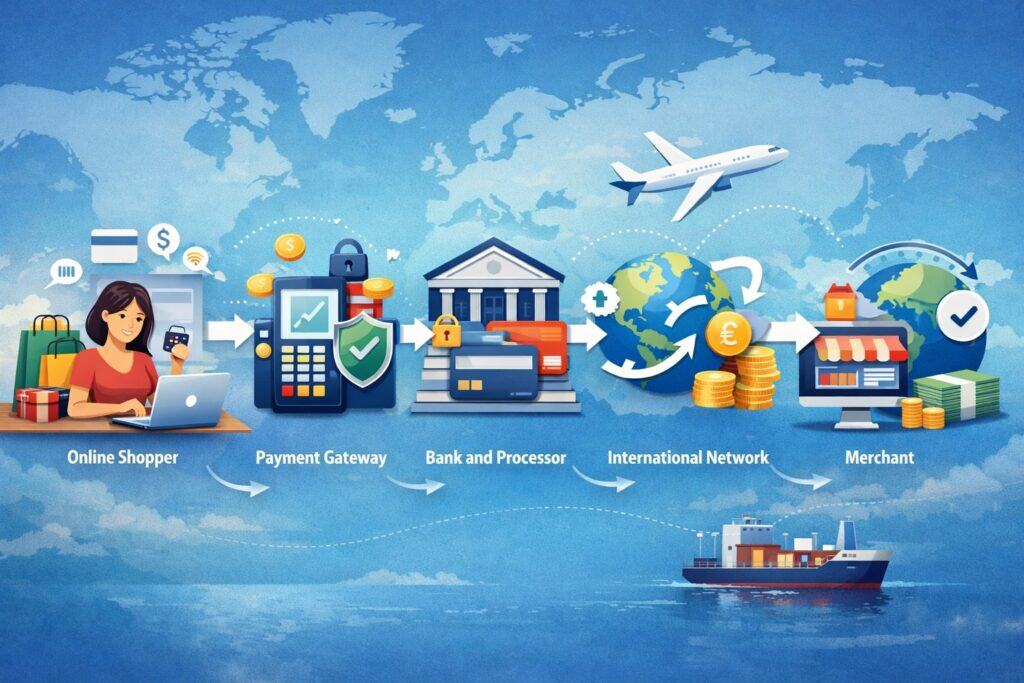
A typical cross-border transaction has more moving parts than a domestic one, and understanding the flow helps you improve approvals and reduce cost. Here’s what international payment gateways usually do, step by step.
First, the gateway collects payment data at checkout using secure fields or a hosted payment page. Modern international payment gateways rely on tokenization so sensitive card data never touches the merchant’s servers, reducing security scope and risk.
Next, the gateway enriches the request: device fingerprint signals, billing and shipping context, customer history, and (when applicable) 3-D Secure authentication data.
Then comes routing and authorization. The gateway sends the authorization request through a processor to an acquirer, which submits it to the relevant network and the issuing bank.
In cross-border scenarios, smart routing matters because issuing banks can be more conservative when the merchant’s acquiring region doesn’t match the customer’s region. Many international payment gateways use dynamic routing rules (by BIN range, geography, currency, risk score, or past performance) to select the path most likely to approve.
If approved, the transaction moves to capture (immediate or delayed), and later into clearing and settlement, where funds are transferred to the merchant—sometimes in the customer’s currency, sometimes converted and settled in the merchant’s chosen payout currency. International payment gateways also handle exceptions: partial captures, refunds, chargebacks, and dispute evidence submission.
In 2026, the best international payment gateways treat payments like an optimization loop: they log detailed decline reasons, measure acceptance by route and issuer, and continuously adapt rules to improve net revenue—especially as cross-border payments move toward faster rails and stronger fraud controls.
Key Components That Make a Gateway “International”

A gateway becomes truly “international” when it can reliably handle currencies, local payment methods, cross-border risk, and region-specific compliance—not just accept a foreign card.
Multi-currency pricing and settlement is a core component. International payment gateways may offer: (1) presentment in local currency (customer sees familiar amounts), (2) settlement in one or multiple merchant currencies, and (3) FX conversion tools with transparent rates and markup controls.
This matters for customer trust and for reducing cart abandonment. If you show only one currency, customers may hesitate due to uncertainty around bank FX fees.
Local payment method orchestration is another major differentiator. In many markets, cards are not the dominant online method; wallets and bank transfers can outperform cards on both conversion and cost.
Strong international payment gateways unify these options behind a single integration so your checkout can adapt by country, device, and customer segment.
Cross-border authorization optimization is also essential. International transactions can face higher decline rates due to issuer risk models, mismatched billing signals, or inconsistent authentication.
Gateways that support 3-D Secure 2, network tokenization, and adaptive routing can materially improve approval rates while lowering fraud exposure.
Finally, international payment gateways need robust risk controls and compliance tooling, including sanctions screening expectations for payment systems, and modern card data security standards. These are not “nice to have”—they’re operational requirements that protect your ability to keep processing at scale.
International Payment Methods You Should Support (And Why)
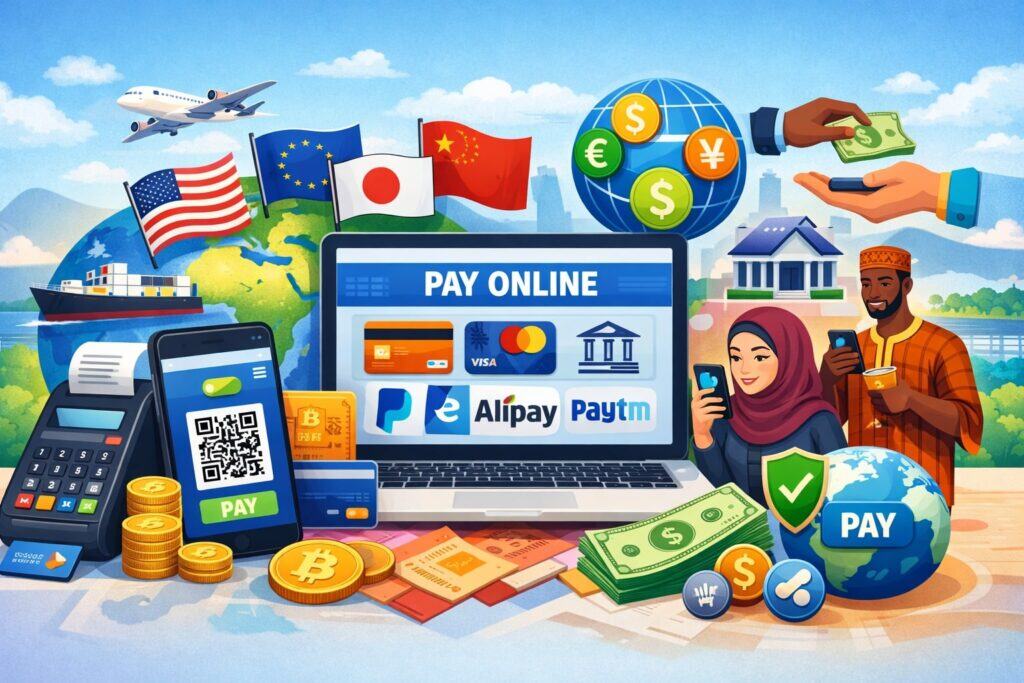
International payment gateways are only as effective as the payment methods they can present to customers. In 2026, method coverage is a growth strategy, not a checkbox.
Cards remain foundational: credit and debit cards provide broad global reach and fast authorization. But performance depends on strong authentication (where needed), issuer trust signals, and a clean fraud posture.
International payment gateways that support network tokenization and account updater services can reduce failed renewals for subscriptions and improve lifetime value.
Digital wallets often lift mobile conversion because they reduce typing and add biometric confirmation. Wallet coverage varies by market, and wallets can be particularly powerful for first-time buyers who do not want to enter card details on a small screen.
Bank transfer options can be cost-effective for higher ticket items and B2B. They also reduce chargeback exposure compared to cards. Where instant or near-instant bank rails are available, bank pay-by-link or real-time transfer methods can compete with cards on speed and customer confidence.
Buy Now, Pay Later (BNPL) options may increase average order value in some verticals, but they add complexity: underwriting, regional availability, refund behavior, and reconciliation. International payment gateways that unify BNPL with other methods help keep your checkout logic manageable.
The key is not to show every method to everyone. Instead, configure international payment gateways to prioritize the top-converting methods per region, and keep checkout uncluttered. A clean method strategy can improve conversion more than adding dozens of options that confuse customers.
Currencies, FX, and Pricing Psychology at Checkout
Currency handling is one of the most underestimated drivers of conversion in cross-border commerce. International payment gateways can either reduce friction—or amplify it—depending on how you configure presentment, conversion, and settlement.
Presentment is what the customer sees. If you can display prices in the shopper’s local currency, customers spend less mental energy estimating exchange rates, and they feel more confident about completing the purchase.
Many merchants also see fewer “friendly fraud” disputes when the currency and descriptor are clear, because customers recognize the charge.
Conversion is where hidden costs can creep in. FX is typically priced as a mid-market rate plus a markup. International payment gateways may apply FX at different points: at authorization, at capture, or at settlement. Each approach has tradeoffs.
Converting at authorization can stabilize the amount the issuer sees, but can also create reconciliation differences if the capture happens later. Converting at settlement can simplify operations, but you need transparency on rates and markups.
Settlement determines what lands in your account(s). Some businesses prefer one payout currency for accounting simplicity. Others need multi-currency settlement to match local expenses, reduce FX churn, or manage supplier payments.
International payment gateways with multi-currency balances can help you net inflows and outflows in the same currency before converting.
The practical advice: treat FX as part of unit economics. Track it like you track shipping cost or ad spend. A “good” international payment gateway is one that makes FX transparent and configurable—so you can optimize revenue, not just accept payments.
Security and Compliance Expectations in 2026
Security is not only about preventing breaches; it’s also about maintaining long-term processing stability. In 2026, international payment gateways are expected to support modern security standards and risk-based compliance approaches—especially as payments become faster and more interoperable.
Card data security remains central. The PCI Data Security Standard (PCI DSS) has continued evolving, with version 4.0 introducing additional requirements that become mandatory after the transition period ending March 31, 2025, for many organizations.
This affects how merchants manage access controls, continuous security testing, authentication, and system hardening. If you use international payment gateways that provide hosted fields or tokenization, you may reduce your exposure and simplify compliance scope, but you still need strong policies around access, logging, and incident response.
Sanctions and prohibited-party risk is another area that can impact cross-border acceptance. In the United States, the Office of Foreign Assets Control (OFAC) emphasizes a risk-based approach and has issued guidance for instant payment systems, encouraging sanctions compliance considerations to be built into payment technology design.
Even if you are not using “instant” rails, cross-border acceptance often touches the same screening expectations: counterparties, regions, and transaction patterns can trigger compliance reviews. International payment gateways with better risk tooling can help reduce false positives while meeting screening needs.
Data privacy and localization concerns can also influence architecture. While requirements vary by region, the safe baseline is: collect the minimum necessary data, encrypt in transit and at rest, segregate environments, and maintain a clear data retention policy.
If you want one takeaway: choose international payment gateways that invest in security and provide clear compliance documentation, because gateways become long-term infrastructure—not short-term plugins.
Fraud, Chargebacks, and 3-D Secure 2 in Cross-Border Commerce
Fraud pressure tends to be higher in cross-border transactions because fraudsters exploit distance, unfamiliar merchant brands, and inconsistent identity signals. International payment gateways help by layering prevention tools that reduce fraud while protecting conversion.
A common failure mode is over-blocking: merchants crank up filters, then lose legitimate sales to false declines. Better international payment gateways combine multiple signals—device reputation, behavioral analytics, velocity patterns, and issuer trust signals—so decisions are more accurate.
3-D Secure 2 (3DS2) plays a major role in card-not-present authentication. It enables risk-based “frictionless” flows for low-risk transactions while stepping up to challenge flows when needed.
In markets where authentication is common, 3DS2 can reduce fraud and improve issuer confidence, but implementation quality matters: poorly configured challenges can reduce conversion.
International payment gateways that manage 3DS2 well can help you tune when to invoke it, how to present challenges, and how to route authenticated transactions to improve approvals.
Chargebacks are not only a fraud issue; they are also an operations and communication issue. Clear descriptors, timely shipping updates, easy refunds, and responsive support reduce disputes. On the gateway side, strong evidence tooling and dispute workflows help you respond faster and win more cases.
In 2026, the merchants who win cross-border are the ones who treat fraud controls as precision tools, not blunt instruments. Configure your international payment gateways to protect approvals first, then use step-up authentication and targeted rules to manage risk.
Fees and Pricing: What You’re Really Paying For
International payment gateways often look “expensive” until you break down what the fees cover. Pricing usually includes a combination of transaction fees, cross-border costs, FX spread, and optional services (fraud tools, chargeback automation, advanced routing).
Common fee components include:
- Gateway/processing fee: charged per transaction, sometimes with a percentage plus a fixed amount.
- Cross-border and network assessments: card networks and acquirers often apply additional fees when the issuer and acquirer are in different regions.
- Currency conversion (FX) markup: added on top of an exchange rate; varies by provider and currency corridor.
- Chargeback fees: per dispute, regardless of win/loss, plus potential program penalties if ratios are high.
- Payout fees: for faster payouts, multi-currency settlement, or certain payout methods.
What matters is not the headline rate; it’s the blended effective cost after approvals, fraud losses, and operational effort. A slightly higher processing rate can be cheaper overall if it increases approvals by even a small margin—because the incremental approved revenue often outweighs fee differences.
When evaluating international payment gateways, ask for transparency: how FX is priced, how cross-border fees are calculated, and whether routing or advanced acceptance tools cost extra. Then measure performance by net revenue, not just fee percentage.
Choosing the Right International Payment Gateway for Your Business
The “best” international payment gateways depend on your business model, geography, average ticket size, and risk profile. The goal is to match capabilities to what moves your metrics—conversion, approval rates, fraud, and cash flow.
Start with coverage: ensure your target customer regions have the payment methods they prefer, and verify currency support for both presentment and settlement. Next, evaluate authorization performance: do they offer smart routing, local acquiring options, network tokenization, and strong issuer connectivity?
Then look at risk and compliance fit. If you sell digital goods, you may need stronger fraud tooling. If you sell physical goods, you may prioritize address verification, shipping-based risk controls, and clear dispute evidence workflows.
Consider developer experience and uptime. International payment gateways should offer stable APIs, webhooks, idempotency, good documentation, and sandbox testing. If your checkout goes down, revenue stops.
Finally, assess payout flexibility and reporting. Multi-currency settlement, predictable payout schedules, and clear reconciliation reports reduce operational friction.
A practical selection approach: choose one primary gateway, then add a secondary option only if it clearly improves resilience or regional performance. Too many gateways can create reporting complexity and fragmented risk control. The right international payment gateways simplify operations while improving growth.
Integration Best Practices for Higher Conversion
A high-performing integration is not just “connected.” It’s optimized for speed, clarity, and fallback behavior. International payment gateways can support multiple integration models, and the right choice depends on how much control you want versus how quickly you need to launch.
Hosted checkout reduces security scope and speeds deployment. It can also benefit from the gateway’s UI optimizations and A/B learnings.
Embedded fields give you more control over branding and user experience while still keeping sensitive data away from your servers via tokenization. Direct API integrations provide maximum flexibility but often increase your security responsibilities.
Regardless of model, prioritize:
- Fast page load and minimal friction: slow checkouts lose cross-border buyers quickly.
- Localized checkout: language, currency, and region-appropriate methods.
- Clear error handling: explain declines in plain language and offer an alternative method.
- Smart retries: avoid repeated attempts that look like fraud; use gateway retry guidance when available.
- Fallback routing: if one acquiring path degrades, route to another without disrupting the customer.
International payment gateways that support detailed decline codes and analytics help you continuously improve. Treat declines as product bugs: categorize them, fix the biggest buckets, and measure lift.
Settlement, Payouts, and Reconciliation Across Borders
Receiving money reliably is as important as accepting it. International payment gateways can settle funds in different ways, and understanding these mechanics prevents cash-flow surprises.
Settlement timing varies based on method, risk profile, and provider. Card settlements may follow standard clearing cycles, while some local bank methods can settle faster or slower depending on the rail. Gateways may also apply reserves, rolling holds, or delayed payouts for new merchants or higher-risk categories.
Multi-currency settlement can be a major advantage if you have costs in multiple currencies. Instead of converting everything immediately, you can hold balances and convert when rates are favorable—or net off payments against refunds in the same currency. This can reduce FX leakage.
Reconciliation is often the operational pain point. A “good” international payment gateway provides consistent identifiers across the lifecycle: authorization, capture, settlement, payout, refunds, and disputes.
It also provides downloadable reports and API endpoints that map fees and FX to each transaction, so finance teams can close books accurately.
If you sell subscriptions, pay attention to failed renewal handling, account updater services, and dunning flows. If you sell physical goods, pay attention to partial captures, split shipments, and refund timing.
Scaling Internationally: Approval Rate Optimization That Actually Works
Once you’re processing volume, small improvements in acceptance can create outsized revenue gains. International payment gateways can help you optimize approval rates by focusing on root causes rather than guessing.
Start by segmenting declines:
- Issuer declines: often caused by risk concerns, insufficient funds, or authentication needs.
- Gateway/processor declines: integration issues, data formatting, missing fields.
- Fraud-tool declines: rules too aggressive, poor signal quality, limited whitelisting.
Then use levers that improve issuer trust:
- 3DS2 strategy: apply risk-based authentication instead of blanket challenges.
- Local acquiring and routing: improve “domestic-like” acceptance in key markets; route by BIN and currency corridor.
- Descriptor clarity: reduce confusion and disputes that can damage your reputation.
- Network tokenization and saved payment methods: reduce friction and improve repeat purchase performance.
Cross-border payments are also trending toward faster and more interoperable systems, which increases expectations for speed and transparency. Industry reporting highlights momentum in real-time rails expansion, interoperability efforts, and broader modernization across payment corridors.
The best approach is continuous: monitor acceptance weekly, test routing changes carefully, and balance fraud controls against conversion impact. International payment gateways are most valuable when they provide the data and controls to run this process systematically.
Future Trends and Predictions for International Payment Gateways
International payment gateways are evolving from “transaction pipes” into intelligent networks that blend cards, bank rails, and digital settlement. Several trends are likely to shape the next few years.
Real-time and interoperable rails will keep expanding, with growing expectations for near-instant cross-border transfers, better tracking, and fewer intermediaries. Industry trend reports point to real-time systems and regional integration as key themes for 2025 and beyond, alongside AI-driven fraud prevention and broader multi-currency tooling.
AI-driven risk and compliance automation will accelerate. As payment systems speed up, risk checks must happen faster with fewer false positives.
Guidance on sanctions compliance for instant payment systems emphasizes risk-based approaches and encourages incorporating compliance considerations into technology design—directionally aligned with more automated screening and smarter decisioning.
Stablecoins and tokenized money may become more common as settlement rails—especially for cross-border use cases where speed and transparency are valuable.
Recent commentary in major financial news has highlighted efforts to build currency-backed stablecoin infrastructure and regulatory approval paths into 2026, framing stablecoins as potential “payment rails of the future” for cross-border settlements.
Stronger security baselines will remain. The shift to PCI DSS 4.0 requirements becoming mandatory after March 31, 2025, pushes merchants and providers toward more continuous security practices rather than periodic compliance checklists.
Prediction-wise, the winning international payment gateways will be those that unify method choice, routing intelligence, fraud controls, and multi-currency settlement—while keeping integration simple.
Merchants will increasingly choose gateways based on measurable acceptance lift and operational clarity, not just brand recognition.
FAQs
Q.1: What’s the difference between an international payment gateway and a payment processor?
Answer: A processor handles the mechanics of moving the transaction through payment networks and banking partners, while the gateway handles secure data capture, orchestration, routing, and often fraud/authentication.
Many providers bundle gateway + processing. If you want maximum control, you can use international payment gateways that let you bring your own acquirer and processor.
Q.2: Do international payment gateways automatically improve approval rates?
Answer: Not automatically. They improve approval rates when they provide tools like smart routing, local acquiring options, and optimized authentication (including 3DS2). You still need to configure rules and monitor performance.
Q.3: How do international payment gateways handle currency conversion?
Answer: Most convert using a market reference rate plus a markup. Conversion can happen at authorization, capture, or settlement depending on the provider. The best practice is to track FX as part of unit economics and choose international payment gateways with transparent pricing and multi-currency settlement options.
Q.4: Are international payment gateways “PCI compliant” so I don’t have to worry about security?
Answer: A gateway can reduce your PCI scope by tokenizing and hosting sensitive fields, but you still need to maintain secure systems, access controls, and policies. PCI DSS 4.0 increases emphasis on ongoing security practices and becomes mandatory for many requirements after March 31, 2025.
Q.5: Should I enable 3-D Secure 2 for all international transactions?
Answer: Usually no. A risk-based approach is better: enable 3DS2 where it improves issuer trust and lowers fraud without adding unnecessary friction. International payment gateways with adaptive 3DS2 tooling can help you balance conversion and security.
Q.6: What are the biggest risks when expanding cross-border payments?
Answer: Common risks include higher fraud rates, higher issuer declines, FX margin surprises, and compliance exposure (including sanctions screening expectations). Choose international payment gateways with strong analytics, clear reporting, and configurable controls.
Conclusion
International payment gateways are infrastructure, but they’re also a growth lever. The best international payment gateways do more than “accept payments”—they help you localize checkout, improve authorization performance, reduce fraud, manage compliance expectations, and settle funds predictably with transparent FX and reporting.
To choose wisely, focus on the outcomes that matter: higher approval rates, lower chargeback exposure, cleaner reconciliation, and a checkout experience that feels native to each customer.
Then treat your gateway setup as a living system: monitor declines, tune authentication, expand local methods where they lift conversion, and keep security baselines aligned with evolving standards like PCI DSS 4.0.
As cross-border commerce moves toward faster rails, more automation, and potentially new settlement models like tokenized money, international payment gateways will continue to converge—cards, bank transfers, wallets, and emerging rails under one orchestration layer.