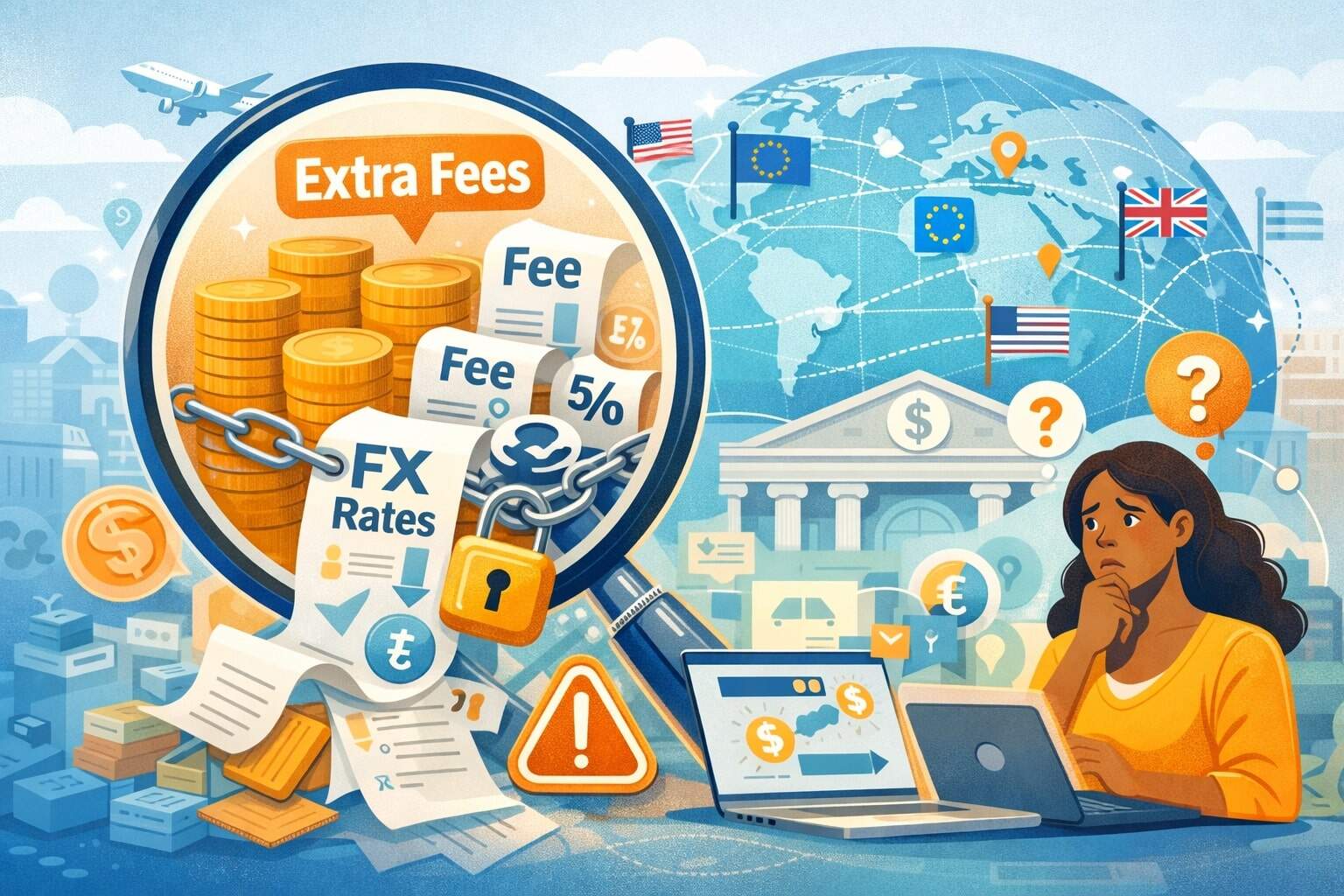
International payments look simple on the surface: you send money, someone receives money. But in real life, the amount that arrives (and the total cost you pay) can be meaningfully different than what you expected. That gap is where hidden costs in international payments live.
These costs rarely appear as a single “mystery fee.” They show up as a stack of small frictions: exchange rate markups, intermediary bank deductions, card network assessments, compliance holds, return fees, and timing losses.
Some are legitimate operational costs. Others are avoidable pricing choices. Either way, if you don’t measure them, they will quietly erode margins, distort cash flow, and create supplier or customer disputes.
This guide breaks down hidden costs in international payments in a practical, easy-to-audit way. You’ll learn where costs hide, how to spot them on statements and receipts, and which payment rails reduce them.
You’ll also get a forward-looking view of what will likely change in the next few years as transparency standards and infrastructure modernize.
What “Hidden Costs” Really Means in International Payments

The phrase “hidden costs” doesn’t always mean unethical behavior. In cross-border money movement, it often means costs that are not obvious at the moment you approve the transfer—or costs that appear later, deducted along the route.
In many cases, the payment experience shows you a single outgoing fee, but the final delivered amount is affected by additional factors. The most common is the difference between the mid-market exchange rate and the rate you actually receive, which can embed a spread (markup) that isn’t itemized.
Another frequent source is intermediary bank fees that are deducted before funds reach the beneficiary, especially in correspondent banking routes. Swift-related transfers can also use charge handling instructions (like shared vs sender-paid), which changes where deductions appear and who absorbs them.
It’s also important to recognize timing as a cost. If a transfer takes days, the currency market can move, and your effective cost changes. Even if the fee looks “low,” the total economic impact may be higher once you include delays, reconciliation time, and support overhead.
So the best definition is this: hidden costs in international payments are all-in costs you don’t clearly see upfront—including fees, spreads, deductions, and operational friction. Once you adopt that view, you can audit the entire payment lifecycle instead of only comparing advertised transfer fees.
The Biggest Money Leak: Exchange Rate Markups and FX Spreads

If you only remember one thing, make it this: FX is where the largest hidden costs in international payments usually hide.
Many providers quote “low fees” while earning revenue through the exchange rate. Instead of giving you the mid-market rate (the rate you’ll see on major market feeds), they provide a slightly worse rate.
That difference—often called a spread or markup—can be small in percentage terms, but large in dollars at scale.
Why is this so common? Because it’s easy to price and hard to detect without a benchmark. Customers tend to compare the visible transfer fee, not the exchange rate. And even sophisticated businesses sometimes focus on wire fees while ignoring FX economics.
How FX markups show up in real transactions
You may see:
- A rate that is “locked” at checkout, but not compared to mid-market.
- A “no-fee transfer” paired with a weaker exchange rate.
- A beneficiary bank converting funds on receipt at its own rate (so you lose control of FX).
Swift GPI case studies often highlight shortfalls caused by conversion at the receiving side plus added bank fees.
Practical audit method (fast)
To measure FX hidden cost:
- Record the timestamp you approved the transfer.
- Note the currency pair and the rate you received.
- Compared to a reliable mid-market reference at that moment.
- Multiply the difference by the converted amount.
Do this for 10–20 transactions and you’ll quickly see whether FX is your dominant hidden cost in international payments. For many businesses, it is.
Intermediary Banks, Correspondent Routes, and “Lifting Fees”

Another major source of hidden costs in international payments is the path your money takes between banks.
International transfers often move through correspondent banking networks. If your bank doesn’t have a direct relationship with the recipient’s bank, the payment may pass through one or more intermediaries.
Each intermediary may deduct a fee—sometimes called a lifting fee—before forwarding the funds. This is why a recipient can receive less than expected even when the sender paid an outgoing wire fee. In practice, you can see:
- Intermediary deductions during transit
- Receiving bank fees on arrival
- Additional conversion charges if currency is exchanged at the end of the route
Swift GPI is one effort to improve traceability and transparency, helping senders track where a payment went and why amounts changed—though the final cost still depends on each bank’s policies and fee schedule.
Why this becomes expensive operationally
Even when the deduction is “only” $10–$30, the business impact can be bigger:
- Suppliers short-paid by $18 may hold shipments.
- Finance teams spend hours tracing shortfalls.
- Support tickets increase because nobody can explain the difference quickly.
That time cost is also part of hidden costs in international payments. A “cheap” transfer that creates reconciliation chaos is not cheap.
What to do
If shortfalls are common:
- Ask providers for route predictability or fee guarantees.
- Prefer rails with fewer intermediaries.
- Use solutions that show fee breakdowns or delivered-amount certainty when possible.
Charge Codes and Who Pays: Sender-Paid vs Shared vs Receiver-Paid
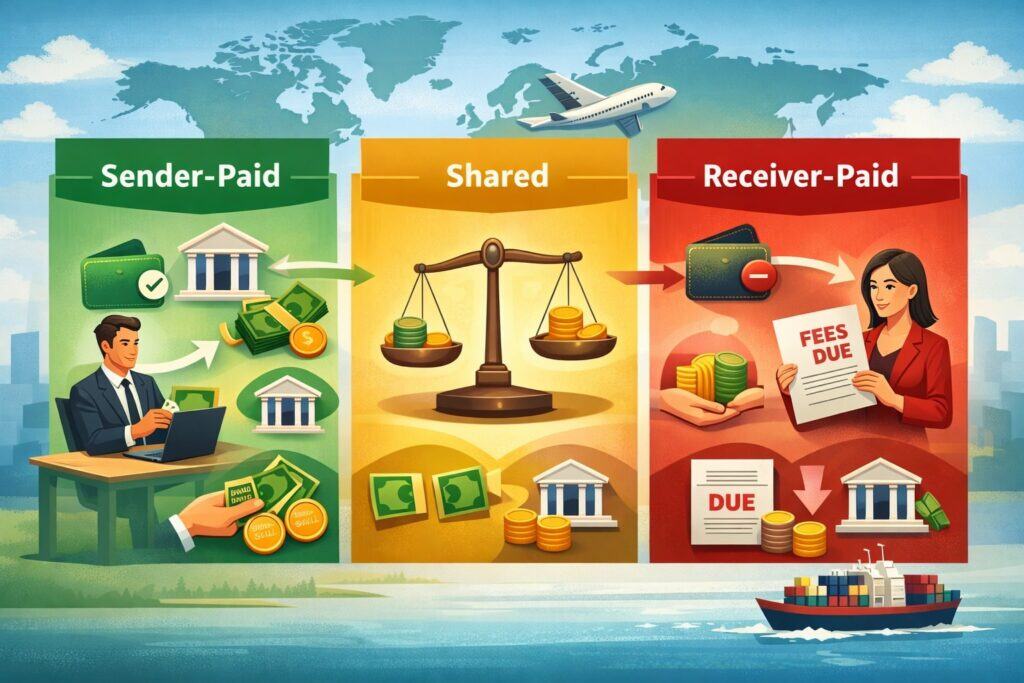
A confusing but important driver of hidden costs in international payments is charge allocation. Some payment instructions determine whether fees are paid by the sender, shared, or deducted from the recipient.
In many bank wire contexts, the sender may choose a charge option that affects fee visibility and recipient amount. When charges are “shared,” the sender pays the sending bank’s fee while other banks may still deduct fees from the amount delivered.
This matters because it changes how “hidden” a fee feels:
- If the recipient receives less, they see it as a short payment.
- If the sender pays all charges upfront, the recipient is more likely to receive the full intended amount, but the sender may pay more.
The operational takeaway is simple: choose the method that fits the business relationship. For vendor payments, certainty of delivered amount often matters more than shaving a small outgoing fee.
Even if you don’t memorize the terminology, you should document it in your payment policy so your AP team uses consistent settings. Inconsistent charge handling is a repeat cause of hidden costs in international payments because it produces unpredictable outcomes.
Cross-Border Card Payments: Assessments, Conversion Markups, and “Extra” Surcharges
International costs aren’t limited to bank wires. If you accept cards for cross-border transactions, you can face hidden costs in international payments through card network pricing and currency conversion.
Cross-border card transactions often include multiple fee layers:
- Interchange (varies by card type and scenario)
- Processor/acquirer markup
- Network assessment fees
- Cross-border assessments
- Currency conversion markup (sometimes separate, sometimes bundled)
Payment industry explainers commonly break cross-border card fees into these components, emphasizing that assessment fees and conversion markups can stack.
Where merchants get surprised
Merchants frequently expect “their” standard processing rate, then see:
- Higher effective rate for cards issued abroad
- Additional assessment line items
- Extra costs when settlement currency differs from billing currency
Because these charges can be buried inside statements, merchants may not attribute margin compression to hidden costs in international payments. If you sell online, it can be especially tricky because cardholders may be traveling or using foreign-issued cards more often than you think.
How to reduce card-related cross-border costs
- Ensure you understand settlement currency configuration.
- Review processor statements for cross-border assessments.
- Consider local acquiring strategies where volume justifies it.
- Make sure pricing is transparent (blended rates can mask cross-border uplift).
Compliance, Screening, and Return Fees: The Costs Nobody Budgets For
Compliance isn’t optional in international money movements. But it can create indirect hidden costs in international payments that are rarely priced into the “fee per transfer” comparison.
Typical compliance-related cost drivers include:
- Sanctions screening delays
- Manual review holds
- Requests for additional documentation (invoices, IDs, proof of purpose)
- Returned payments due to missing or incorrect beneficiary details
- Fees charged for repair, recall, investigation, or return
These costs are “hidden” because they show up later as operational disruption and exception handling. A payment that gets returned can generate:
- Return/repair fees
- Lost time
- Reprocessing costs
- Vendor relationship stress
The solution is partly process and partly provider choice. Strong onboarding and validation—like collecting correct beneficiary details, bank identifiers, and purpose-of-payment information—reduces exception rates. Good providers also offer better error messaging and status tracking, lowering support time.
In modern cross-border operations, the best teams treat compliance overhead as a measurable part of hidden costs in international payments, not as an unavoidable “admin annoyance.”
Consumer Transfers and Required Disclosures: What Transparency Looks Like
For consumer-initiated international money transfers, there are disclosure requirements that push the market toward transparency. In the U.S., the CFPB’s Remittance Transfer Rule requires providers to disclose key details such as fees, exchange rates (when applicable), the amount to be received, and certain rights like cancellation and error resolution.
Providers often describe that consumers receive upfront disclosure of fees and exchange rate, plus receipts and rights around cancellations and errors.
From a business perspective, the lesson is valuable even if your transfers are not consumer remittances: the gold standard is full pre-transfer clarity:
- Total fees (not just “our fee”)
- Exchange rate used
- Expected delivery date
- Expected amount to recipient
When your payment workflows mimic that level of clarity, hidden costs in international payments drop because surprises drop. That reduces disputes and support tickets, which reduces real cost.
Timing, Settlement Speed, and the Cost of Being “In Transit”
Speed is not only about convenience. It’s directly connected to hidden costs in international payments because time affects:
- FX exposure (rates can move while funds are in flight)
- Working capital (cash is locked up)
- Inventory or service delivery (vendors wait, projects stall)
- Fee predictability (some rails add repair costs if details are incomplete)
Traditional cross-border wires can take multiple business days, especially when weekends, time zones, and compliance reviews are involved. Even if the posted wire fee is acceptable, the total economic cost can be higher when the payment lifecycle is slow and opaque.
The hidden operational cost: reconciliation
When finance teams don’t have real-time status and can’t confirm “delivered amount,” they spend more time:
- tracing payments
- answering supplier questions
- matching bank statements to invoices
Swift GPI and similar tracking improvements aim to reduce this by improving visibility into flow-of-funds and fee-related shortfalls.
The practical takeaway: choose rails and providers that reduce time-to-certainty, not only time-to-send.
Pricing Models That Create Hidden Costs (and How to Compare Providers Correctly)
A key reason hidden costs persist is the way providers package pricing. The same all-in cost can be presented in very different ways.
Common pricing styles:
- Low transfer fee + FX markup (looks cheap, costs more)
- Higher fee + better FX (looks expensive, may be cheaper overall)
- Blended pricing (simple, but hides variability by transaction type)
- Pass-through + markup (transparent if itemized, confusing if not)
To compare providers and reduce hidden costs in international payments, evaluate total landed cost:
- Outgoing fee
- FX rate vs mid-market
- Expected intermediary/receiving deductions
- Time-to-delivery and tracking quality
- Exception/return/repair fee policies
- Support and dispute handling responsiveness
If a provider can’t explain total cost mechanics clearly, that is a pricing risk. Transparency is a feature.
A Practical “Hidden Cost Audit” Checklist You Can Run Monthly
You don’t need a massive treasury team to control hidden costs in international payments. You need a repeatable audit.
Step 1: Build a sample set
Pick the last 30–50 cross-border transactions across:
- different currencies
- different rails (wire, ACH-like alternatives, cards)
- different geographies and counterparties
Step 2: Record five fields
For each payment:
- Amount sent
- Total fees charged by your provider
- Exchange rate applied
- Amount received by beneficiary
- Total time to delivery (and time to certainty)
Step 3: Calculate three metrics
- Effective FX spread vs mid-market at send time
- Fee leakage rate (total fees + deductions / amount sent)
- Exception rate (repairs, returns, investigations as a share of volume)
Step 4: Turn insights into policy
- If FX spread is high: renegotiate or switch rails/providers.
- If deductions are unpredictable: use delivered-amount solutions or different routing.
- If exceptions are frequent: fix data collection and validation.
Run this monthly and hidden costs in international payments become measurable, manageable, and reducible.
Future Predictions: Where International Payments Are Heading Next
Hidden costs in international payments are likely to shrink over time, mainly because transparency is becoming a competitive advantage and infrastructure is modernizing.
Here are realistic trends to watch:
1) More tracking, better fee visibility
Fee tracing tools are improving. Swift GPI and similar approaches push the ecosystem toward clearer flow-of-funds visibility. While they don’t eliminate fees, they can reduce “mystery shortfalls” and lower support overhead.
2) Increased pressure for upfront cost clarity
Consumer-facing disclosure regimes demonstrate what “good” looks like: clear fee and exchange rate disclosures, delivery estimates, and rights frameworks. Expect expectations for transparency to rise across business payments too.
3) More competition from modern payment networks
Newer providers often compete on all-in cost clarity and faster settlement. As these options mature, traditional players may respond with improved transparency and pricing.
4) Smarter treasury practices becoming standard
More companies will treat FX and cross-border payment optimization as a standard finance function rather than a specialist topic. That alone reduces hidden costs in international payments because providers must compete against informed buyers.
The broad direction is positive: fewer surprises, more predictability, and better tools. But hidden costs won’t disappear. They’ll shift. Your advantage will come from measurement and policy discipline.
FAQs
Q 1: What is the most common hidden cost in international payments?
Answer: For many businesses and consumers, the most common hidden cost in international payments is the exchange rate markup. A provider can advertise a low transfer fee while earning more through a worse FX rate than the mid-market benchmark.
Because the markup isn’t always itemized, it’s easy to overlook. The fix is to compare the applied rate to a reliable mid-market reference at the same timestamp and calculate the spread in dollars.
Q 2: Why does the recipient sometimes receive less than I sent?
Answer: This usually happens due to intermediary bank deductions and receiving bank fees, especially in correspondent banking routes. Additional charges can also occur if currency conversion happens on the beneficiary side at the bank’s rate.
Tracking tools such as Swift GPI are designed to make these shortfalls easier to investigate, though fee policies still vary by institution.
Q 3: Are cross-border card payments subject to hidden costs too?
Answer: Yes. Cross-border card acceptance can include multiple components beyond “normal” processing: network assessment fees, cross-border assessments, and currency conversion markups. The final effective rate can be higher than expected, especially when the card is issued abroad or settlement currency differs.
Q 4: How can I reduce hidden costs in international payments without changing banks?
Answer: Start by reducing what you can control:
- Standardize payment instructions and beneficiary data collection.
- Avoid beneficiary-side conversions when possible by sending in the needed currency.
- Track FX rates and negotiate spreads based on volume.
- Use clear charge allocation settings for vendor payments to reduce disputes.
Even small process changes can reduce exceptions, returns, and reconciliation overhead.
Q 5: What should I demand from a provider to avoid hidden costs?
Answer: Ask for:
- A clear explanation of FX pricing (mid-market vs markup)
- Transparent fee schedules (including repairs/returns/investigations)
- Delivered-amount predictability (or at least strong tracking)
- Status visibility and timestamps
Providers that can’t explain total landed cost mechanics are more likely to produce hidden costs in international payments.
Q 6: Do consumer international transfers have required disclosures?
Yes, for covered consumer remittance transfers in the U.S., providers must disclose key information such as fees, taxes (when applicable), exchange rate (when applicable), and the amount expected to be received, along with certain rights like cancellation and error resolution.
Conclusion
Hidden costs in international payments thrive on ambiguity. The best way to beat them is not guesswork—it’s measurement.
Start by treating every cross-border transaction as an “all-in cost” event. Track the exchange rate you received versus a mid-market benchmark. Monitor intermediaries and receive deductions.
Count exception events like repairs and returns. Then add the cost that finance teams usually ignore: time-to-certainty and reconciliation effort.
Once you do that, patterns become obvious. You’ll see whether your biggest hidden costs in international payments come from FX spreads, unpredictable routing deductions, cross-border card assessments, or compliance-related friction.
And when you know the source, the fix becomes straightforward: better rails, clearer pricing, stronger data validation, improved tracking, and smarter policy.
The future is moving toward more transparency and better tracking, but the companies that win won’t wait for the industry to fix itself. They’ll build a repeatable audit process now—so hidden costs in international payments stop being “hidden,” and start being controllable.