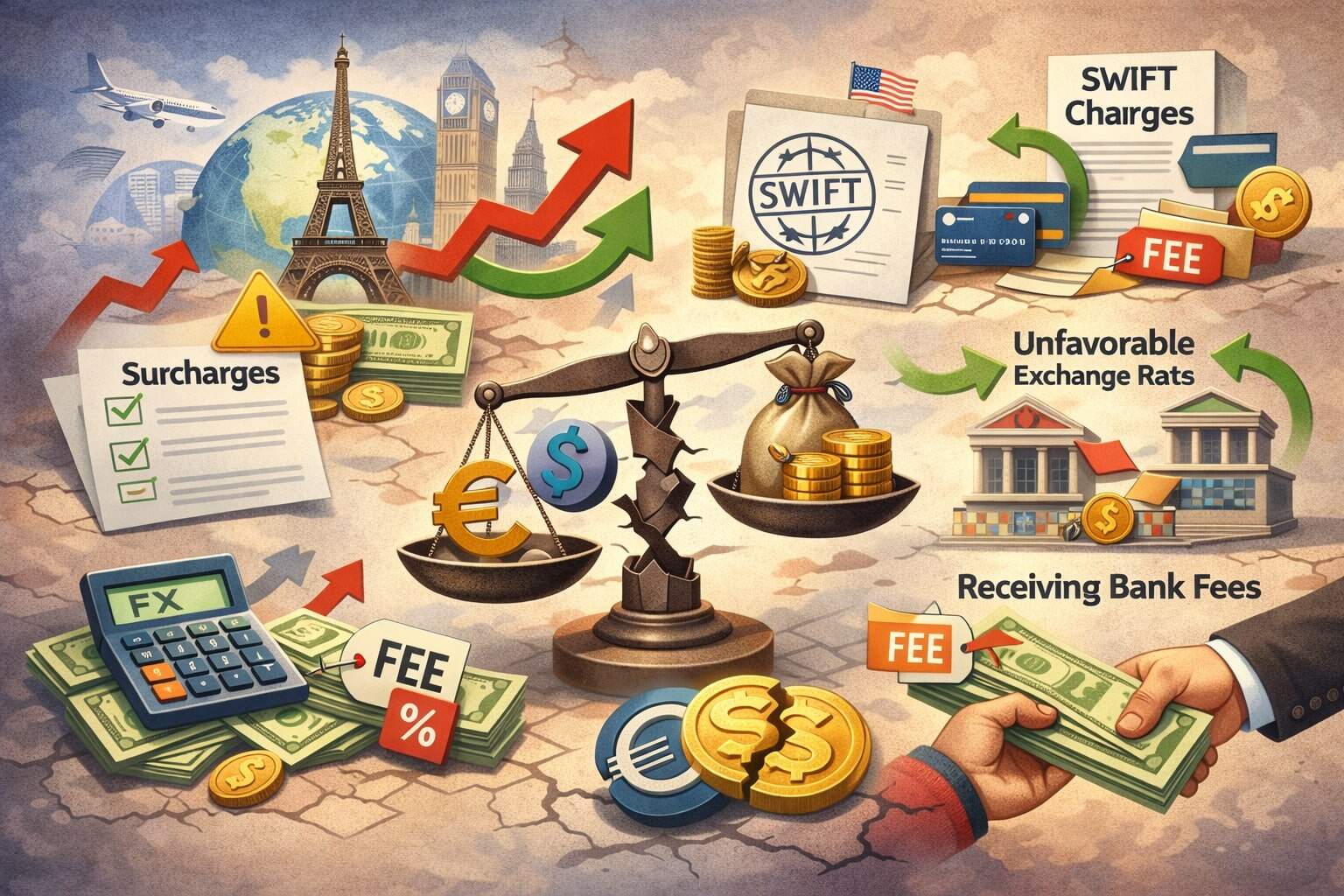
Cross-border payment fees are the total costs that show up when money, card payments, or settlement instructions move between different banking systems, currencies, and compliance zones. In real life, these fees rarely appear as one neat line item.
They usually show up as a mix of explicit charges (a wire fee, a transfer fee, a network fee) and implicit costs (an exchange-rate markup, a “lift” taken by an intermediary bank, or a hidden spread built into a payout quote).
For people and businesses sending payments from a U.S. location, cross-border payment fees can feel unpredictable because pricing depends on the rail you choose (wire, card, ACH-style transfer partners, wallets, remittance providers, and newer networks), how many intermediaries touch the transaction, and how currency conversion is handled.
Industry research consistently highlights that cross-border experiences and cost transparency still vary widely across providers because of differences in technology, regulations, and how systems integrate with local financial infrastructure.
This guide breaks down the most common types of cross-border payment fees, why they exist, where they hide, and how to reduce them—without drowning you in jargon.
You’ll also see practical forecasting: where fees are most likely to shrink, where they may rise, and what “next-generation” cross-border payments will mean for pricing over the next few years.
The Real “All-In” Cost of Cross-Border Payment Fees

When people ask “What are cross-border payment fees?”, they usually mean the fee they can see at checkout or in a bank’s fee schedule. But the true all-in cost includes every deduction and markup from initiation to final receipt.
That’s the key reason cross-border payment fees create frustration: the payer and recipient often see different numbers.
A simple example: you send a fixed amount, but the recipient receives less. That gap can come from an exchange-rate spread, intermediary “lifting” fees, or receiving bank charges.
Some rails also allow different fee handling instructions—often described as who pays the fees (sender, recipient, or shared). Even when a provider advertises “low transfer fees,” cross-border payment fees may be embedded in the rate, the payout margin, or the network routing.
Why this matters: predictable cost is not just about price. It’s also about cash-flow planning, supplier satisfaction, refund accuracy, and compliance.
In B2B, cross-border payment fees can distort invoice reconciliation because fees may post separately or reduce the net received. In consumer payments, they can trigger disputes because the recipient assumes the sender “shorted” them.
As cross-border volumes grow, transparency pressure rises. Global initiatives (including goals to reduce remittance costs) have pushed providers to show more of the true cost.
The World Bank’s remittance monitoring has long been used to measure progress toward global fee reduction objectives, including the widely referenced target of bringing average costs down.
The takeaway is simple: to manage cross-border payment fees, you need to understand categories of fees—not just the fee label your app displays.
Transfer and Service Fees Charged by the Provider

Transfer fees are the most visible cross-border payment fees: the upfront charge a bank, fintech, remittance company, or payment platform takes to initiate a cross-border transaction.
These fees can be flat (for example, a fixed wire initiation fee) or variable (a percentage of the amount sent). Some providers use tiered pricing based on urgency (standard vs. expedited), destination corridor risk, or payout method (cash pickup vs. bank deposit vs. wallet).
In a U.S.-based business context, transfer and service fees often show up in three places: the outgoing payment fee, the inbound receipt fee, and the exception-handling fee. Outgoing fees cover initiation and messaging.
Receipt fees can apply when you’re paid by an overseas customer and your bank charges to accept and process an international credit.
Exception fees apply when information is missing (incorrect account identifier, invalid bank code, name mismatch, or compliance flags). These exception charges can become significant because they happen after the payment is already in motion, which is when you have the least leverage.
Service fees also include “value add” features that can reduce operational pain but increase cost—such as tracking, payment confirmation, recipient validation, and reconciliation enhancements.
Providers increasingly compete on speed and tracking, but the cost structure still varies widely by provider model and integration choices, which is a major reason cross-border payment fees remain inconsistent.
To keep transfer fees under control, compare providers using the same scenario: same send amount, same payout method, same currency handling, and same speed. If you compare a “fee-only” quote to an “FX-included” quote, you’ll misread the real cross-border payment fees by a wide margin.
Currency Conversion Fees and FX Markups
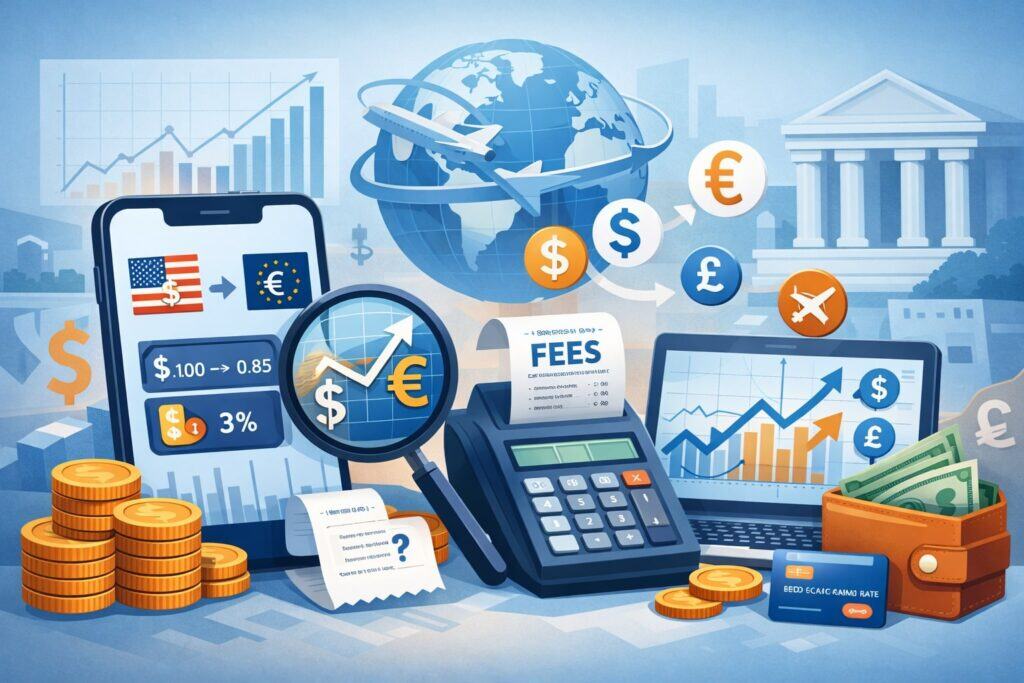
Currency conversion is where cross-border payment fees most commonly hide. Even if a provider advertises “zero transfer fees,” they can still earn revenue by applying a markup to the exchange rate.
The markup is often the difference between the mid-market rate (the rate you see on financial sites) and the rate actually used to convert your payment. This difference is called the FX spread or FX margin, and it can be the largest component of cross-border payment fees.
FX costs show up in several ways. First is the direct conversion fee—a stated percentage or flat charge for exchanging currency. Second is the embedded rate markup—the provider gives you a “retail” rate that includes profit.
Third is double conversion, where funds convert from your currency to an intermediate currency and then again to the recipient’s currency. That can happen when the route passes through correspondent networks or when settlement rules push conversion at different stages.
Businesses often face additional FX costs through dynamic currency conversion (DCC) on card-present transactions. DCC offers the customer a price in their “home” currency, but it typically comes with a higher markup than the card network’s standard conversion.
DCC-related cross-border payment fees can also affect chargebacks and refunds because the refund might be processed using a different exchange rate than the original sale.
The strongest fee-control tactic is to decide who performs conversion: you, your bank, the recipient bank, the network, or a specialist FX provider.
If you can quote and collect in the recipient’s preferred currency while converting at a competitive rate, you can reduce cross-border payment fees and improve customer trust. But if you don’t control conversion, you should treat the FX rate as a fee—because economically, it is one.
Bank Wire Fees, Correspondent Banking Charges, and “Lifting” Fees
Traditional cross-border wires often move through correspondent banking relationships. This structure is reliable and widely available, but it can introduce layered cross-border payment fees because multiple institutions may touch the transaction.
Each intermediary can apply a handling fee, and some may deduct fees from the transferred amount—creating the classic “sent X, received less than X” experience.
The most commonly misunderstood charges in this category are intermediary fees and lifting fees. A lifting fee is a deduction taken by an intermediary bank for processing the payment through their network.
It might not appear on the sender’s bank receipt. Instead, it’s deducted during routing, so the recipient sees a reduced amount. That’s why reconciliation is hard: the fee is “somewhere in the middle.”
There are also message-related fees (for sending and processing payment instructions), receiving bank credit fees (a charge to post funds to the recipient’s account), and investigation fees (charged when a payment is delayed and you request a trace).
Investigations can be expensive because multiple banks may need to search their ledgers, and each step can trigger additional fees.
Modern initiatives aim to make cross-border payments faster and more transparent, but industry research still notes that cross-border experience and cost visibility vary by provider and integration approach.
In practice, if you must use wires, the most cost-stable approach is to standardize on correct beneficiary details, choose the right fee option (sender-paid vs shared), and use providers that support stronger tracking and pre-validation.
Card Network Cross-Border Assessment Fees and Related Charges
Card-based cross-border payment fees aren’t just “interchange.” They can include network assessments, cross-border assessments, and program-related charges that apply when the merchant location and cardholder location differ.
These fees can be applied as a percentage of volume and can vary by transaction type, card category, and program rules.
For example, Mastercard publishes network assessment fee documentation that includes an Acquirer Cross-Border Assessment concept—applied on volume when merchant and cardholder country codes differ—alongside other assessment structures.
In addition to network fees, merchants may face higher fraud tooling costs (3DS, risk scoring, manual review), increased chargeback exposure, and sometimes higher “international” pricing tiers from processors.
Cross-border payment fees also increase when transactions involve currency conversion at the network level (where the exchange rate and any network currency conversion charge apply). If you offer multi-currency pricing or DCC, the fee stack can get even more complex.
A practical approach is to segment your card volume: domestic vs cross-border, card-present vs card-not-present, high-risk corridors vs low-risk corridors.
Once you know where cross-border payment fees concentrate, you can decide whether to steer customers toward cheaper rails (bank transfer, wallet, local transfer partners) or whether to adjust pricing to preserve margin.
Receiving Bank Fees and Beneficiary-Side Charges
One of the most frustrating cross-border payment fees is the one the sender doesn’t control: the receiving bank’s fee. Some recipient banks charge for incoming international credits, for currency conversion, or for “special handling.”
These charges can be flat or percentage-based and may depend on account type (consumer vs business), transaction description, or compliance screening requirements.
Beneficiary-side fees can also occur when the recipient bank requires additional information to release funds. That includes invoice references, purpose-of-payment codes, or documentation supporting the source of funds.
If the recipient can’t provide the needed details quickly, the payment can be held, and the bank may charge an amendment or handling fee. In some cases, the payment is returned—triggering return fees on both ends and additional FX losses if the return converts currency back at a different rate.
For businesses paying international contractors or suppliers, beneficiary-side cross-border payment fees can damage relationships because the recipient assumes the payer selected a “cheap” method.
The fix is expectation-setting: state clearly whether your payment method sends fees as “shared,” and consider sending slightly more to offset predictable receiving fees when the corridor is known for them.
As payment networks evolve, transparency is improving, but variability remains a defining feature of cross-border payment fees across providers and destinations.
The operational lesson is to treat beneficiary fees as part of vendor onboarding: collect correct payout details, document common receiving charges by corridor, and confirm whether the recipient’s bank charges for incoming international funds.
Compliance, Screening, and Regulatory Pass-Through Fees
Compliance isn’t optional in cross-border money movement, and it can create its own layer of cross-border payment fees. Providers incur costs for identity verification, sanctions screening, fraud monitoring, and transaction monitoring.
Some of these costs are baked into pricing, while others show up as explicit fees—especially when a payment triggers enhanced due diligence.
Common compliance-related charges include: KYC verification fees for business onboarding, document review fees, investigation fees when a transaction is flagged, and amendment fees when required details are missing.
Some providers also charge for proof-of-delivery, payment confirmation letters, or compliance attestations for audit purposes.
Screening delays can also create indirect costs. If a payment is held for review, the sender may pay for urgent re-issuance, the recipient may charge late fees, or exchange rates may move against you.
In high-frequency operations, the biggest “fee” is the operational drag: extra staff time, customer support tickets, and reconciliation overhead.
While cross-border modernization is pushing the market toward improved experiences, current realities still depend heavily on provider capabilities and local integration choices. That means compliance-driven cross-border payment fees are unlikely to disappear.
Instead, they’ll become more predictive: better data, better formatting standards, and richer payment messages should reduce exceptions—but only for senders who adopt the newer standards and submit complete, validated data upfront.
Speed, Urgency, and “Expedited” Cross-Border Payment Fees
Speed costs money. Many providers price cross-border payment fees based on how fast the recipient needs funds. Expedited wires, same-day processing windows, premium payout routes, and higher-priority queueing can all add fees. Even when the provider doesn’t label it “expedited,” speed can be priced through worse FX rates or higher transfer fees.
Speed also interacts with cutoffs. If you miss a processing window, your payment may roll to the next business day. If you pay for urgency, the provider may route through a more direct (and often more expensive) partner to reduce hops.
In card payments, faster settlement options can come with additional pricing tiers. In some account-to-account systems, “instant” may mean higher per-transaction pricing.
The trap: paying for speed without measuring business value. If you’re paying suppliers, speed may reduce late penalties and improve supply continuity. If you’re paying contractors, it can reduce support tickets. But if the payment isn’t time-sensitive, the premium may be pure margin leakage.
Modern payment initiatives emphasize improving cross-border speed and tracking, but the market remains uneven across providers and destinations.
The best practice is to create a policy: which payment types must be fast, which can be standard, and which should be batched. That policy alone can reduce cross-border payment fees significantly—without changing providers.
Hidden Fees in Refunds, Chargebacks, Returns, and Reconciliation
Cross-border payment fees don’t stop once money arrives. They can come back during refunds, disputes, and returns—especially for card-based cross-border commerce.
Refunds can be hit by FX differences (the refund exchange rate differs from the original), network refund rules, and processor handling fees. Chargebacks can be more expensive when cross-border fraud rates are higher, because you may need additional evidence, translation, and longer response management.
For bank transfers, returns can be costly due to investigation fees, return fees, and conversion losses. A payment might be returned because of an incorrect identifier, mismatched beneficiary name, closed account, or missing compliance details. Each return often triggers extra charges at both ends, plus opportunity cost from delays.
Reconciliation is an indirect fee that becomes very real at scale. If your accounting team spends hours tracking down why a recipient received less than expected, that labor cost is part of cross-border payment fees.
Providers that support richer remittance data, end-to-end tracking, and consistent reference fields reduce this “hidden” fee category.
Industry research emphasizes that cross-border payment experience design and integration choices heavily influence transparency and outcomes.
That’s why operational tooling—tracking, validation, and structured references—often beats “cheaper” headline pricing. The cheapest transfer is not cheap if it generates exceptions, returns, and support work.
How to Reduce Cross-Border Payment Fees Without Sacrificing Reliability
Reducing cross-border payment fees starts with choosing the right rail for the use case. Card payments are convenient, but they often carry higher cross-border assessments and dispute risk. Wires are universal, but they can stack intermediary fees.
Specialized transfer providers can offer better pricing, but you must evaluate payout reliability and transparency. The right answer depends on transaction size, frequency, urgency, and the recipient’s banking access.
Next, control currency conversion whenever possible. If your provider’s FX markup is high, negotiate, shop alternatives, or separate FX from payment execution using a dedicated FX solution.
Always compare all-in costs: fee + FX spread + recipient fees + operational overhead. For recurring payments (like international contractors), standardize your workflow: pre-validate recipient data, store correct payout details, and include robust references to avoid investigation fees.
Finally, segment and monitor. Track cross-border payment fees by corridor, method, and provider. If you don’t measure, you can’t optimize. Many organizations discover that a small number of corridors generate most of the fee pain due to higher exception rates, higher fraud, or less mature local banking connectivity.
Cross-border modernization is improving transparency and speed, but experiences still vary by provider and integration depth. So your strategy should combine pricing optimization with process optimization.
The best fee reduction often comes from eliminating errors, exceptions, and rework—not from chasing the lowest advertised transfer fee.
Future Predictions: Where Cross-Border Payment Fees Are Headed Next
Cross-border payment fees are likely to split into two stories: consumer remittances and business payments. On the consumer side, the long-running push to reduce average remittance costs continues, and monitoring frameworks remain focused on driving costs down over time.
At the same time, demand remains strong—remittance flows have been forecast to keep growing in the mid-2020s, reinforcing the economic importance of efficient cross-border rails.
Rising volumes typically create scale efficiencies, which can reduce unit costs, but compliance and fraud pressures can offset those savings in specific corridors.
On the business side, expectations for tracking, transparency, and faster settlement will keep rising. Providers investing in better messaging standards, richer data, and improved interoperability can reduce exception rates—shrinking hidden fees like investigation charges and returns.
However, as fraud tools and compliance screening become more sophisticated, some costs may move from “implicit” to “explicit,” meaning you might see more line-item fees for verification, validation, and premium compliance services.
Card network pricing will continue to evolve. Network assessment fee structures and program fees are updated periodically, and cross-border assessments remain a key lever as networks price risk and value in international commerce.
Merchants should expect continued complexity rather than a sudden simplification—especially as new authentication and tokenization models change cost allocation.
Over the next few years, the most meaningful fee reductions will likely come from (1) better transparency (so you can compare true all-in costs), (2) smarter routing (choosing optimal payout paths), and (3) structured data improvements (reducing exceptions).
The net result: cross-border payment fees won’t disappear, but for well-instrumented businesses, they should become more predictable—and easier to manage.
FAQs
Q.1: What is the difference between a transfer fee and an exchange-rate fee in cross-border payment fees?
Answer: A transfer fee is the explicit charge your provider shows for sending the payment—like a wire initiation fee or a platform service fee. An exchange-rate fee is usually an implicit cost built into the currency conversion rate you receive.
Many people think they paid “low cross-border payment fees” because the transfer fee is small, but then they unknowingly pay a larger amount through a worse FX rate.
The easiest way to tell the difference is to compare the provider’s rate to the mid-market rate at the time of the transaction. The gap is the FX spread, and that spread is a real economic fee even if it’s not labeled as one.
Some providers also add a stated conversion fee on top of the spread. In that case, you pay both. If you’re optimizing cross-border payment fees for business, you should always calculate your all-in cost in percentage terms: (fees + FX difference) divided by the amount sent.
The reason FX fees persist is structural: the provider takes market risk, operational costs, and profit from conversion. The best approach is not assuming FX is “free,” but negotiating it, separating it from the transfer where possible, and choosing the rail that gives you the best combined result: predictable delivery plus a competitive effective rate.
Q.2: Why do recipients sometimes get less money than the sender paid in cross-border payment fees?
Answer: This usually happens in correspondent banking routes when intermediary institutions deduct handling charges during routing—often called lifting fees.
The sender’s receipt may show the amount sent, but the payment passes through one or more intermediaries, and each can deduct a fee before the funds reach the recipient. The recipient then receives the net amount after those deductions.
Recipient bank fees can also reduce the amount credited. Some banks charge for receiving international credits, converting currency, or performing additional compliance checks.
If the transfer instructions specify that fees are “shared,” the recipient-side deductions are more likely. This is why cross-border payment fees are not just about what the sender pays; they include what gets deducted after initiation.
To reduce surprises, send complete beneficiary details, use providers that offer better routing transparency and tracking, and align expectations with recipients when the corridor is known for intermediary deductions.
Cross-border payment fee predictability improves dramatically when you treat the end-to-end process as a system rather than a single bank charge.
Q.3: Are card payments or bank transfers cheaper for cross-border payment fees?
Answer: It depends on the scenario, but card payments often have higher variable cross-border payment fees because they may include network cross-border assessments, higher fraud risk costs, and dispute exposure.
Networks can apply cross-border assessment concepts when merchant and cardholder locations differ, which contributes to a higher effective cost for international cards versus domestic cards.
Bank transfers (including wires and specialized account-to-account routes) can be cheaper for larger amounts because they may have flat fees and better FX options, but they can also be unpredictable due to intermediary and receiving bank charges.
For smaller payments, the simplicity of cards might win despite higher percentage fees, especially if speed and consumer convenience matter.
For businesses, the best approach is rail selection by use case: cards for frictionless checkout and consumer preference, account-to-account for higher-ticket invoices and contractor payments, and specialized transfer providers when you need better FX and transparent delivery.
The cheapest method is the one that minimizes all-in cost and minimizes exceptions, disputes, and operational overhead.
Q.4: How can businesses estimate cross-border payment fees before sending money?
Answer: To estimate cross-border payment fees accurately, you need a quote that includes: (1) the transfer fee, (2) the exchange rate or FX markup, (3) any expected intermediary deductions, and (4) any beneficiary-side receiving fees if known.
The hard part is that intermediary and beneficiary fees can be uncertain on some routes, which is why provider transparency and tracking matter so much.
A practical method is to run test payments per corridor and log results: sent amount, received amount, time to deliver, and any deductions. Over a few transactions, you’ll build a corridor-specific cost model.
If you operate at scale, negotiate pricing using your measured data: providers take your request more seriously when you show your real fee leakage.
Also factor in operational costs. If a “cheap” rail causes frequent exceptions and customer support cases, your true cross-border payment fees are higher than your spreadsheet shows. Providers focusing on improved cross-border experiences and data quality aim to reduce this variability, but market differences remain.
Q.5: Will cross-border payment fees go down in the next few years?
Answer: Some parts likely will, especially where competition and scale are strong—like consumer transfers and high-volume corridors. Global monitoring and policy goals have kept pressure on reducing remittance costs over time.
Growing remittance volumes also create incentives to improve efficiency, and forecasts show continued growth in flows, reinforcing demand for better rails.
However, other parts of cross-border payment fees may rise or become more explicit, especially compliance-related costs. Fraud patterns, sanctions complexity, and verification expectations are not trending downward. Instead, providers may itemize more fees for validation, risk controls, and premium compliance handling.
So the likely future is “lower but more transparent” for some consumer use cases and “more predictable but still layered” for business payments.
The winners will be businesses that choose the right rails, control FX, adopt structured payment data practices, and monitor corridor-specific performance—because fee improvements will not be evenly distributed across every route and method.
Conclusion
Cross-border payment fees are not one fee—they’re a stack. Transfer charges, FX spreads, intermediary deductions, network assessments, beneficiary fees, compliance costs, and exception-handling charges all combine into the real end-to-end cost.
For U.S.-based senders and merchants, the fastest way to reduce cross-border payment fees is to stop evaluating pricing in isolation. Instead, compare all-in cost and all-in reliability for each payment rail and corridor.
If you remember only three actions, make them these: control currency conversion where you can, standardize beneficiary data to reduce exceptions, and measure outcomes by corridor. Those steps reduce both visible and hidden cross-border payment fees—often more effectively than switching providers based on an advertised “low fee.”
Finally, fee structures are evolving. The market is moving toward better transparency and improved experiences, but differences across providers and integrations still drive variability. As newer standards and smarter routing spread, cross-border payment fees should become more predictable for disciplined operators.
The businesses that treat cross-border payments as a system—with pricing, process, and data quality working together—will consistently pay less, resolve fewer disputes, and deliver a better experience to customers and suppliers.