
Cross-border payments are what make it possible for a merchant to get paid by a customer, marketplace, or business buyer whose bank, card issuer, or wallet provider sits outside the merchant’s home market.
For merchants, cross-border payments look simple on the checkout page—choose a payment method, click “Pay,” receive confirmation—but behind the scenes, cross-border payments move through multiple rails, compliance checkpoints, currencies, and intermediaries.
The core idea is this: a customer pays in one currency (or with a payment instrument issued elsewhere), and the merchant settles in a preferred currency and bank account, often after conversion, routing, and risk checks.
Depending on the payment method (card, wire, local transfer, wallet, invoice, or a specialized cross-border payment platform), the “path” and economics can vary dramatically.
For merchants selling online, cross-border payments affect conversion rate, chargebacks, settlement times, reconciliation workload, and total cost (FX plus fees).
For merchants selling B2B, cross-border payments shape invoice collection, cash-flow forecasting, and counterparty risk. And for platforms, cross-border payments determine whether sellers can onboard quickly and get paid reliably.
This guide explains how cross-border payments work for merchants in practical terms: the main rails, the parties involved, the typical flow, where delays happen, why fees show up, how compliance works, and how to design a cross-border payments setup that scales.
What Counts as a Cross-Border Payment for a Merchant

A transaction becomes “cross-border” when the payer’s issuing institution or funding source is located in a different jurisdiction than the merchant’s acquiring/settlement setup, or when funds move across borders during settlement.
In card payments, cross-border payments often mean the card was issued outside the merchant’s home region or the transaction is processed through an international route that triggers network cross-border assessments.
In bank transfer scenarios, cross-border payments are even more literal: funds are transmitted from a foreign bank through correspondent networks or cross-border clearing arrangements to the merchant’s bank account.
Merchants commonly encounter cross-border payments in these situations:
- An online shopper uses an internationally issued card on a domestic checkout.
- A buyer pays from an overseas bank account via wire or local transfer.
- A marketplace pays international sellers (payouts are cross-border payments, even if customers are local).
- A subscription business charges travelers or expats whose cards are issued elsewhere.
- A B2B buyer pays an invoice in a different currency than the merchant’s base currency.
In practice, the “cross-border payments” label matters because it changes risk scoring, data requirements, routing options, and fee schedules. Payment networks and banks treat cross-border payments as higher complexity due to currency conversion, sanctions screening, fraud patterns, and the involvement of multiple financial institutions.
That higher complexity is why cross-border payments can be slower, less transparent, and more expensive than domestic payments—exactly what global initiatives aim to improve by 2027.
The Main Parties in Cross-Border Payments

To understand cross-border payments, merchants should know the “cast of characters” involved. Even when you only see one payment provider on your dashboard, that provider typically connects to multiple upstream entities.
- Merchant / Platform: You (or your marketplace) accept the payment and want predictable settlement in a chosen currency.
- Customer / Buyer: Pays with a card, bank transfer, wallet, or invoice payment method.
- Payment Gateway / PSP: The technology layer that captures payment details, tokenizes sensitive data, routes transactions, and returns authorization results.
- Acquirer / Merchant Bank: The entity that sponsors the merchant into card networks or bank rails and manages settlement into merchant accounts.
- Card Network or Payment Rail Operator: For cards, networks route authorizations and clear/settle transactions. For bank rails, clearing systems and messaging networks move payment instructions.
- Issuer (Card Issuer / Customer Bank): The customer’s bank or card issuer approves/declines and ultimately funds the transaction.
- Correspondent Banks (for wires): Intermediary banks that pass instructions and liquidity between banks in different regions.
- FX Providers / Liquidity Providers: Convert currencies and manage spreads, often embedded in PSP pricing.
- Compliance and Screening Layers: Sanctions screening, AML monitoring, fraud systems, and verification services (often layered across PSPs and banks). Guidance from regulators encourages risk-based controls, especially as payment technology becomes faster.
In cross-border payments, every additional party can introduce fees, cutoffs, message formatting issues, and investigation delays. That’s why modern improvements focus on richer payment data and end-to-end tracking.
How Cross-Border Card Payments Work (Authorization → Clearing → Settlement)
Card-based cross-border payments are the most common path for ecommerce merchants because they’re instant at checkout. But “instant” mostly applies to authorization. The money movement is a separate process.
Step 1: Authorization (Seconds)
When a customer submits a card payment, your gateway sends an authorization request to the acquirer. The acquirer routes it through the card network to the issuer. The issuer checks available funds, fraud signals, and account status, then returns approval or decline.
Cross-border payments can trigger extra checks here:
- Issuer fraud models weigh location mismatch, IP/device signals, and merchant category patterns.
- The transaction may be routed internationally, changing risk and fees.
- Additional authentication can be requested (like 3DS flows) depending on routing and region.
Step 2: Clearing (Batch Processing)
Clearing includes the final transaction details sent through the network: amount, currency, merchant data, and interchange-related fields. This is where many fee components become “real”—and where cross-border payments can pick up network assessments and currency conversion handling.
Step 3: Settlement (Days, Sometimes Faster)
Settlement is when funds arrive at the merchant’s account. Even if a customer sees an instant confirmation, the merchant typically receives proceeds after netting of fees, FX, and any holds. For cross-border payments, settlement depends on:
- Merchant currency and settlement configuration
- Whether FX occurs at authorization or settlement
- Bank cutoffs and weekend/holiday calendars
- Risk holds and reserve policies
A key merchant takeaway: cross-border payments can be “approved” and still settle later at a different net amount because FX and network assessments may be applied after clearing.
Cross-Border Fees Merchants See (and Why They Exist)
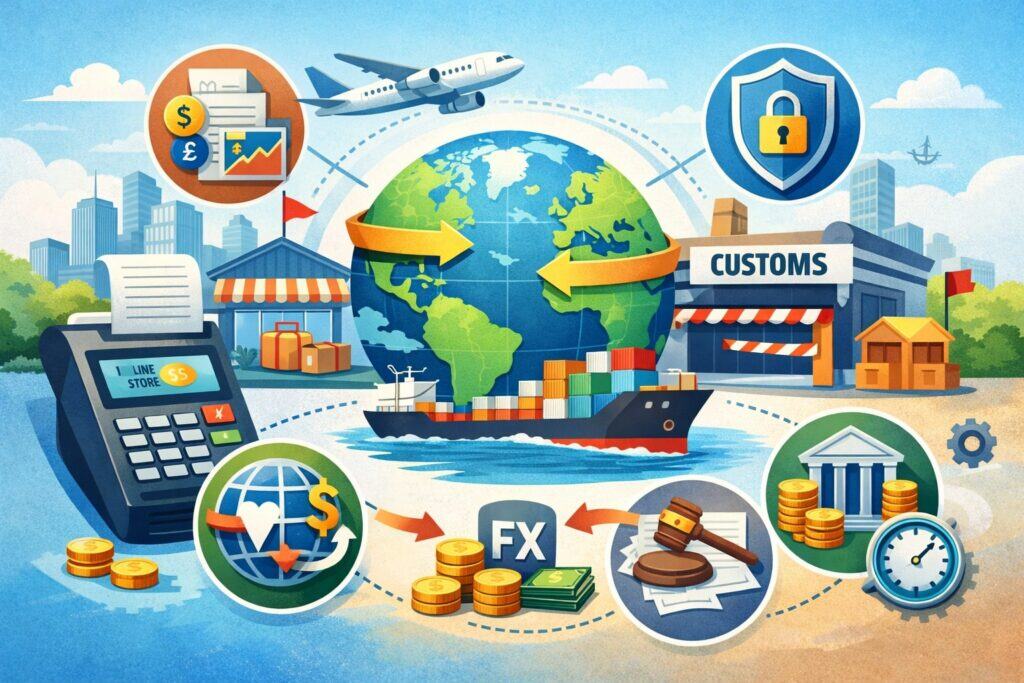
Cross-border payments often cost more than domestic payments because multiple pricing layers stack together. Merchants usually see these costs as blended rates, but it’s useful to understand the components so you can negotiate, route, and optimize intelligently.
- Card Network Assessments / Cross-Border Assessments: Networks can charge cross-border assessments when the issuer country differs from the merchant’s acquiring region or when processing crosses regions. These are often passed through by acquirers and processors.
- Interchange: Paid to the issuer. Interchange can vary by card type (consumer vs commercial), transaction type, and sometimes cross-border category.
- Processor / Acquirer Markup: The gateway/processor margin plus per-transaction fees.
- FX Spread: Often the largest hidden cost. Some providers add a markup to the mid-market rate, either explicitly or embedded.
- Chargeback and Fraud Costs: Not a fee line item, but a real cross-border payments expense due to higher fraud and dispute rates in some corridors.
- Compliance and Risk Costs: Verification, screening, and monitoring can increase operational costs for merchants selling internationally.
The practical merchant strategy is to treat cross-border payments as a margin lever. Two providers can quote “similar” rates but produce very different all-in economics after FX, decline rates, and chargebacks.
Cross-Border Bank Transfers: Wires, Correspondent Banking, and Tracking

B2B merchants and high-ticket sellers often rely on bank transfers. Traditional cross-border payments via wire move through correspondent banking: the payer’s bank sends a message and liquidity is passed through one or more correspondent banks until it reaches the beneficiary bank.
The merchant experience can be frustrating because traditional cross-border payments historically lacked transparency:
- Intermediary fees may be deducted along the path (“lifting fees”).
- Delivery times vary widely by corridor.
- Message formatting errors can cause rejections or manual repairs.
- Investigations can take days.
Modern initiatives aim to fix this with better messaging standards and tracking. SWIFT’s global payments innovation (gpi) introduced end-to-end tracking and status updates for cross-border payments, improving visibility and helping institutions identify delays.
For merchants, better tracking means fewer “where is my money?” tickets and faster reconciliation. But it’s important to know that tracking doesn’t eliminate all friction—cutoffs, compliance holds, and beneficiary bank policies can still slow cross-border payments.
ISO 20022 and Why It Matters for Merchants (Even If You Never See It)
ISO 20022 is a modern, data-rich messaging standard for payment instructions. Merchants may never type “ISO 20022” into a terminal, but the standard affects cross-border payments quality: better remittance data, fewer truncated fields, fewer repair messages, and more automation.
A key industry milestone: cross-border payments messaging has been migrating from older MT formats to ISO 20022 as part of the CBPR+ program, with major cutover milestones in 2025.
Why merchants should care about ISO 20022:
- Cleaner reconciliation: More structured invoice references and payer data.
- Fewer exceptions: Reduced need for manual repair of payment instructions.
- Better compliance alignment: Richer fields support sanctions screening and AML monitoring without breaking the payment.
- Improved straight-through processing: Faster posting into merchant accounts and ERP systems.
If you accept cross-border payments via bank transfers, ask your banking or PSP partners how they handle ISO 20022 fields and whether they preserve remittance data end-to-end. Merchants that invest early in data mapping (invoice IDs, customer references, order numbers) often see a measurable reduction in payment exceptions.
FX in Cross-Border Payments: Pricing, Timing, and Risk
Foreign exchange is the “silent engine” inside most cross-border payments. The buyer pays in one currency, and the merchant settles in another, which creates three merchant-critical questions:
- Where does FX happen?
- At checkout (dynamic currency conversion, local currency pricing)
- At authorization (issuer converts)
- At settlement (acquirer/PSP converts)
- What rate is used?
- Mid-market rate (rare for merchants)
- Network rate (cards often use network FX rates)
- Provider rate (PSP adds markup/spread)
- Who carries FX risk?
- Merchant (you accept FX variability until settlement)
- PSP (they lock rates and charge a premium)
- Customer (they accept issuer FX pricing)
For merchants, the best cross-border payments setup balances conversion and predictability. Local currency pricing can boost checkout confidence and reduce surprises, but it can also introduce FX exposure if your settlement currency differs.
Conversely, forcing a single settlement currency can simplify accounting but may reduce authorization approval rates for certain buyers.
A practical approach many merchants use is: local currency display for top markets, multi-currency settlement where volume justifies it, and clear FX reporting in dashboards so finance teams can reconcile cross-border payments without manual spreadsheets.
Compliance in Cross-Border Payments: Sanctions, AML, and Screening
Cross-border payments are closely tied to financial crime controls because funds cross jurisdictions and can involve sanctioned parties, money laundering typologies, or fraud.
Merchants don’t “run sanctions lists” the same way banks do, but merchants still feel compliance through onboarding requirements, transaction monitoring holds, and payout delays.
Two big compliance themes impact merchants:
Risk-based sanctions compliance
Regulators emphasize a risk-based approach for payment systems, especially as innovation increases speed and reduces time to intervene. That matters because real-time or near-real-time cross-border payments reduce the window for screening and freezing.
AML obligations for money movement businesses
If your business model looks like facilitating transfers (marketplaces, platforms, payouts, stored value), rules may treat the entity as a money services business (MSB) or similar category, which can require AML programs, reporting, and monitoring. The regulatory framework for MSB program requirements is codified in federal regulations.
Merchants should implement “compliance-friendly” cross-border payments operations:
- Collect accurate customer identity and business info for higher-risk orders.
- Store consistent name/address data to reduce screening false positives.
- Avoid mismatches between shipping, billing, and payer data when possible.
- Maintain clear refund and dispute workflows to limit suspicious patterns.
- Work with providers that offer transparent compliance holds rather than silent delays.
If you’re scaling internationally, treat compliance as a product feature: clean data lowers friction, improves approval rates, and reduces payout interruptions.
Speed, Cost, and Transparency: Where Cross-Border Payments Are Headed
Cross-border payments are improving, but progress is uneven. Industry programs aim to make cross-border payments faster, cheaper, more transparent, and more inclusive by end-2027, with a roadmap organized into “building blocks” across legal, technical, and market infrastructure changes.
At the same time, reporting has suggested the 2027 targets may be difficult to meet on schedule due to coordination complexity and the scale of infrastructure upgrades needed.
For merchants, this means two things:
- You should expect gradual improvements in tracking, data, and settlement options—especially through ISO 20022 adoption and enhanced tracking layers.
- You should not wait for “the system” to fix merchant pain by itself. Merchants that optimize routing, add local payment methods, and tighten reconciliation will outperform competitors even before macro targets are met.
The merchant advantage comes from treating cross-border payments as a conversion lever, not just a back-office necessity. Faster payouts, clearer fee breakdowns, and fewer failed payments translate directly into higher revenue and lower support costs.
Building a Merchant Strategy for Cross-Border Payments (What to Choose and When)
A scalable cross-border payments strategy isn’t “pick one provider and hope.” It’s a set of choices that match your product, ticket size, markets, and risk tolerance.
1) Choose your settlement model
- Single-currency settlement: simplest accounting; can reduce local conversion comfort.
- Multi-currency settlement: better margin control and transparency; more treasury complexity.
- Hybrid: multi-currency for top markets, single currency for long-tail.
2) Decide on routing and redundancy
Smart routing can reduce declines and costs in cross-border payments:
- Route by region, card type, and issuer response patterns.
- Use local acquiring where volume supports it.
- Maintain secondary routes for outages and high-decline corridors.
3) Add the right payment methods
Cards are universal, but local transfers and wallets can reduce cost and improve approvals in specific markets. For B2B, invoice payments and bank transfers can be preferred—especially when buyers want predictable fees and clear remittance references.
4) Operationalize reconciliation
Cross-border payments create messy finance data unless you plan for it:
- Store order ID and customer reference in payment metadata.
- Normalize currency and FX fields in your reporting.
- Reconcile at the transaction level, not just deposit totals.
5) Design fraud controls that don’t kill conversion
Cross-border payments can be higher risk, but blunt rules reduce revenue. Use layered controls:
- Device fingerprinting and velocity limits
- 3DS or step-up verification where it makes sense
- Risk-based manual review for high-value international orders
The merchants that win globally treat cross-border payments as an integrated system: checkout UX, payment routing, risk controls, and finance operations working together.
Common Failure Points in Cross-Border Payments (and How Merchants Prevent Them)
Cross-border payments fail for predictable reasons. Merchants who diagnose the category of failure can fix it faster.
- High decline rates: Often caused by issuer risk models, missing authentication, mismatch signals, or poor routing. Fix with local acquiring, better authentication strategy, cleaner descriptor data, and improved device/identity signals.
- Unexpected fees and margin leakage: Usually FX spread plus cross-border assessments. Fix with transparent FX pricing, multi-currency settlement where justified, and clear fee reporting. Cross-border assessments are a known network component that can be passed to merchants.
- Slow bank transfers and “lost” wires: Often due to correspondent chain complexity, cutoffs, missing beneficiary details, or compliance holds. Fix with structured beneficiary templates, ISO 20022-compatible data fields, and tracking-enabled transfer rails such as gpi-connected pathways where available.
- Refund friction: Cross-border payments refunds may require FX reversals and can be slower than domestic refunds. Fix with clear refund policies and proactive communication.
- Chargebacks and disputes: Higher for some cross-border payments segments due to fraud and delivery disputes. Fix with strong proof of delivery, clear descriptors, customer support responsiveness, and risk-based order review.
The operational reality is that cross-border payments are not just “payments.” They are a combination of payments, identity, compliance, and logistics signals that must align.
Future Predictions for Cross-Border Payments (What Merchants Should Expect Next)
Cross-border payments are likely to change more in the next few years than they did in the prior decade—mainly through better data, better interoperability, and new settlement models.
Prediction 1: More data-rich payments, fewer exceptions
ISO 20022 adoption and better structured fields will reduce truncated information and repair rates, improving straight-through processing.
Prediction 2: Tracking becomes the default expectation
Just like package tracking changed ecommerce logistics, end-to-end tracking is becoming a standard expectation for cross-border payments, especially for higher-value B2B transfers. gpi-style tracking has already shifted norms for transparency.
Prediction 3: Pricing pressure increases, but not evenly
Global initiatives target lower cost and higher speed by end-2027, but public reporting suggests timelines may slip. Merchants should plan for a mixed world: some corridors get cheaper and faster, others remain expensive due to compliance risk, limited competition, or infrastructure gaps.
Prediction 4: New rails grow alongside traditional rails
Stablecoins, tokenized deposits, and other digital settlement options will likely expand in certain use cases (especially treasury and high-frequency flows). But mainstream merchant adoption will depend on regulation, consumer UX, and the ability to integrate compliance controls.
Prediction 5: “Embedded compliance” becomes normal
Regulators emphasize risk-based controls for faster payments, and merchants will feel this through provider requirements and automated screening.
For merchants, the play is to build flexibility now: multi-rail acceptance, data discipline, and provider redundancy. That way, as cross-border payments evolve, you can adopt improvements without rewriting your entire payments stack.
FAQs
Q.1: What’s the fastest option for cross-border payments?
Answer: For ecommerce, card authorizations happen in seconds, but settlement still takes time. For bank transfers, speed depends on the rail and the banks involved. Tracking-enabled and modernized transfer networks can improve transparency and reduce investigation delays, but cutoffs and compliance checks still matter.
Q.2: Why do cross-border payments get declined more often?
Answer: Cross-border payments carry more risk signals for issuers: location mismatch, unfamiliar merchant patterns, and higher fraud prevalence in some corridors. Declines often drop when merchants use better authentication, cleaner customer data, and routing that matches the payer’s region.
Q.3: Are cross-border fees the same as foreign transaction fees?
Answer: Not exactly. Cardholders may see foreign transaction fees, while merchants may see network cross-border assessments and other cross-border payments costs that are passed through by acquirers and processors.
Q.4: How can merchants reduce FX costs in cross-border payments?
Answer: Start by measuring the effective FX rate you receive versus mid-market. Then evaluate: local currency pricing, multi-currency settlement, and providers with transparent FX markups. Often the biggest win is eliminating hidden spread and aligning settlement currency to revenue concentration.
Q.5: Do merchants need to worry about sanctions and AML?
Answer: Merchants aren’t banks, but cross-border payments touch systems that must comply with sanctions and AML rules. Merchants experience this through onboarding requirements, transaction monitoring holds, and payout delays. Regulators encourage risk-based sanctions controls, particularly as payment systems become faster.
Q.6: How do I make cross-border payments easier to reconcile?
Answer: Use consistent payment metadata (order ID, invoice number), preserve payer references, and choose providers that support rich remittance data. ISO 20022 improves structured data in cross-border payments, which can reduce manual matching work.
Q.7: Will cross-border payments get cheaper by 2027?
Answer: That’s the target of global programs focused on speed, cost, transparency, and access. However, progress reports have suggested the targets may be difficult to hit on schedule. Merchants should plan for incremental improvements rather than a single “cost drop” moment.
Conclusion
Cross-border payments are a revenue unlock for merchants—but only if you treat them as a system, not a checkbox. When a buyer pays from outside your home market, the transaction may pass through international routing, FX conversion, risk checks, compliance screening, and multi-step settlement.
Each step can add friction or cost, which is why cross-border payments can feel unpredictable compared with domestic payments.
The best merchants reduce that unpredictability with a clear strategy: choose the right rails (cards, bank transfers, local methods), optimize routing and authentication to improve approvals, control FX spread and settlement currency choices, and build reconciliation processes that scale.
On the infrastructure side, the industry is moving toward richer data standards and better tracking—ISO 20022 adoption and tracking initiatives are designed to make cross-border payments more transparent and automated.
At the same time, merchants shouldn’t wait for global targets to fully materialize. Cross-border payments will continue evolving over the next few years, but the highest-performing merchants will be the ones who build flexibility now: multi-rail acceptance, clean customer and payment data, provider redundancy, and reporting that makes every cross-border payment traceable from checkout to bank deposit.